
The Ultimate Buyer’s Guide to CNC Bushings
1. Introduction
In the complex ecosystem of industrial machinery, CNC bushings are foundational components that ensure reliability, precision, and longevity. From the high-stakes environment of aerospace to the punishing conditions of mining and construction, these precision-engineered parts are critical for managing friction, bearing immense loads, and protecting capital-intensive equipment. For industrial buyers, procurement managers, and engineers, the process of sourcing CNC bushings is a strategic task that directly impacts not just component performance, but the overall profitability and reputation of their final product.
The choice of a bushing is a decision that balances precision, durability, and cost. A seemingly minor oversight in material specification or tolerance can lead to catastrophic equipment failure, unscheduled downtime, and a surge in the Total Cost of Ownership (TCO). Therefore, a deep understanding of the entire lifecycle—from design and manufacturing to inspection and supply chain management—is essential for making informed decisions.
This guide is designed to be the definitive resource for sourcing CNC bushings. It provides a comprehensive, end-to-end overview of every critical aspect a buyer needs to consider. We will explore material science, manufacturing processes, quality control standards, and supplier evaluation criteria to help you build a resilient, cost-effective, and high-performing supply chain.
2. What Are CNC Bushings?
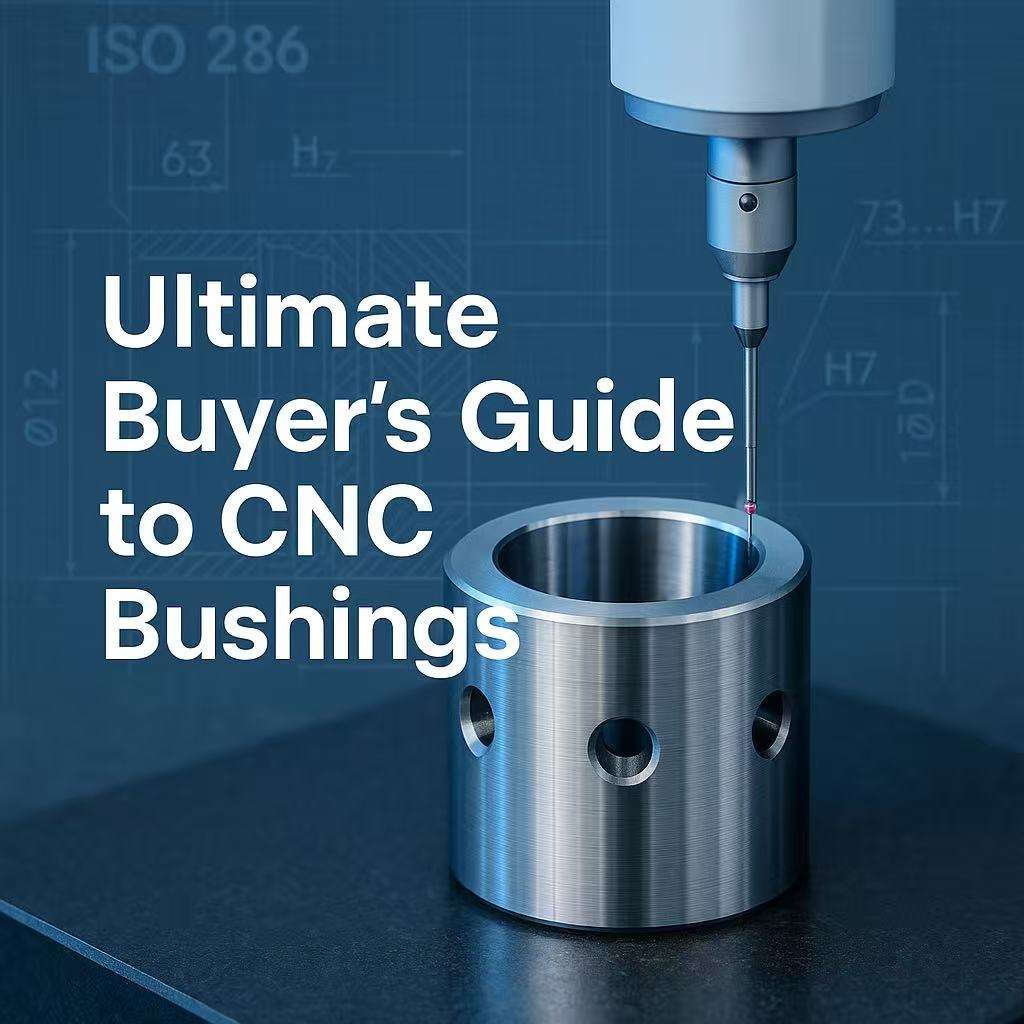
A CNC (Computer Numerical Control) bushing is a type of plain bearing, typically cylindrical, that is manufactured to precise specifications using automated machining processes. It serves as an interface between two moving parts, such as a shaft and a housing, to provide a low-friction, wear-resistant surface.
CNC Bushings vs. Standard Bushings: The key differentiator is customization and precision. While standard bushings are mass-produced to common sizes with general tolerances, custom CNC bushings are made-to-order based on a specific engineering drawing. This allows for:
- Custom Dimensions: Any required ID, OD, or length.
- Tight Tolerances: Precise control over the fit and clearance.
- Special Features: Incorporation of oil grooves, keyways, flanges, etc.
- Material Choice: Selection from a wide range of high-performance materials.
This level of precision and customization makes CNC bushings indispensable in demanding industries like automotive, mining, robotics, energy, and construction machinery. Understanding the right material is the first step in leveraging these benefits.
3. Material Selection Guide
The material is the heart of a bushing’s performance. The right choice depends on a careful analysis of the load, environment, lubrication, and temperature of the application.
- Alloy Steel (e.g., 4140, 4340): The top choice for high-impact and extreme load-bearing applications. It must be heat-treated to achieve its full potential for hardness and wear resistance, making it ideal for the pivot points in heavy machinery.
- Stainless Steel (304, 316, Duplex): Essential for applications requiring corrosion resistance. Grade 316L is common for marine and food-grade applications, while Duplex stainless steel offers superior strength and resistance to stress corrosion cracking in harsh chemical or offshore environments.
- Bronze / Aluminum Bronze: Prized for their excellent wear resistance and natural lubricity. In dusty or poorly lubricated conditions, bronze can embed abrasive particles, which protects the more expensive mating shaft from damage.
- Engineering Plastics (PEEK, PTFE, Nylon): These materials are lightweight, self-lubricating, and offer excellent chemical resistance and electrical insulation. They are ideal for low-load, high-speed applications or in environments where external lubrication is not desirable, such as in food processing or medical devices.
Once the right material is chosen, the next critical step is ensuring it is manufactured under strict processes to guarantee performance.
4. Manufacturing Process of CNC Bushings
A high-quality CNC bushing is the result of a multi-stage, precision-controlled manufacturing process.
- CNC Turning & Milling: The process begins with a solid bar of raw material. CNC turning is used to machine the basic cylindrical shape, including the inner and outer diameters, with high precision. If the design includes features like oil grooves, keyways, or mounting holes, CNC milling is used to create these complex geometries.
- Heat Treatment: For steel bushings, heat treatment is a critical step to enhance mechanical properties. Processes like quenching, tempering, and carburizing are used to create a hard, wear-resistant surface while maintaining a tough, ductile core that can withstand shock loads.
- Secondary Machining (Grinding, Honing): After heat treatment, parts often undergo a final machining pass to correct any minor distortion and achieve the tightest tolerances. Grinding, honing, or superfinishing are abrasive processes used to produce an extremely precise diameter and a very smooth surface finish.
- Coating & Finishing: A final surface treatment may be applied to enhance corrosion resistance or reduce friction. Common options include hard chrome plating, zinc plating, nickel plating, or thermal spray coatings.
These manufacturing steps are all geared towards one goal: achieving the precise tolerances and surface finish required for optimal performance.
5. Tolerances & Surface Finish
Tolerances and surface finish are the technical specifications that define a bushing’s performance.
- ISO 286 Fits: This international standard is the language of precision fits. A callout like H7/h6 on a drawing defines a specific clearance fit, ensuring parts will assemble and function correctly. Understanding these fits is crucial for engineers and buyers.
- Dimensional vs. Geometric Tolerances:
- Dimensional tolerances control size (ID, OD, length).
- Geometric tolerances control form and position, such as roundness, concentricity, and cylindricity. For high-speed applications, excellent concentricity is vital to prevent vibration.
- Surface Roughness (Ra): The surface finish, typically specified as an Ra value (e.g., Ra 0.4–1.6 μm), is critical for lubrication. A surface that is too rough will cause wear, while a surface that is too smooth may not retain the oil film effectively.
However, achieving these specifications consistently presents several challenges, leading to common quality issues that buyers must be aware of.
6. Common CNC Bushing Quality Issues & Solutions
Understanding potential defects is key to evaluating a supplier’s quality control capabilities.
| Quality Issue | Common Causes | Supplier’s Solution |
|---|---|---|
| Tolerance Errors | Tool wear, thermal drift, machine instability | Climate-controlled workshop, in-process probing, CMM verification. |
| Surface Defects | Improper cutting parameters, vibration | Secondary processes (grinding/honing), profilometer checks. |
| Heat Treatment Distortion | Uneven heating/cooling, thin walls | Leaving a machining allowance, post-heat treatment grinding. |
| Material/Hardness Non-Conformance | Incorrect raw material, poor process control | Material Test Certificates (MTC), Rockwell hardness testing, full traceability. |
| Coating Defects | Poor surface prep, incorrect parameters | Adhesion tests, coating thickness measurement, salt spray testing. |
A reliable supplier should have proactive solutions and be able to provide documentation (CMM reports, MTCs, hardness reports) to prove their processes are under control. A supplier’s ability to proactively manage these issues is a key criterion for selection.
7. Supplier Selection Criteria
Choosing the right manufacturing partner requires a holistic evaluation.
- Experience & Industry Case Studies: Does the supplier have a proven track record in your industry? Ask for examples of similar parts they have produced.
- Certifications: ISO 9001 is a baseline for quality management. For automotive applications, IATF 16949 is the gold standard.
- Inspection Capabilities: Do they have a climate-controlled quality lab with modern equipment like CMMs, surface roughness testers, and hardness testers?
- Documentation & Compliance: Can they provide full MTC, RoHS, and REACH compliance documentation?
- Small-Batch & Customization Capability: Can they support rapid prototyping and small-volume orders for custom parts?
While technical capabilities are crucial, the final decision often comes down to balancing cost and long-term value.
8. Cost Considerations & CNC Bushing TCO
The choice between a low-cost standard bushing and a higher-priced custom CNC bushing should always be evaluated from a Total Cost of Ownership (TCO) perspective.
- Initial Cost vs. Lifecycle Cost: A standard bushing has a low initial price. A custom CNC bushing is more expensive upfront due to setup and machining time.
- The TCO Calculation: TCO includes the initial price plus all downstream costs, such as maintenance labor, replacement parts, and, most importantly, lost production from downtime.
- Case Analysis: A high-precision CNC bushing, despite a higher unit price, often has a much lower TCO in critical applications. Its superior durability extends maintenance intervals and prevents costly equipment failures, delivering a significant return on investment.
Just as TCO offers a forward-looking view of cost, understanding future manufacturing trends provides a glimpse into the future of the supply chain.
9. Future Trends in CNC Bushing Manufacturing
The industry is constantly evolving. Forward-thinking buyers should look for suppliers who are embracing these trends:
- Digitalization & IoT: Smart factories use sensors to monitor production in real-time, improving traceability and reliability.
- Advanced Materials: The use of composite materials and nano-coatings is growing, offering superior performance in extreme environments.
- Automation: Robotic loading and unloading of CNC machines is leading to “lights-out” manufacturing, increasing efficiency and consistency.
- Sustainable Manufacturing: The push for eco-friendly coatings and energy-efficient machines is becoming a key compliance requirement.
As these trends reshape the industry, a structured procurement process remains essential. The following checklist summarizes the key points for today’s sourcing environment.
10. Buyer’s Checklist
Use this checklist during your sourcing process:
- ✅ Dimensions & Tolerances: Are all critical dimensions and ISO 286 fits clearly specified on the drawing?
- ✅ Material & Heat Treatment: Is the exact material grade and required hardness (HRC) defined? Are certificates required?
- ✅ Coatings & Testing: Is the surface treatment and any required validation (e.g., salt spray test hours) specified?
- ✅ CMM Reports: Have you requested CMM inspection reports for critical geometric tolerances?
- ✅ Packaging: Have you specified export-worthy, anti-rust packaging?
- ✅ RoHS/REACH Compliance: Is this required for your market?
To see how these principles apply in a real-world scenario, let’s examine a case study from the mining industry.
11. Case Study
A major mining equipment OEM was experiencing frequent field failures of the main pivot bushings on their large excavators. The standard bushings they were using had a replacement cycle of just 3 months in the highly abrasive conditions. They partnered with a specialized supplier to develop a custom CNC bushing made from a case-hardened alloy steel with internal lubrication grooves and a hard chrome coating.
The new custom bushing had a higher unit price, but its service life was extended to 12 months—a 4x improvement. This drastically reduced warranty claims and maintenance needs for their customers, leading to a 40% reduction in downtime-related costs for the end-users and solidifying the OEM’s reputation for reliability.
This case study clearly illustrates the tangible benefits of a strategic sourcing approach, which brings us to our final conclusion.
12. Conclusion
Sourcing CNC bushings is a complex but critical task that has a profound impact on equipment performance and your company’s bottom line. By moving beyond a simple focus on unit price and embracing a TCO-driven approach, buyers can make strategic decisions that deliver long-term value.
Choosing a reliable supplier—one with deep technical expertise, robust quality systems, and a commitment to partnership—is the most important step in this process. A strong supplier relationship is the foundation of a resilient and cost-effective supply chain.
As a leading custom CNC bushings supplier in China, we are ready to help you engineer a CNC bushing solution that enhances performance and lowers your Total Cost of Ownership.