
The Role of Heat Treatment in CNC Bushing Manufacturing
Introduction
In the world of industrial components, the performance of a CNC bushing is often determined by more than just its dimensions. While precision machining creates the form, the heat treatment process defines its character and ultimate resilience. For industrial buyers, understanding this critical manufacturing step is key to sourcing components that offer long-term durability and reduce the total cost of ownership. Heat treatment transforms a standard machined part into a high-performance component, capable of withstanding the immense stresses of modern machinery and delivering significant cost savings through extended service life.
What Is Heat Treatment in CNC Bushings?
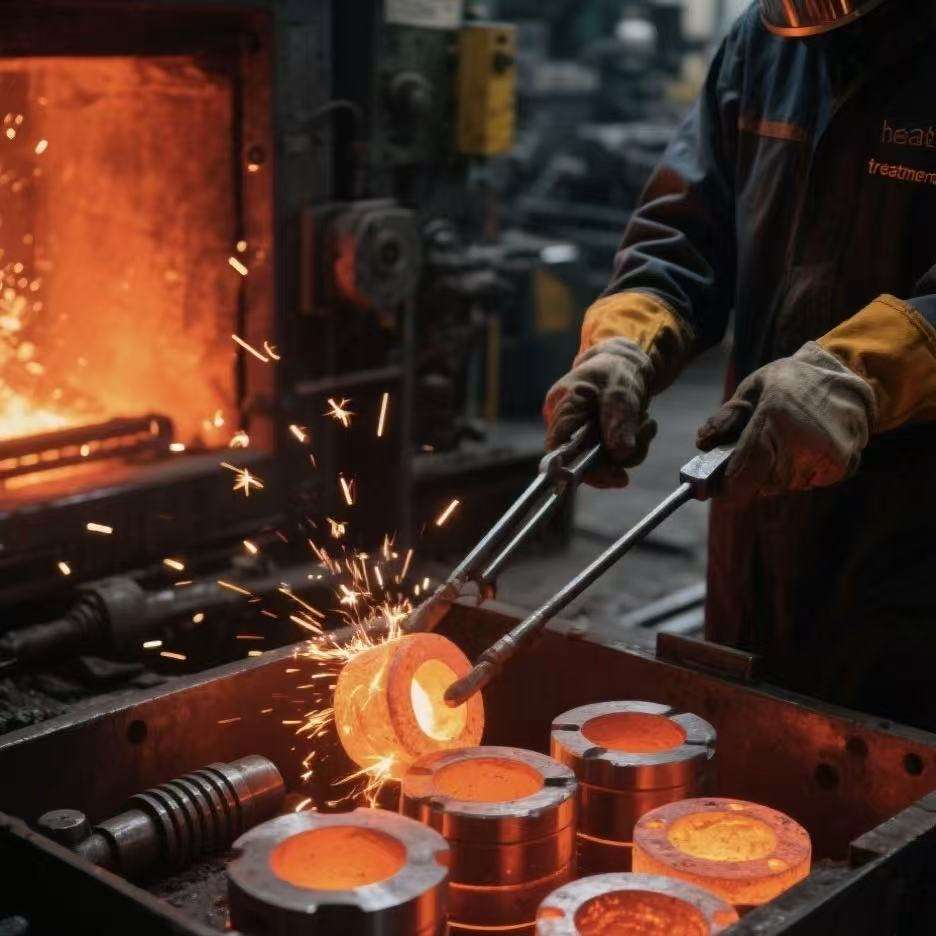
Heat treatment is a controlled process of heating and cooling metals to alter their physical and mechanical properties without changing the product’s shape. For CNC bushings, this process is not an optional extra; it is fundamental to achieving the required levels of hardness, toughness, and wear resistance. A bushing’s primary role is to endure friction and high loads. Without proper heat treatment, even the most precisely machined steel bushing would fail prematurely under the demanding conditions found in industrial applications, leading to costly downtime and repairs.
Key Heat Treatment Processes
Different heat treatment methods are employed to achieve specific properties, tailored to the bushing’s intended application.
Annealing
Before machining, raw metal bars are often annealed. This process involves heating the material and then cooling it slowly. The primary goal is to relieve internal stresses and soften the metal, which improves its machinability and prevents warping during subsequent CNC processes.
Quenching & Tempering
This two-step process is central to strengthening steel bushings.
- Quenching: After machining, the bushing is heated to a critical temperature and then rapidly cooled (quenched) in a medium like oil or water. This locks in a very hard but brittle crystalline structure.
- Tempering: The quenched part is then reheated to a lower temperature and held for a specific time. This process reduces brittleness and develops toughness while retaining much of the hardness. Quenching and tempering together create a component that is both hard and tough.
Case Hardening (Carburizing / Nitriding)
For applications requiring extreme surface durability and a ductile core, case hardening is the ideal solution.
- Carburizing: The bushing is heated in a carbon-rich atmosphere. Carbon diffuses into the surface, creating a high-carbon “case.” When quenched, this case becomes extremely hard, while the low-carbon core remains tough and impact-resistant.
- Nitriding: This process uses nitrogen to achieve a similar hard surface. It is performed at lower temperatures, which minimizes distortion.
Induction Hardening
This method uses electromagnetic induction to heat only specific areas of the bushing surface. It allows for localized hardening of critical wear surfaces without affecting the properties of the entire part. This is a cost-effective way to enhance durability in industrial machinery
How Heat Treatment Improves CNC Bushing Performance
The chosen heat treatment directly influences the final performance characteristics of a CNC bushing.
- Hardness & Wear Resistance: This is the most significant benefit. Processes like quenching and case hardening create a surface that can withstand abrasive wear and friction, drastically increasing the bushing’s lifespan.
- Fatigue Strength: Tempering and case hardening improve a bushing’s ability to resist fatigue failure under cyclical or heavy loads, which is crucial in applications like hydraulic cylinders and pivot joints.
- Dimensional Stability: Stress-relieving processes like annealing and proper tempering are vital for maintaining tight dimensional tolerances after the part is put into service.
- Corrosion Resistance: While not a primary goal, some heat treatments, when combined with surface coatings, can enhance a bushing’s resistance to environmental corrosion.
Applications Across Industries
The need for heat-treated bushings is universal across heavy-duty sectors:
- Heavy Machinery: In excavators and loaders, pivot point bushings are case-hardened to handle immense loads and abrasive dirt.
- Mining & Metallurgy: Bushings in crushers and conveyor systems are heat-treated to resist extreme impact and wear.
- Automotive & Agricultural Machinery: Components like kingpin bushings and suspension parts are quenched and tempered for a balance of strength and toughness.
- Precision Machinery: In industrial presses and molds, induction-hardened bushings ensure long-term alignment and accuracy.
Quality Assurance: Verifying Heat Treatment in CNC Bushings
A reliable manufacturer validates the heat treatment process through rigorous testing.
- Methods: Common checks include Rockwell hardness testing to verify surface hardness, microstructure analysis to inspect the depth and quality of the case hardening, and final dimensional checks to ensure tolerances were maintained.
- Certification: Industrial buyers should always request documentation. A supplier’s ability to provide hardness test reports and material certifications is a key indicator of their quality control standards.
Procurement Considerations for Bushings
When sourcing heat-treated components, procurement managers should dig deeper than the initial quote.
Questions to Ask Suppliers:
- “What specific heat treatment methods do you use for this type of bushing application?”
- “Can you provide hardness test reports and material certifications with our order?”
- “Do you offer custom heat treatment solutions, such as localized induction hardening?”
It is crucial to balance the upfront cost with long-term value. A slightly more expensive, properly heat-treated bushing will almost always provide a better return on investment by minimizing maintenance and preventing premature equipment failure.
Conclusion
Heat treatment is the invisible but essential step that elevates a standard CNC bushing to a component capable of withstanding the rigors of industrial use. It is a critical value-adding process that directly impacts wear resistance, strength, and the overall reliability of the machinery it serves.
For industrial buyers, making the procurement of bushings an informed decision means choosing a manufacturing partner with proven expertise in heat treatment. This ensures that the components you source are not just made to specification, but are truly engineered for durability. For industrial buyers, choosing a supplier with in-house heat treatment expertise ensures longer equipment uptime and lower maintenance costs.
Contact us today for customized CNC bushing solutions with certified heat treatment processes.