
FAQ: Surface Coatings for CNC Bushings – Options, Costs, and Buyer Guidelines
Introduction
When procuring CNC bushings, buyers rightly focus on dimensional precision and material selection. However, the performance and durability of a bushing are often determined by its surface. A surface coating is a critical, value-adding step that protects the component from corrosion, reduces friction, and enhances wear resistance. For industrial buyers, understanding the different coating options is key to controlling costs and ensuring the long-term reliability of their equipment. This guide answers the most common questions about surface coatings for CNC bushings in a clear FAQ format.
Core FAQ: Understanding Surface Coatings
Q1: Why are surface coatings for CNC bushings important?
Surface coatings act as a protective shield for the base metal of a CNC bushing. Their importance lies in three key areas. First, they provide corrosion resistance, creating a barrier that prevents rust and degradation from moisture, chemicals, or salt spray. Second, many coatings have a lower coefficient of friction or higher hardness than the base material, which reduces friction and improves wear resistance. Third, they can extend the service life of a component made from a cost-effective material like carbon steel, allowing it to perform in environments where it would otherwise fail quickly. For buyers, this translates directly into longer maintenance intervals and a lower Total Cost of Ownership (TCO).
Q2: What are the most common CNC bushing coating options?
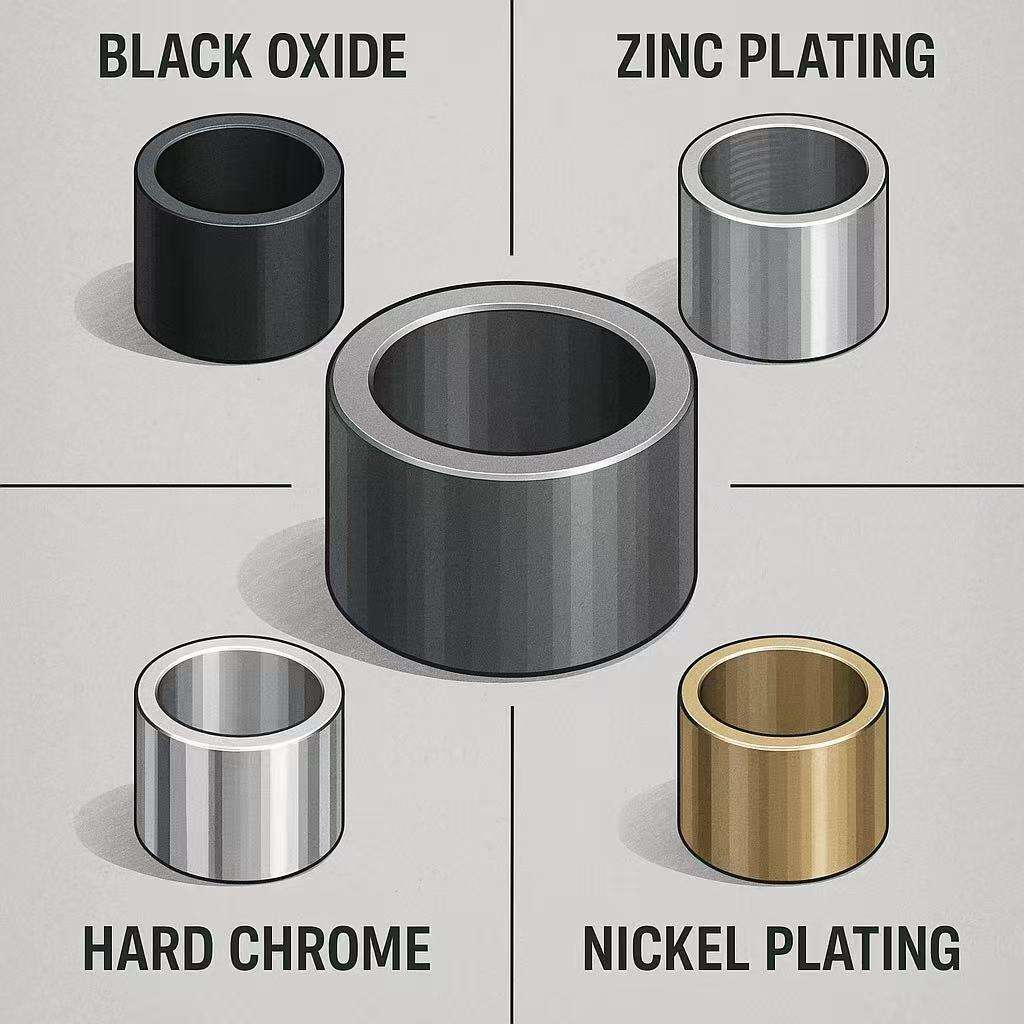
There are several common coatings, each with distinct properties and costs.
- Black Oxide: A chemical conversion coating that provides mild corrosion resistance and a professional black finish without changing the part’s dimensions. It’s a very cost-effective option for controlled, indoor environments.
- Zinc Plating: An electroplated sacrificial coating that offers good corrosion protection at a low cost. It’s a popular choice for general industrial and outdoor applications.
- Hard Chrome Plating: A very hard, low-friction, and wear-resistant coating. It is excellent for high-performance applications like hydraulic cylinders but is a more expensive option.
- Electroless Nickel Plating: Provides a very uniform coating with excellent corrosion and chemical resistance, making it suitable for complex shapes and harsh environments.
Q3: How do coatings affect durability and cost?
There is a direct trade-off between a coating’s performance and its price. Durability is a function of both the coating type and its thickness. Hard chrome plating offers the best durability against abrasive wear, while electroless nickel provides superior chemical resistance. The cost generally follows this hierarchy (from lowest to highest): Black Oxide < Zinc Plating < Electroless Nickel Plating < Hard Chrome Plating. While a high-performance coating increases the initial unit price of a bushing, it often delivers a better return on investment by significantly extending the part’s service life and reducing the frequency of costly equipment downtime and maintenance.
Q4: Which coatings are best for harsh environments?
The choice of coating should be matched to the specific environmental challenge.
- Mining & Construction (High Abrasion/Impact): Hard Chrome Plating is the ideal choice due to its exceptional hardness (often >65 HRC) and wear resistance.
- Marine & Offshore (Saltwater Corrosion): Electroless Nickel Plating provides a uniform, non-porous barrier that is highly effective against saltwater. High-thickness Zinc Plating with a high-performance passivate is a more economical alternative.
- Food Processing & Chemical Plants (Washdowns/Chemicals): Electroless Nickel Plating is often preferred for its excellent resistance to a wide range of chemicals and cleaning agents. Stainless steel is also a common choice in these sectors.
Q5: What should buyers specify in RFQs about coatings?
To ensure you receive the correct coating, your Request for Quotation (RFQ) and drawings must be specific.
- Coating Type and Standard: Clearly state the coating required (e.g., “Hard Chrome Plating per ASTM B177”).
- Thickness: This is a critical parameter. Specify the required thickness range in micrometers (µm) (e.g., “Zinc Plating, 8-12 µm thickness”).
- Corrosion Resistance Requirements: If applicable, request that the coating meets a certain performance standard, such as a Salt Spray Test duration (e.g., “96 hours per ASTM B117 without red rust”).
- Compliance: For products sold in regulated markets, specify the need for RoHS/REACH compliance.
Q6: How do surface coatings compare with using stainless steel?
This is a classic cost-vs-performance decision. Coating a carbon or alloy steel part is a cost-effective way to add surface protection to a strong and affordable base material. However, if the coating is scratched or damaged, the underlying steel can begin to corrode. Using solid stainless steel means the entire part is inherently corrosion-resistant, providing protection even if the surface is scratched. Stainless steel has a higher material cost but may be the better long-term solution in extremely corrosive environments or where coating damage is likely.
Conclusion
Choosing the right surface coating is a strategic decision that directly impacts the durability, performance, and lifecycle cost of your CNC bushings. By understanding the options and clearly communicating your technical requirements, you can significantly reduce the risk of premature failure and lower your equipment’s Total Cost of Ownership (TCO). Always partner with a supplier who can provide technical guidance on coating selection and can back up their quality with verifiable test reports.
Contact our engineering team for expert advice on choosing the right coating for your application and to receive a quotation for high-performance CNC bushings.