
CNC Bushings in the Automotive Manufacturing Supply Chain
1. Introduction
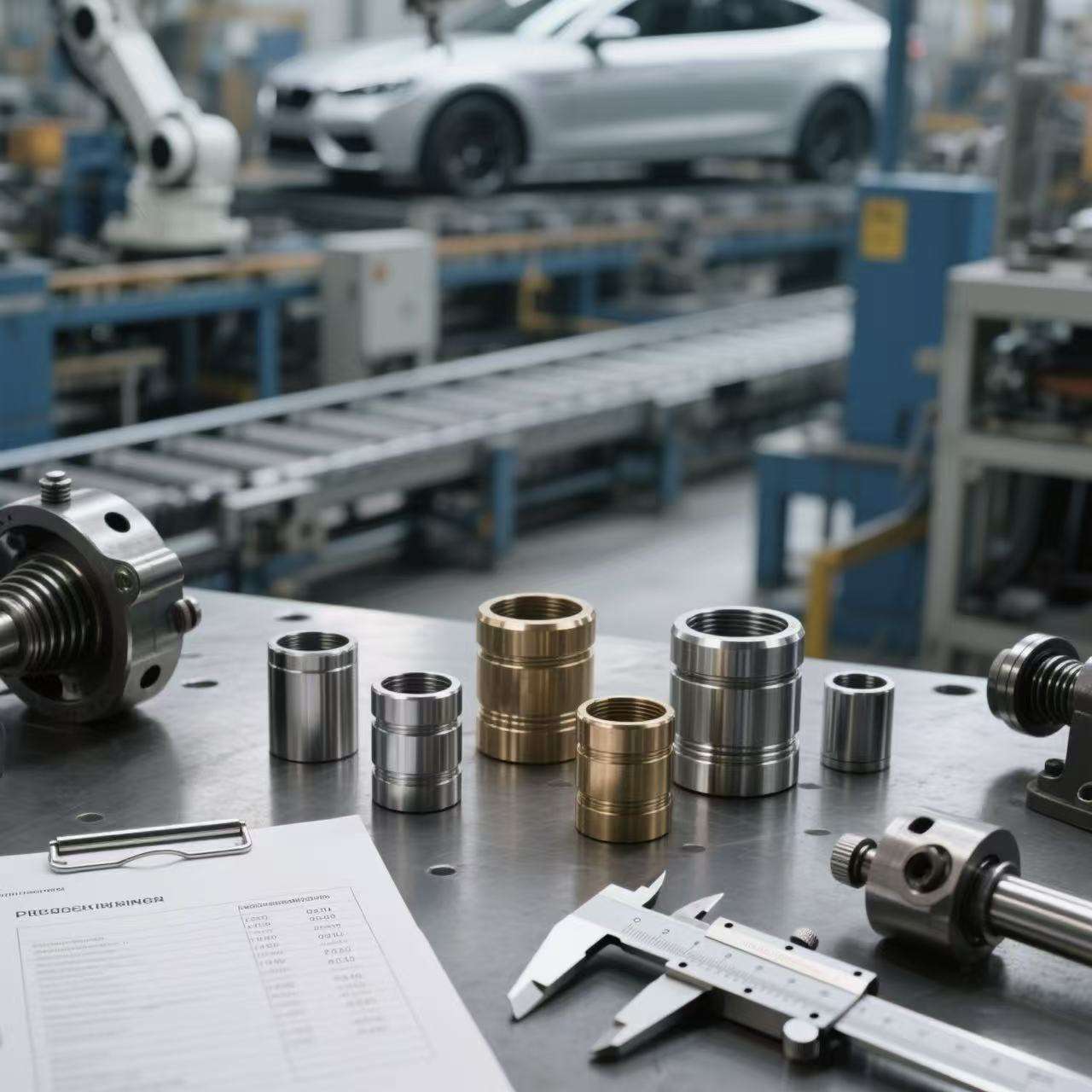
The automotive manufacturing supply chain is a highly complex system with extremely demanding quality requirements. From the power output of the engine to the vibration filtering of the suspension system, the performance of every single component directly impacts the vehicle’s reliability, safety, and driving experience. Among the many precision components, CNC bushings in automotive manufacturing play a crucial role, widely used in transmission, suspension, steering, and engine systems. Understanding the role of CNC bushings in automotive manufacturing is essential for maintaining quality and efficiency.
For suppliers at all levels of the supply chain, procuring high-quality CNC bushings is not just about meeting drawing specifications; it is a comprehensive consideration of product performance, reliability, and cost control. This article aims to provide an in-depth analysis of the technical points, application scenarios, and procurement strategies for automotive-specific CNC bushings.
2. What Are CNC Bushings in Automotive Applications?
In automotive applications, a CNC bushing is a cylindrical or custom-shaped sleeve precision-machined using Computer Numerical Control (CNC) technology. Their core function is to act as an interface between two moving parts to achieve one or more of the following objectives:
- Supporting Rotation and Sliding: Providing smooth motion support for components like kingpins and control arms.
- Reducing Friction and Wear: Acting as a sacrificial part to protect more expensive shafts or bores.
- Absorbing Shock and Vibration: Reducing the impact of road bumps and engine vibrations on the vehicle body, improving comfort.
Compared to bushings produced by traditional processes (such as casting followed by rough machining), the advantage of CNC machining lies in its unparalleled precision, repeatability, and consistency, which is essential for meeting the high-volume, high-quality production requirements of the automotive industry.
3. Material Selection for Automotive CNC Bushings
The working conditions of different automotive systems vary greatly, so material selection is the first step in determining a bushing’s performance. Selecting the right CNC bushings in automotive manufacturing requires careful material consideration.
- Bronze/Brass
- Characteristics: Excellent wear resistance and self-lubricating properties.
- Applications: Commonly used in high-friction, reliably lubricated areas such as control arm bushings in suspension systems and kingpin bushings.
- Alloy Steel
- Characteristics: Extremely high strength, hardness, and impact resistance, which can be further enhanced through heat treatment.
- Applications: Widely used inside transmissions and differentials, as well as on axles and other parts that need to withstand significant torque and impact loads.
- Stainless Steel
- Characteristics: Excellent corrosion resistance.
- Applications: Suitable for components exposed to moisture, road salt, and other corrosive environments, such as exhaust system hanger bushings.
- Aluminum Alloy
- Characteristics: Lightweight, good heat dissipation.
- Applications: Increasingly popular in the lightweight design of new energy vehicles (EVs), used in non-critical load-bearing support structures like seat adjustment mechanisms.
- Polymers (Nylon, PEEK)
- Characteristics: Self-lubricating, lightweight, noise-reducing, and chemically resistant.
- Applications: Often used in automotive interiors, seat adjustment slides, and steering system components where noise control is critical.
Material and Application Chart for Automotive Bushings
| Material | Core Advantages | Typical Automotive Applications |
|---|---|---|
| Bronze | Wear-resistant, self-lubricating | Suspension control arm bushings, kingpin bushings |
| Alloy Steel | High strength, impact-resistant | Transmission gear bushings, differentials, axles |
| Stainless Steel | Corrosion-resistant | Exhaust systems, sensor housings |
| Aluminum Alloy | Lightweight | EV battery pack brackets, seat adjustment mechanisms |
| Nylon/PEEK | Noise reduction, self-lubricating, lightweight | Steering column bushings, interior moving parts |
4. CNC Machining and Tolerance Requirements
The automotive industry has extremely high precision requirements for its components, which necessitates advanced CNC machining technology for automotive CNC bushings.
- CNC Turning and Milling: CNC turning is used to machine the inner and outer diameters of bushings, ensuring concentricity and dimensional accuracy. CNC milling is used to machine complex features like oil grooves, keyways, and mounting holes.
- Tolerance Standards: Automotive components typically adhere to strict fit tolerances, such as the H7/h6 (clearance fit) in the ISO 286 standard, to ensure smooth operation without noise at high speeds.
- Surface Roughness (Ra): The surface roughness of a bushing’s working surface (typically required to be between Ra 0.4-1.6μm) directly affects the formation and retention of an oil film, which is crucial for reducing noise and extending service life.
- Inspection Tools: Reliable automotive component suppliers must be equipped with a full suite of inspection tools, including digital calipers, micrometers, and Coordinate Measuring Machines (CMMs) for final dimensional verification and geometric tolerance inspection.
5. Applications in the Automotive Supply Chain
Automotive supply chain bushings are key nodes that ensure the performance of major systems.
- Suspension Systems
- Application Case: Control arm bushings connect the wheel to the vehicle body and must withstand continuous impacts and vibrations from the road. CNC bushings made of hardened alloy steel or high-strength bronze provide long-lasting wear resistance and reliability in such conditions.
- Transmission & Gearbox
- Application Case: The planetary gear bushings inside a gearbox require extremely high dimensional accuracy and concentricity to ensure smooth gear meshing and efficient power transmission at high rotational speeds.
- Steering Systems
- Application Case: Self-lubricating polymer bushings used in steering columns and tie rods can effectively reduce friction during steering, making driving easier and reducing noise.
- Electric Vehicles (EVs)
- Application Case: With the trend of “weight reduction for range extension,” lightweight aluminum alloy CNC bushings are widely used in the mounting brackets of battery packs, locating sleeves for motor housings, and more, contributing to the overall lightweighting of the vehicle.
6. Cost & Procurement Considerations
For automotive component suppliers, cost control is one of the core competitive advantages.
- Cost Factors: The total cost of a bushing is determined by a combination of material, precision level, the need for heat/surface treatment, and order volume. A hardened alloy steel bushing that requires precision grinding will cost far more than a standard tolerance nylon bushing.
- Total Cost of Ownership (TCO): A wise procurement decision should focus on TCO. A high-quality, long-lasting bushing, though more expensive upfront, can reduce warranty repairs and claim risks, thereby lowering the supplier’s overall costs.
- Clear Request for Quotation (RFQ): When requesting quotes from manufacturers, it is essential to provide complete technical drawings and clearly specify tolerances, material grades, heat treatment hardness, surface treatment requirements, and any necessary inspection reports.
- Supplier Evaluation: Prioritize CNC bushing suppliers who are certified with ISO 9001 or IATF 16949 (the quality management system for the automotive industry) and have stable quality control processes and on-time delivery capabilities.
7. Conclusion & Call to Action
CNC bushings in automotive manufacturing are a key part of achieving high performance, high reliability, and cost-effectiveness for the entire vehicle. From material selection to precision machining and strict quality control, every step is indispensable.
For automotive component suppliers, procurement decisions must go beyond unit price and comprehensively evaluate the precision, material performance, and long-term reliability of the bushings. Partnering with a manufacturer who deeply understands the demands of CNC bushings in automotive manufacturing is fundamental to maintaining a competitive edge in a fierce market.
Contact us today for reliable CNC bushing solutions tailored to your automotive manufacturing needs.