
Buyer’s Guide to Custom Pneumatic CNC Components
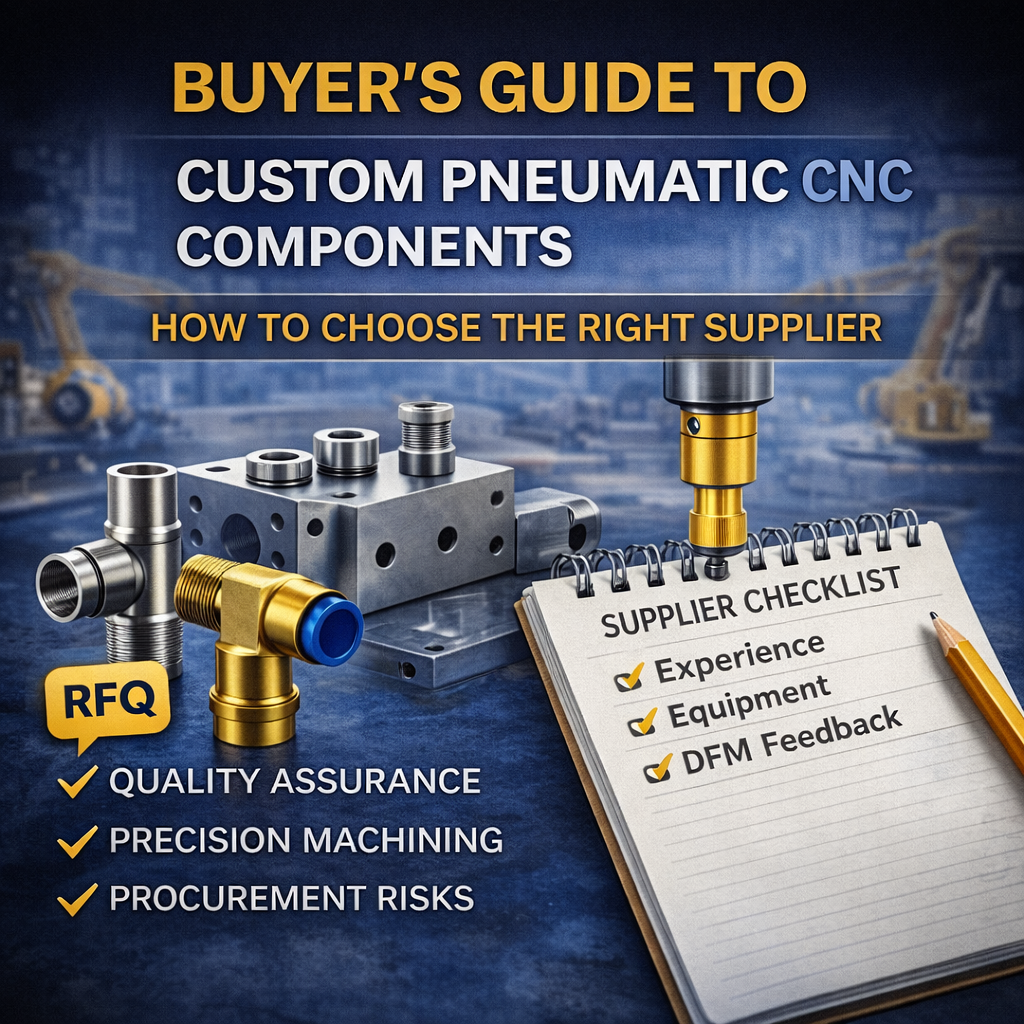
In the high-stakes world of industrial automation, a pneumatic system is only as strong as its most precise connection. For procurement teams and engineers, the stakes of sourcing are incredibly high. For OEM buyers, even minor air leakage can result in thousands of dollars in annual energy loss and unexpected downtime. Even a minor oversight in thread compatibility or surface finish can translate into chronic air leakage and catastrophic system failure. Navigating the complexities of pneumatic components procurement requires more than just a part number; it requires a strategic approach to manufacturing, quality, and supplier partnership.
This buyers guide to custom pneumatic CNC components is designed to provide OEM buyers and automation engineers with the technical and commercial framework needed to mitigate risks and ensure the long-term reliability of their fluid power systems. By understanding the nuances of CNC precision, material performance, and quality verification, you can transform your supply chain from a source of risk into a competitive advantage.
2. What Are Custom Pneumatic CNC Components?
Standard pneumatic fittings are mass-produced catalog items, often die-cast or injection-molded for generic applications. While cost-effective for basic setups, they frequently fall short in high-performance automation where spatial constraints, non-standard port configurations, or extreme pressure transients are present.
Custom pneumatic components are bespoke solutions engineered and machined directly from solid billet metal. Unlike cast parts, which may harbor internal porosity, these components are manufactured using precision CNC turning and milling. This significantly improves sealing performance and reduces the risk of long-term air leakage. This subtractive manufacturing process allows for:
Custom Manifolds: Consolidating multiple air paths into a single, compact block.
Transition Fittings: Bridging disparate thread standards (e.g., NPT to Metric).
Proprietary Connectors: Designed for specific machine footprints.
The primary benefit of custom pneumatic components is their structural integrity. CNC machining ensures absolute concentricity and wall thickness, which are critical for maintaining airtight seals under continuous operation.
3. Key Factors Buyers Should Consider
Successful procurement begins with a rigorous technical evaluation. To avoid the common pitfalls of air leakage and poor fitment, consider the following five pillars:
Application Requirements
The environment dictates the design. Is the component part of a high-speed packaging line requiring 120 cycles per minute, or a static air control system? Understanding the cycle frequency, vibration levels, and ambient temperature is critical before finalizing the design.
Pressure & Performance
Pneumatic systems typically operate between 80 to 120 PSI, but spikes are common. Your CNC pneumatic parts manufacturer must ensure that the components have an engineered safety factor (often 4:1). Precision machining ensures that the component won’t “creep” or deform under long-term pressure stress.
Material Selection
Material choice impacts both the unit cost and the component’s lifespan.
Brass: The standard for most indoor automation due to its machinability and natural corrosion resistance.
Aluminum: Ideal for lightweight robotics where mass impacts cycle speed.
Stainless Steel (316L): Mandatory for food processing or corrosive washdown environments.
Thread Standards (NPT, BSP, Metric)
One of the most frequent procurement errors is the “thread standard mismatch.” A 1/4-inch NPT will not safely mate with a 1/4-inch BSPP port. In international procurement, verifying the thread standard is the first line of defense against delivery delays and assembly failure.
Sealing Design
Effective sealing is not just about the rubber O-ring; it is about the metal surface it rests against. The design must account for O-ring squeeze, groove depth, and the chamfers required to prevent the seal from being sheared during installation.
4. CNC Machining Capabilities
When sourcing custom CNC machining pneumatic parts, the manufacturer’s shop floor capability is your primary assurance of quality. Pneumatic components require a specific subset of machining skills:
Precision CNC Turning: Essential for fittings and connectors to ensure the cylindrical geometry is perfectly true.
Multi-Axis Milling: Required for complex manifolds. 5-axis machines allow for the drilling of intersecting internal air channels in a single setup, ensuring perfect alignment.
CNC Thread Milling: Unlike traditional tapping, thread milling produces cleaner, more accurate thread profiles with superior surface finish, reducing the risk of galling or cross-threading during assembly.
5. Quality Control Requirements
A “good-looking” part can still be a failure if it leaks. The core of this buyer’s guide to custom pneumatic CNC components is the insistence on rigorous quality verification. You should demand a supplier who provides:
Thread Inspection: Mandatory use of calibrated Go/No-Go thread gauges.
Surface Roughness (Ra): For dynamic seals, a surface finish of Ra 0.8 μm or Ra 1.6 μm is often required. Without this, the rubber seal will be shredded by microscopic metal “peaks.”
CMM Inspection: Coordinate Measuring Machines verify the complex internal geometries of manifolds that manual tools cannot reach.
Leak Testing: Every critical component should undergo air decay or pressure testing.
6. MOQ and Lead Time Considerations
Commercial friction often arises around volume and delivery speed. In the procurement lifecycle, you usually face two scenarios:
Prototyping: Small batches (1-10 pcs) needed within 7-10 days for engineering validation.
Batch Production: Mass orders (500+ pcs) requiring a 15-30 day lead time.
Many CNC manufacturers also support flexible MOQ to accommodate prototype and small-batch production needs. A reliable supplier should offer this flexibility, allowing you to scale from a pilot run to mass production without the penalty of high inventory costs.
7. Cost Factors
Understanding the “why” behind the quote helps in negotiation and budgeting. Four factors drive the cost of custom pneumatic parts:
Material Choice: Stainless steel costs significantly more than brass, both in raw material and in the slower machining speeds required.
Geometry Complexity: The more intersecting holes a manifold has, the more time it spends on the machine.
Tolerances: Demanding ±0.01mm on a non-critical outer surface unnecessarily inflates the price. Focus tight tolerances only on sealing faces and threads.
Surface Treatment: Anodizing or passivation adds a secondary process and extra days to the timeline.
8. How to Choose a Reliable Custom Pneumatic Components Supplier
In the manufacturing world, you are not just buying a component; you are buying a partnership. Finding the right custom pneumatic components supplier means vetting them for technical depth and operational stability.
Technical Experience
Does the supplier understand fluid power? Do they know the difference between a static seal and a dynamic seal? Ask for a technical overview or a case study of past projects to verify their expertise.
Modern Equipment
A shop full of 20-year-old manual lathes cannot produce the precision needed for modern automation. Look for 5-axis mill-turn centers and digital metrology tools.
Engineering Support (DFM)
This is the most critical value-add. A great supplier provides Design for Manufacturability (DFM) feedback. They should look at your drawings and suggest optimizations that cut machining time and improve airflow. This collaborative approach reduces costs and improves the final product.
Industrial Procurement Checklist
| Checklist Item | What to Verify |
| Material | Correct alloy grade and MTC certification |
| Thread Standard | Precise NPT / BSP / Metric callouts |
| Surface Finish | Ra ≤ 1.6 μm (or Ra 0.8 μm for dynamic seals) |
| Inspection | Hydrostatic leak testing & CMM reports |
| MOQ & Lead Time | Flexible MOQ and realistic production schedule |
| Engineering Support | Proactive DFM capability |
9. Common Mistakes to Avoid
To ensure your pneumatic components procurement is successful, avoid these three “red flag” mistakes:
Ignoring Tolerances: Providing a drawing with no tolerances forces the machinist to guess. This leads to parts that “look right” but leak under pressure.
Wrong Thread Standards: Never assume “1/2 inch” is enough information. Always specify NPT, BSPP, BSPT, or Metric (with pitch).
Choosing Lowest Price Only: Sourcing from the cheapest possible vendor often leads to components with internal porosity and rough O-ring seats. The cost of a single machine failure far outweighs the pennies saved per fitting.
10. Conclusion
Navigating the procurement of pneumatic components doesn’t have to be a source of risk. By following this buyer’s guide to custom pneumatic CNC components, you can shift your focus from simply buying “parts” to securing high-performance assets for your automation systems.
The formula for success is simple: prioritize material integrity, demand precision CNC manufacturing, and partner with a supplier that offers proactive engineering and DFM support. When you combine these factors, you eliminate the risks of air leakage and operational downtime, ensuring your automated systems run at peak efficiency.
Looking for a reliable supplier for custom pneumatic CNC components?
Send us your drawings today to get custom pneumatic solutions, DFM optimization, and precision CNC machining support tailored to your automation systems. We are ready to help you optimize your pneumatic systems for long-term, leak-free performance.