
CNC Pneumatic Parts for Automation Equipment
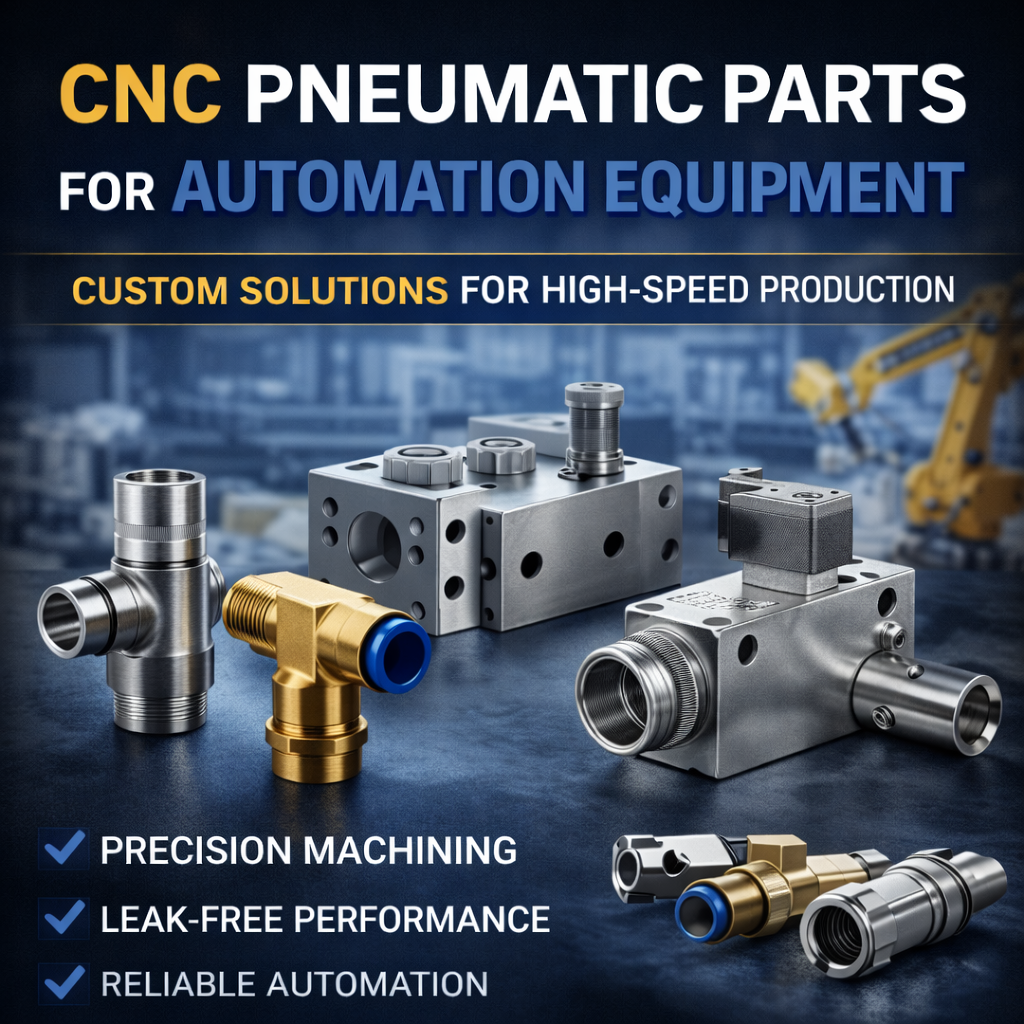
1. Introduction
In modern industrial manufacturing, the success of any production line hinges on speed, precision, and relentless efficiency. To achieve these metrics, engineers rely heavily on pneumatic systems to drive the rapid, repetitive motions required on the factory floor. However, an automation system is only as reliable as its weakest connection.
To prevent costly pressure drops and unexpected machine downtime, OEM buyers and procurement managers are increasingly turning away from standard cast fittings. Instead, they are sourcing high-precision CNC pneumatic parts for automation equipment. By utilizing advanced computer numerical control (CNC) machining, manufacturers can eliminate the structural flaws of mass-produced parts, delivering the exacting tolerances, flawless threads, and leak-free performance that modern automated machinery demands.
2. What Are CNC Pneumatic Parts
Pneumatic components are the physical infrastructure of a compressed air system. They include the hardware necessary to connect hoses, direct airflow, and regulate the pressure that drives mechanical actuators.
While standard injection-molded or die-cast parts are cheap and readily available, they often harbor microscopic internal voids, shifting mold lines, and inconsistent thread geometries. CNC machined pneumatic parts are engineered differently. They are cut directly from solid extruded metal or plastic billets using multi-axis lathes and mills. This subtractive manufacturing process guarantees absolute precision, batch-to-batch consistency, and superior thread accuracy. Whether it is a complex directional valve body or a simple straight connector, CNC machining ensures the component meets the strict geometric requirements of industrial automation.
3. Role in Automation Equipment
The deployment of CNC pneumatic parts for automation equipment spans across the most demanding sectors of industrial manufacturing. Reliable airflow is critical in the following applications:
Pick-and-Place Systems: High-speed gantry robots rely on instantaneous bursts of compressed air to activate vacuum grippers. Precision automation pneumatic fittings ensure there is no pressure lag during these rapid cycles.
Packaging Machinery: Automated packaging lines use pneumatic cylinders to fold, cut, and seal cardboard and plastics. Custom CNC components ensure these machines run continuously without air leaks degrading their sealing force.
Assembly Lines: Complex jigs and automated clamping fixtures use pneumatics to hold raw materials securely in place while other robots perform welding or fastening operations.
Robotics: End-of-arm tooling (EOAT) utilizes compact, lightweight pneumatic manifolds to distribute air to various actuators without overloading the robotic arm’s payload capacity.
4. Key Advantages of CNC Pneumatic Parts
Transitioning from standard catalog items to purpose-built CNC pneumatic parts for automation equipment offers several critical engineering benefits.
Precision & Repeatability
Automation equipment requires exact, predictable motion. CNC machining delivers unparalleled geometric tolerance control. This ensures that every valve spool fits perfectly and every O-ring compresses identically, guaranteeing that the ten-thousandth part performs exactly like the first.
Leak-Free Performance
Air leaks are a massive hidden cost, forcing compressors to overwork and wasting significant electrical energy. By achieving a mirror-smooth surface finish and exact thread accuracy, CNC machined parts guarantee tight, leak-free performance under continuous, high-frequency pressure cycling. This directly reduces compressed air consumption and lowers long-term operational costs for automation systems.
Lightweight Design
In fast-moving automation, excess weight reduces cycle speeds and increases motor wear. CNC machining allows engineers to design thin-walled, low-profile components that maximize airflow while shedding unnecessary bulk.
Customization Flexibility
OEM equipment often faces severe spatial constraints. Relying on standard parts forces engineers into compromised designs. Sourcing custom pneumatic components for automation allows buyers to perfectly integrate tailored manifolds and bespoke transition fittings into their proprietary machinery.
5. Types of CNC Pneumatic Components
A fully optimized pneumatic circuit requires a variety of precision-machined hardware:
Fittings: The critical connection points linking hoses to cylinders and compressors, requiring flawless internal or external threads to prevent air loss.
Manifolds: Solid blocks featuring intersecting internal fluid channels. They consolidate multiple valves into one central hub, reducing the number of external hoses required.
Valves: Precision housings and internal spools that manually or electronically dictate the flow rate and direction of the compressed air.
Connectors: Adapters used to change hose diameters, split air lines, or transition between different international thread standards.
Quick Reference: Automation Pneumatic Components
| Component Type | Function | Application |
| Fittings | Connect air lines | Assembly lines |
| Manifolds | Distribute airflow | Robotics |
| Valves | Control air direction | Packaging |
| Connectors | Adapt connections | Automation systems |
6. Materials Used
The operating environment of the automation equipment strictly dictates the raw material selection. Precision CNC facilities machine these components from several industrial-grade billets:
Brass: The highly machinable, cost-effective standard for dry, indoor factory automation lines.
Stainless Steel: Mandatory for food packaging, medical device assembly, and highly corrosive washdown environments.
Aluminum: The ultimate choice for weight-sensitive robotics, typically anodized to prevent thread galling.
Engineering Plastics: Materials like POM and PEEK are used when electrical insulation or extreme low-friction properties are required.
To learn more about how to optimize your alloy selection, explore our guide on materials for pneumatic components used in automation systems.
7. CNC Machining Capabilities for Automation Pneumatic Parts
Manufacturing reliable CNC pneumatic parts for automation equipment requires advanced shop-floor capabilities. Modern multi-axis machining centers perform several critical operations:
Turning: High-speed lathes cut the cylindrical profiles, bore out internal air channels, and cut precise O-ring grooves.
Milling: Live tooling cuts external wrenching flats and machines the complex block geometries required for pneumatic manifolds.
Thread Cutting: Single-point carbide inserts cut flawless NPT, BSP, or Metric threads, preventing the cross-threading and binding common in cast fittings.
Surface Finishing: Specialized finishing passes achieve the exact surface roughness (Ra) necessary to ensure elastomeric seals seat perfectly.
This ensures consistent performance across high-volume production cycles in automation environments. For a deeper look into these shop-floor processes, review our CNC pneumatic components manufacturing overview.
8. Quality Control for CNC Pneumatic Parts in Automation Equipment
To guarantee leak-free performance, a premium pneumatic components manufacturer must utilize rigorous quality control protocols.
Visual inspection is never enough. Machinists use calibrated Go/No-Go thread gauges directly on the floor to verify pitch diameters. In the metrology lab, digital profilometers drag across sealing faces to verify strict surface roughness tolerances. Finally, sample batches of CNC pneumatic parts for automation equipment undergo pressurized air-decay leak testing to physically prove their structural integrity before they ever reach an OEM assembly line.
9. Customization for OEM Applications
Standard components often fail to meet the complex footprint and performance demands of proprietary automation systems. Sourcing custom pneumatic components bridges this gap.
An experienced CNC manufacturer provides comprehensive Design for Manufacturability (DFM) support. When an OEM engineer submits a non-standard design, the supplier analyzes the blueprint to optimize internal flow dynamics, ensure thread compatibility, and reduce overall machining time. This collaborative approach allows for fast prototyping, ensuring that the custom CNC pneumatic parts for automation equipment are validated and pushed into mass production without delaying the final machine assembly schedule.
10. Conclusion
In the demanding landscape of industrial automation, compressed air is the lifeblood of motion. The speed, efficiency, and uptime of an entire factory floor rely directly on the integrity of the pneumatic circuit. By rejecting standard cast fittings in favor of precision CNC pneumatic parts for automation equipment, procurement teams eliminate the persistent threats of air leaks and mechanical failure. CNC machining guarantees the absolute precision, repeatability, and superior surface finishes required to keep automated machinery running flawlessly.
Looking for reliable CNC pneumatic parts for your automation equipment?
Send us your drawings today to get custom pneumatic solutions, DFM feedback, and precision CNC machining support for your automation equipment.