
Precision Machining for Pneumatic Sealing Surfaces: The Key to Leak-Free Systems
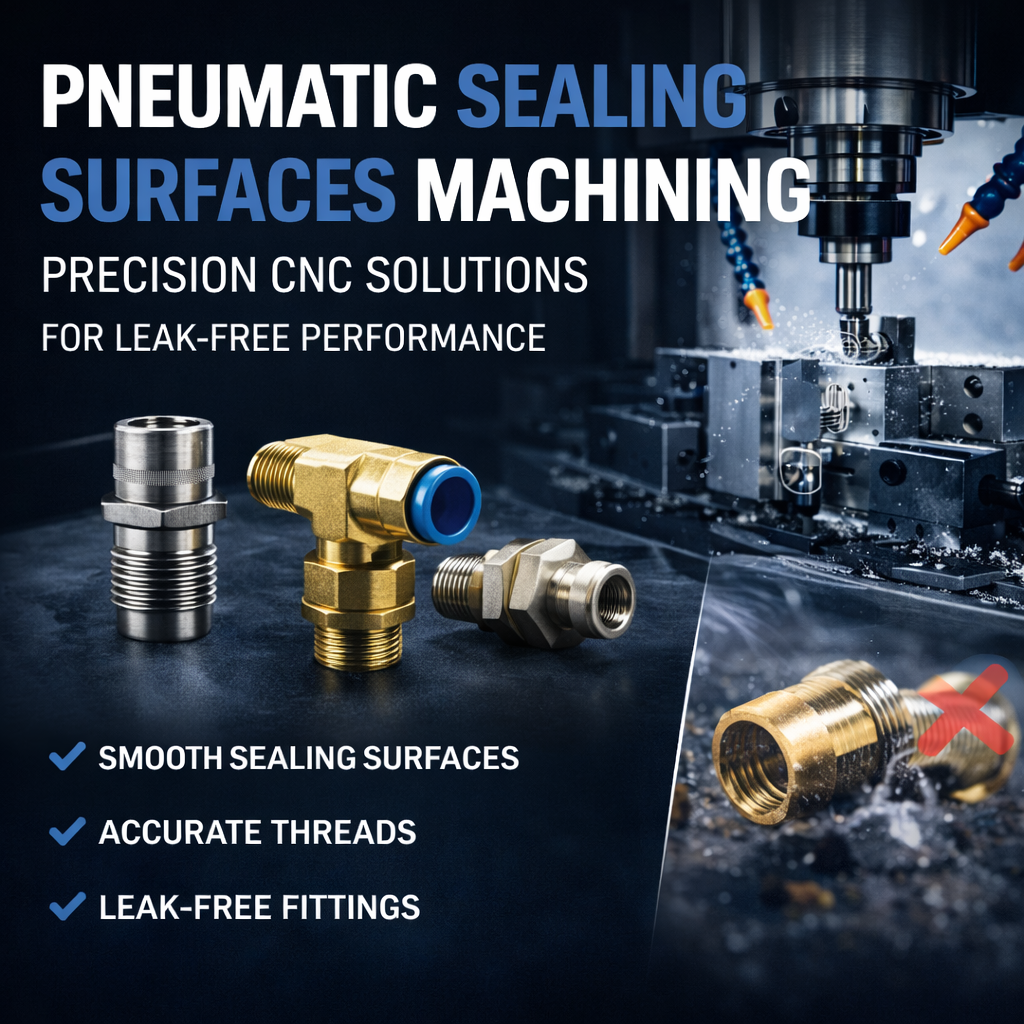
1. Introduction
In industrial automation, compressed air is an expensive utility to generate. Containing it efficiently is the highest priority for mechanical engineers and automation system designers. Even minor air leakage causes severe pressure loss and sluggish actuator response times. It also creates massive increases in energy consumption as compressors work overtime.
Preventing these hidden costs requires flawless connections. This makes pneumatic sealing surfaces machining one of the most critical manufacturing processes in fluid power engineering. Precision CNC machining directly addresses the root causes of air leaks. By understanding this, OEM buyers can source highly reliable components that guarantee long-term operational efficiency.
2. What Are Pneumatic Sealing Surfaces
To contain compressed air, a component relies on specific geometric interfaces. These are designed to mate perfectly with other parts or elastomeric seals. In pneumatic engineering, critical sealing surfaces include:
Threads: Tapered threads (like NPT or BSPT) rely on metal deformation. Parallel threads rely on exact pitch diameters to hold the assembly secure.
O-Ring Grooves: Precisely cut internal or external channels. These compress a rubber O-ring to a specific ratio.
Flat Sealing Faces: Smooth, perpendicular surfaces. They are designed to compress a gasket or bonded washer securely.
Push-to-Connect Interfaces: Internal cylindrical cavities. These house stainless steel grab rings and internal seals for instant tubing connections.
3. Common Causes of Air Leakage
Air is highly fluid and forcefully seeks out microscopic imperfections to escape. Poor machining directly leads to air leakage in pneumatic systems. When components fail in the field, it is typically due to:
Poor Surface Roughness: CNC cutting tools can leave chatter marks, scratches, or burrs. Air will bypass the rubber seal through these microscopic valleys.
Thread Inaccuracy: Incorrect thread pitch or depth prevents parts from engaging fully. This leads to loose connections.
Misalignment and Eccentricity: An O-ring groove must be perfectly concentric with the fluid bore. Otherwise, the seal crushes on one side and leaks on the other.
Low Machining Precision: A general lack of tolerance control allows parts to vibrate loose under mechanical stress.
4. Role of Precision CNC Machining
To combat persistent leakage issues, engineers must rely on precision machining for pneumatic components. Modern multi-axis CNC turning and milling centers provide exact control. They eliminate leak paths at the microscopic level.
A major advantage is material integrity. CNC machining eliminates porosity and ensures consistent sealing surfaces compared to casting. This directly translates into more stable sealing performance and reduced maintenance costs in long-term operation.
Cast parts often harbor hidden internal voids that eventually fracture under continuous pressure cycling. Machining custom pneumatic fittings from solid extruded metal billets guarantees superior structural strength. Furthermore, advanced CNC machines hold exceptionally tight tolerances (often ±0.01mm). This ensures every O-ring groove and flat face matches the engineered blueprint. This high level of pneumatic sealing surfaces machining separates high-performance OEM parts from generic catalog fittings.
5. Surface Roughness and Sealing Performance
The most vital metric in pneumatic sealing performance is the Surface Roughness Average (Ra). You cannot simply cut an O-ring groove; you must engineer its surface texture.
If a sealing surface is too rough, jagged metal peaks will gradually shred the elastomeric O-ring under pressure cycling. A smoother sealing surface (Ra ≤ 1.6 μm) ensures proper O-ring compression and prevents micro-leakage.
Highly dynamic seals—where a spool moves continuously across the sealing face—require even stricter control. They often demand an ultra-smooth Ra 0.8 μm finish or better. Mastering pneumatic sealing surfaces machining means consistently hitting these exacting Ra targets across large-scale production batches.
Quick Reference: Surface Roughness and Sealing
| Surface Condition | Impact on Sealing |
| Rough surface (Ra > 3.2 μm) | Air leakage risk |
| Medium finish (Ra ≈ 1.6 μm) | Standard sealing |
| Fine finish (Ra ≤ 0.8 μm) | High-performance sealing |
6. CNC Machining Techniques for Pneumatic Sealing Surfaces
Achieving a leak-free Ra 0.8 μm surface requires highly specialized CNC sealing surface machining techniques:
CNC Turning with High-Pressure Coolant: Rigid lathes spin the metal at high speeds. High-pressure coolant blasts away metal chips before they can score the delicate sealing face.
Fine Finishing Passes: Machinists program a heavy roughing cut followed by a micro-thin finishing pass. This utilizes specialized carbide or diamond inserts.
Precision Thread Cutting: Single-point threading tools cut exact thread profiles. These mate flawlessly without galling or binding.
Polishing and Honing: Extreme-tolerance valve spools may use secondary honing operations to achieve near-mirror finishes.
For a broader look at the entire production process, read our CNC pneumatic components manufacturing overview.
7. Materials and Sealing Compatibility
The raw material heavily influences both the machining strategy and the final sealing integrity.
Brass: Offers excellent machinability. It is relatively easy to achieve a smooth Ra 1.6 μm finish. This makes it highly cost-effective for standard factory automation.
Stainless Steel (316L): Mandatory for food processing and corrosive environments. However, it is prone to work-hardening. Machining flawless stainless steel requires strict tool-wear monitoring to prevent tearing the metal.
Aluminum: Ideal for lightweight robotics. Because aluminum is soft, threads and sealing faces can easily gall during assembly. They are typically anodized to harden the surfaces and protect O-rings from abrasion.
To learn more about optimizing your alloy selection, check out our guide on materials for pneumatic components.
8. Quality Control for Pneumatic Sealing Surfaces Machining
You cannot guarantee leak-free pneumatic fittings through visual inspection alone. Elite manufacturers utilize comprehensive metrology to verify their processes.
Thread Gauges: Calibrated Go/No-Go gauges are used directly on the CNC floor. This ensures pitch diameters remain strictly within tolerance.
Surface Roughness Profilometers: Quality control engineers use highly sensitive digital stylus instruments. They drag across O-ring grooves to scientifically verify the Ra 0.8 μm or Ra 1.6 μm requirements.
Leak Testing: Sample batches undergo pressurized air-decay testing or helium leak detection. This physically proves the sealing design under real-world pressure conditions.
9. Applications
Flawless pneumatic sealing surfaces machining is non-negotiable in demanding industrial sectors:
Automation Systems: Assembly line actuators require perfect sealing. This maintains the rapid, repeatable cycle times necessary for mass production.
Pneumatic Valves: Directional control valves rely on ultra-smooth internal bores. Spools must redirect air instantly without internal crossover leaks.
Connectors and Fittings: Transition adapters and multi-port manifolds depend on exact thread geometries. This bridges different international standards safely.
Sourcing high-quality custom pneumatic components ensures your system operates exactly as engineered without losing pressure.
10. Conclusion
In the demanding world of industrial fluid power, pressure drops and air leaks are not inevitable. They are the direct result of poor manufacturing. Precision CNC machining provides the ultimate solution to rough surfaces, eccentric grooves, and thread inaccuracies.
CNC machining eliminates the risks of casting porosity. It consistently delivers the strict Ra 1.6 μm finishes required for elastomeric seals and ensures absolute geometric precision. For mechanical engineers and OEM buyers, prioritizing high-quality pneumatic sealing surfaces machining guarantees a truly efficient, reliable, and leak-free automation system.
Send us your drawings today to get precision machining solutions, DFM feedback, and leak-free sealing optimization for your pneumatic components.