
Materials Used in Pneumatic CNC Components
1. Introduction
In industrial automation, a pneumatic circuit’s reliability relies on containing and directing compressed air without leakage. Choosing the right materials for pneumatic components is critical. It prevents pressure drops, environmental corrosion, and premature mechanical failure.
Air leakage is a massive hidden cost in modern manufacturing facilities. Poor material selection causes fittings or valve bodies to degrade. This forces the compressor to work harder to maintain system pressure. Consequently, it wastes energy and causes sluggish actuator response. OEM buyers and engineers must understand how different materials behave under continuous pressurization. This knowledge ensures the final assembly meets strict performance, budget, and lifespan requirements.
2. Key Factors in Material Selection
When evaluating materials for pneumatic components, engineers must balance several variables before approving a design:
Pressure Resistance: The material must withstand the compressor system’s continuous working pressure. It must not deform or crack over time.
Corrosion Resistance: Compressed air often contains trace moisture, lubricants, and contaminants. Components must resist internal oxidation while surviving external environmental hazards.
Weight Restrictions: Moving components on automated machinery face strict payload limits. This dictates using lighter alloys to maintain rapid cycle times.
Cost vs. Performance: Procurement teams must strategically balance the upfront cost of premium alloys against lifecycle maintenance costs and potential downtime.
3. Common Materials for Pneumatic Components
Precision CNC facilities can machine connection parts from a wide variety of industrial-grade billets. The operational environment strictly dictates which material will perform best.
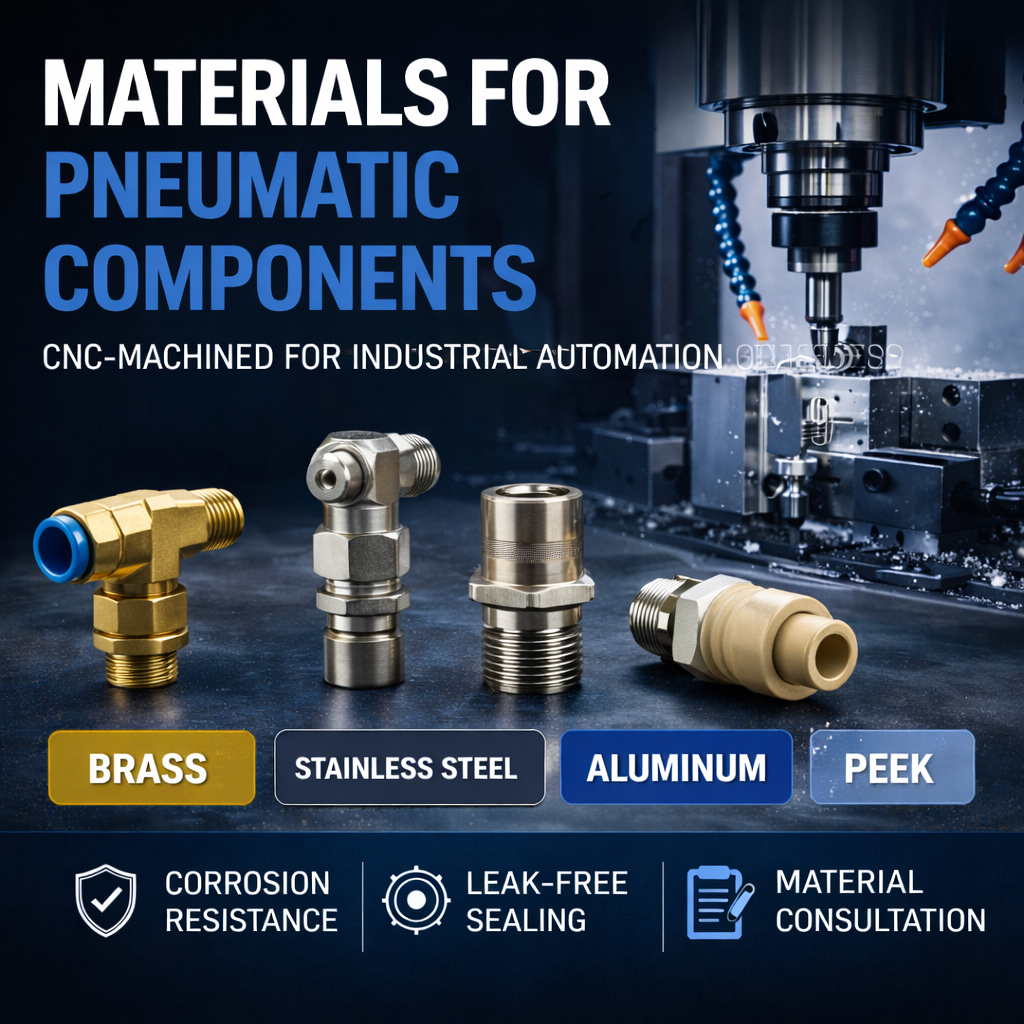
Brass
Widely utilized across general factory automation, brass pneumatic fittings offer an excellent balance of cost-efficiency and natural corrosion resistance. Brass is highly machinable. This reduces CNC cycle times and lowers the overall unit cost. It resists rust from typical moisture found in standard compressed air lines. This makes it the universal standard for indoor air distribution, pressure control valves, and generic connectors.
Stainless Steel (304/316)
For environments where standard metals would rapidly degrade, engineers specify stainless steel pneumatic components. Grade 316L contains molybdenum, offering exceptional resistance to harsh chemicals, washdown agents, and saltwater. It is the mandatory choice for medical devices, food packaging automation, and offshore marine equipment. These applications require strict sanitation and extreme longevity.
Aluminum
When weight reduction is a primary goal, aluminum pneumatic parts (such as 6061-T6 alloys) are heavily utilized. Aluminum offers a high strength-to-weight ratio. It is highly favored for machining complex pneumatic manifolds and air cylinders mounted on moving machinery. Because aluminum is softer, industrial components are almost always anodized. This significantly improves surface hardness and prevents thread galling.
Engineering Plastics (POM, PEEK)
Advanced polymers are deployed when extreme chemical resistance, electrical insulation, or ultra-lightweight properties are required. Materials like Delrin (POM) offer excellent low-friction characteristics for internal valve components. Meanwhile, PEEK withstands aggressive thermal and chemical environments where metal is unsuitable or overly heavy.
Quick Reference: Material Capabilities
| Material | Key Advantage | Typical Use |
| Brass | Cost-effective, corrosion resistant | General automation |
| Stainless Steel | High corrosion resistance | Food, medical |
| Aluminum | Lightweight | Robotics |
| POM / PEEK | Chemical resistance | Valves, seals |
For more insights, see our guide on custom pneumatic components for industrial automation.
4. CNC Machining Impact on Material Performance
The raw material is only half the equation. The manufacturing method ultimately dictates final field performance. When working with CNC pneumatic components materials, precision machining drastically improves sealing performance over traditional die-casting or injection molding.
Castings frequently suffer from internal porosity, microscopic voids, and shifting mold lines. CNC machining from solid extruded billet metal eliminates these structural defects. A rigid CNC turning center provides flawless thread geometries and mirror-smooth internal surface finishes (Ra). This exact precision ensures elastomeric O-rings and push-to-connect grab rings seat perfectly. As a result, it drastically reduces air leakage and extends operational life under high-frequency cycling. To understand the complete production process, see our CNC pneumatic components manufacturing overview.
5. Matching Materials for Pneumatic Components with Applications
Selecting materials must align perfectly with the end-use environment to ensure maximum ROI and system uptime:
Automation Systems: Standard brass is typically sufficient and highly cost-effective for dry, indoor factory air networks and standard assembly line actuators.
Packaging Machines: Food-grade packaging requires stainless steel components. This complies with strict FDA hygiene regulations and survives daily caustic washdown protocols.
Robotics: End-of-arm tooling (EOAT) relies on lightweight anodized aluminum manifolds. These maximize the robot’s payload capacity and prevent motor strain during high-speed movements.
Air Control Systems: High-vibration environments demand rigid, high-tensile materials. These will not fatigue or crack under constant mechanical stress and pressure spikes.
6. Cost Considerations for Materials for Pneumatic Components
The cost of materials for pneumatic components directly influences the final procurement budget. However, buyers must evaluate the total manufacturing cost rather than just the raw billet price.
Total cost includes both the raw material and the required CNC machining time. For example, 316L stainless steel costs more than brass. It is also much harder and prone to work-hardening. This means it wears down CNC cutting tools faster and requires slower spindle speeds, increasing cycle times. Buyers and engineers must carefully weigh these increased machining costs. They must evaluate the absolute necessity of environmental durability to avoid over-engineering the system.
7. Choosing the Right Material with a Supplier
Navigating trade-offs between metallurgy, machinability, and budget is complex. This is why OEM buyers must partner with an experienced pneumatic components manufacturer.
A highly capable supplier does more than just cut metal to a print. They provide proactive Design for Manufacturability (DFM) support. This includes optimizing material selection based on sealing performance, machining feasibility, and long-term system reliability. During the quoting phase, they analyze your operational environment, pressures, and target budget. Then, they recommend the exact alloy that optimizes performance.
Standard catalog parts may fail to meet your footprint or flow requirements. In this case, a technical supplier can engineer custom parts tailored for your machinery. These are machined from the exact metal grade your application demands.
You can also refer to our buyer’s guide to pneumatic components sourcing for more evaluation tips.
8. Conclusion
Any automated system’s success hinges on reliable air containment. This begins with selecting the correct materials for pneumatic components. Procurement teams must match the properties of brass, stainless steel, or aluminum to environmental demands. Doing so prevents costly air leaks and machine downtime. Combining the right material with CNC machining precision guarantees success. Industrial buyers secure leak-free, highly durable connections for their critical pneumatic circuits.
Send us your drawings today to get expert material recommendations, DFM feedback, and a fast quotation for your pneumatic component project.