
Heat Treatment in CNC Shaft Manufacturing: A Technical Guide for Buyers
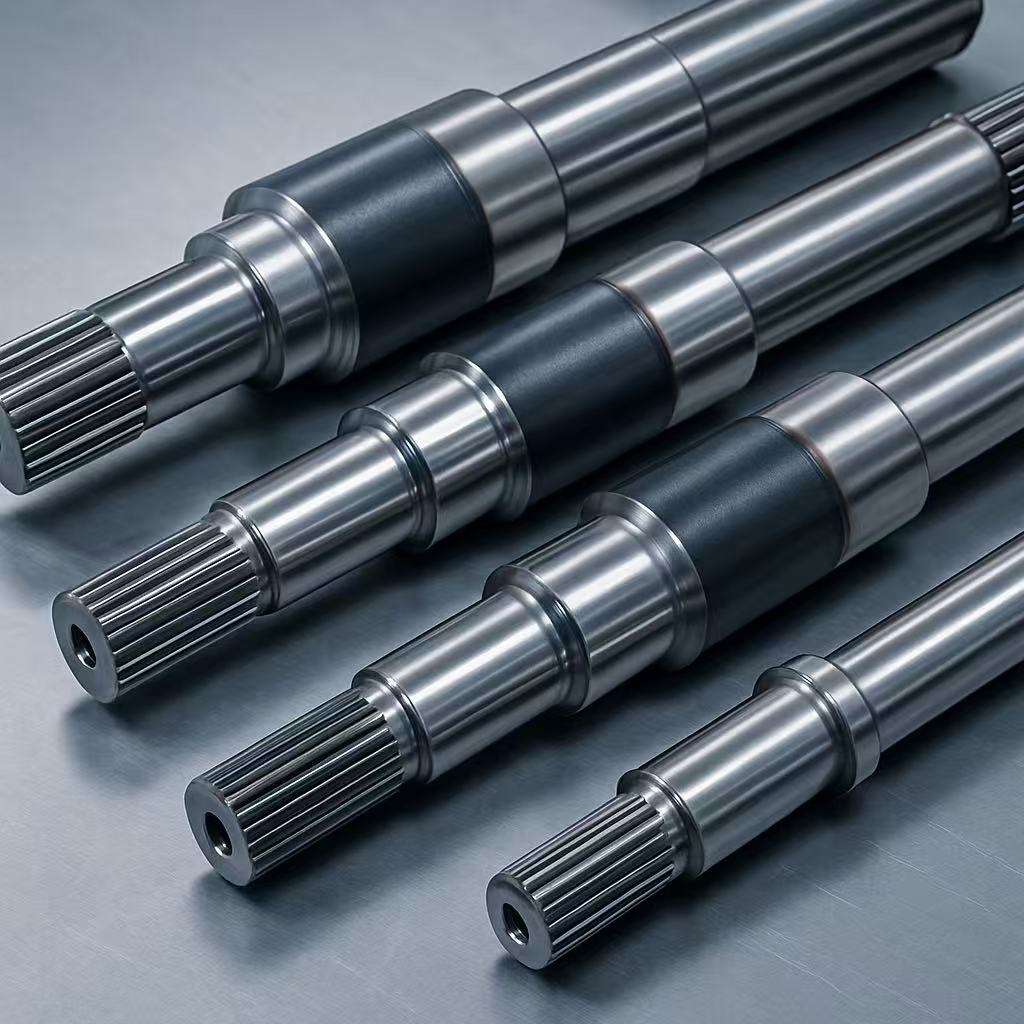
1. Introduction
In the precision engineering sector, the geometric accuracy of a component is only half the battle. For CNC machined shafts operating in high-stress environments—whether inside a hydraulic pump in Singapore or an automotive transmission in Detroit—mechanical properties are just as critical as dimensional tolerances. This is where heat treatment becomes the defining factor between a shaft that fails prematurely and one that delivers years of reliable service.
Heat treatment is not merely a finishing step; it is a controlled metallurgical process that fundamentally alters the microstructure of the metal.1 For industrial buyers and engineers sourcing precision components, understanding heat treatment for CNC shafts is essential. It provides the necessary surface hardness to resist wear, the tensile strength to prevent deformation, and the fatigue resistance to withstand millions of rotational cycles. This guide explores the technical nuances of these processes to help procurement teams make informed decisions when defining specifications for high-performance shafts.
2. Why Shafts Need Heat Treatment
A standard “as-machined” steel shaft, while dimensionally correct, lacks the mechanical resilience required for dynamic industrial applications. Untreated steel is relatively soft and ductile. Under load, it is susceptible to several failure modes:
Abrasive Wear: Without surface hardening, contact with seals, bearings, or bushings will rapidly score the shaft surface, leading to leaks and mechanical slop.2
Fatigue Failure: Cyclic bending and torsional loads create microscopic cracks that propagate through soft steel, causing sudden catastrophic fracture.
Plastic Deformation: High torque or shock loads can twist or bend a soft shaft beyond its yield point.
Shaft surface hardening and core strengthening transform the material properties. A heat-treated shaft exhibits a hard, wear-resistant “case” (surface layer) while maintaining a tough, ductile “core.”3 This duality is critical: the surface resists abrasion from bearings, while the core absorbs shock loads without snapping—a combination untreated steel cannot achieve.
3. Common Heat Treatment Methods for CNC Shafts
There is no single “best” method; the choice depends on the material grade and the shaft’s specific function.
Induction Hardening
This is the most common method for producing induction hardened shafts used in automation and power transmission. An induction coil heats the surface of the shaft via an alternating magnetic field, followed immediately by a quench.4
Mechanism: Localized hardening. Manufacturers can harden specific areas (e.g., bearing journals or spline teeth) while leaving the rest of the shaft soft for further machining or to retain toughness.5
Typical Depth: Case depths usually range from 0.5mm to 3.0mm.
Hardness: Carbon steels like 1045 can achieve 50–55 HRC.6
Carburizing (Case Hardening)
Carburizing is used for low-carbon steels that do not have enough carbon to harden on their own. The shafts are heated in a carbon-rich atmosphere, allowing carbon to diffuse into the surface.7
Mechanism: Creates a high-carbon surface on a low-carbon core.
Application: Ideal for case hardened shafts requiring extreme wear resistance and deep case depths (up to 4mm+), such as heavy-duty gears and mining shafts.
Quenching & Tempering (Q&T)
Unlike surface hardening, Q&T is a “through-hardening” process.8 The entire shaft is heated, quenched, and then reheated (tempered) to a specific temperature.
Mechanism: Transforms the entire cross-section of the shaft.
Result: Significantly increases the yield strength and tensile strength of the core. This is standard for alloy steel shaft heat treatment (e.g., 4140, 4340) where overall structural integrity is paramount.
Nitriding
Nitriding introduces nitrogen into the surface of the steel at lower temperatures (around 500°C) than carburizing.9
Mechanism: Forms very hard nitrides on the surface.10
Benefit: Because it occurs at lower temperatures without a phase change quench, distortion is minimal. This is the preferred method for high-precision shafts where maintaining straightness is critical.
4. How Heat Treatment Affects Shaft Performance
Applying thermal processing to precision shaft manufacturing yields measurable engineering improvements:
Surface Hardness: Increases from ~20 HRC (soft state) to 60+ HRC. This directly correlates to wear life against seals and bearings.
Fatigue Strength: Hardening introduces compressive residual stresses on the surface, which effectively push back against crack initiation, extending fatigue life by up to 500%.
Tensile Strength: Through-hardening increases the load a shaft can carry before bending.
The Engineering Trade-off: Distortion
Heat treatment involves extreme temperature changes, which invariably introduce internal stresses.11 This results in distortion—bending, twisting, or growth/shrinkage of the shaft. Buyers must understand that a shaft coming out of the furnace will rarely meet final print tolerances. This necessitates post-process finishing.
5. Materials Commonly Heat Treated in Shaft Manufacturing
Success depends on matching the material to the method.
AISI 1045 Carbon Steel: The industry standard for induction hardening. It has just enough carbon (0.45%) to harden to 55-58 HRC reliably. Affordable and effective.
4140 / 4340 Alloy Steel: The premium choice for high-stress applications.12 These are typically Quenched and Tempered (Q&T) to 28-32 HRC for core strength, and then may be induction hardened or nitrided for surface wear resistance.13
17-4PH Stainless Steel: A precipitation-hardening stainless grade.14 It is heat-treated to “aging” conditions (e.g., H900, H1150) to achieve high strength and moderate corrosion resistance without the distortion of standard quenching.
Nitriding Steels (e.g., 42CrMo4): Specifically formulated to accept nitrogen diffusion for hard, thin cases with zero distortion.
6. Post-Heat-Treatment Machining
Because heat treatment causes warping and dimensional changes, CNC machined shafts almost always require secondary operations.
Straightening: Shafts are often mechanically straightened in a press to bring them back within a workable range.15
Cylindrical Grinding: This is critical. Hardened shafts cannot be turned easily; they must be ground. Grinding removes the distortion and brings the diameter to ISO IT6 or IT7 tolerances (e.g., ±0.005mm).
Polishing: For seal surfaces, grinding marks are polished out to achieve Ra 0.2–0.4µm finishes to prevent seal leakage.
For procurement, this means “heat treated” implies “ground.” A drawing specifying 60 HRC and a tight tolerance implies a grinding step, impacting cost and lead time.
7. Applications
Heat-treated shafts are ubiquitous in industries where failure is expensive.
Automotive: Camshafts and crankshafts use induction hardening on lobes and journals to resist constant friction.16
Hydraulic Systems: Cylinder rods are induction hardened to prevent nicks and scratches that would destroy hydraulic seals.17
Industrial Automation: Linear guide shafts and precision journals require high surface hardness (60 HRC) to ensure smooth, zero-play motion over millions of cycles.
Heavy Machinery: Transmission shafts in mining trucks utilize carburizing to withstand massive shock loads that would snap a standard carbon steel shaft.18
8. Buyer Checklist for Sourcing Heat-Treated Shafts
To ensure quality, industrial buyers should include the following details in their RFQs:
Specify Hardness and Location: Don’t just say “harden.” Specify “Induction Harden zones A and B to 58-62 HRC.”
Define Case Depth: Effective case depth matters. A case that is too thin will crush under load; too thick makes the shaft brittle. (e.g., “Effective Case Depth 1.5mm – 2.0mm”).
Request Certificates: Demand a Heat Treatment Chart or Certification verifying the hardness and process used alongside the material MTR.
Clarify Runout Requirements: Ensure the drawing specifies runout (TIR) tolerances after heat treatment and grinding.
Verify Capabilities: Confirm the supplier has in-house or partner capabilities for precision grinding. A heat-treated shaft is useless if it’s bent.
9. Frequently Asked Questions (FAQ)
Q: What is the best heat treatment for high-load shafts? A: For shafts bearing heavy structural loads and shock, Quenching and Tempering (Q&T) of alloy steels (like 4340) is best for maximizing core strength. If the shaft also faces abrasive wear, Carburizing is ideal as it provides a hard shell over a tough core.
Q: Why do shafts warp after heat treatment? A: Warping is caused by the release of internal residual stresses and uneven cooling rates during the quenching process. The metallurgical phase transformation (changing from austenite to martensite) also creates volume expansion, leading to distortion.
Q: Is grinding necessary after hardening? A: Yes. Because heat treatment causes distortion and makes the surface too hard for standard turning tools, cylindrical grinding is mandatory to restore straightness, achieve tight tolerances (e.g., ±0.005mm), and create a smooth seal surface.
10. Conclusion
Heat treatment is a vital link in the supply chain of precision shaft manufacturing.19 It transforms a machined piece of raw metal into a durable, high-performance component capable of withstanding the rigors of industrial operation.
For buyers in the U.S., Singapore, and Southeast Asia, the key to successful procurement lies in specificity. By clearly defining material grades, hardening methods (such as induction hardened shafts or case hardened shafts), and post-process grinding requirements, you ensure the longevity of your machinery. Partnering with a CNC manufacturer who understands the interplay between machining tolerances and metallurgical transformation is the best investment in your product’s reliability.