
Custom CNC Milling Parts Supplier Guide for Industrial Buyers: Capabilities & Sourcing
Introduction
In the precision manufacturing sector, sourcing components is rarely about finding a standard product on a shelf. For Original Equipment Manufacturers (OEMs), automation integrators, and product design engineers, the requirement is almost always specific: a unique geometry, a distinct material, and a strict set of tolerances defined by a technical drawing. This is the domain of custom CNC milling parts.
For industrial buyers, choosing the right custom CNC milling parts supplier directly impacts product performance, lead time, and long-term manufacturing stability. Sourcing these components is a strategic decision. The difference between a functional prototype and a failed assembly often lies in the capabilities of the manufacturing partner you choose. A reliable supplier does more than just cut metal; they provide engineering feedback, manage material supply chains, and ensure strict adherence to geometric dimensioning and tolerancing (GD&T).
This guide provides a comprehensive overview for B2B buyers looking to navigate the complexities of sourcing custom CNC milling parts. From material selection to supplier evaluation, this article outlines the critical factors that ensure your supply chain remains robust, cost-effective, and quality-driven.
What Are Custom CNC Milling Parts?
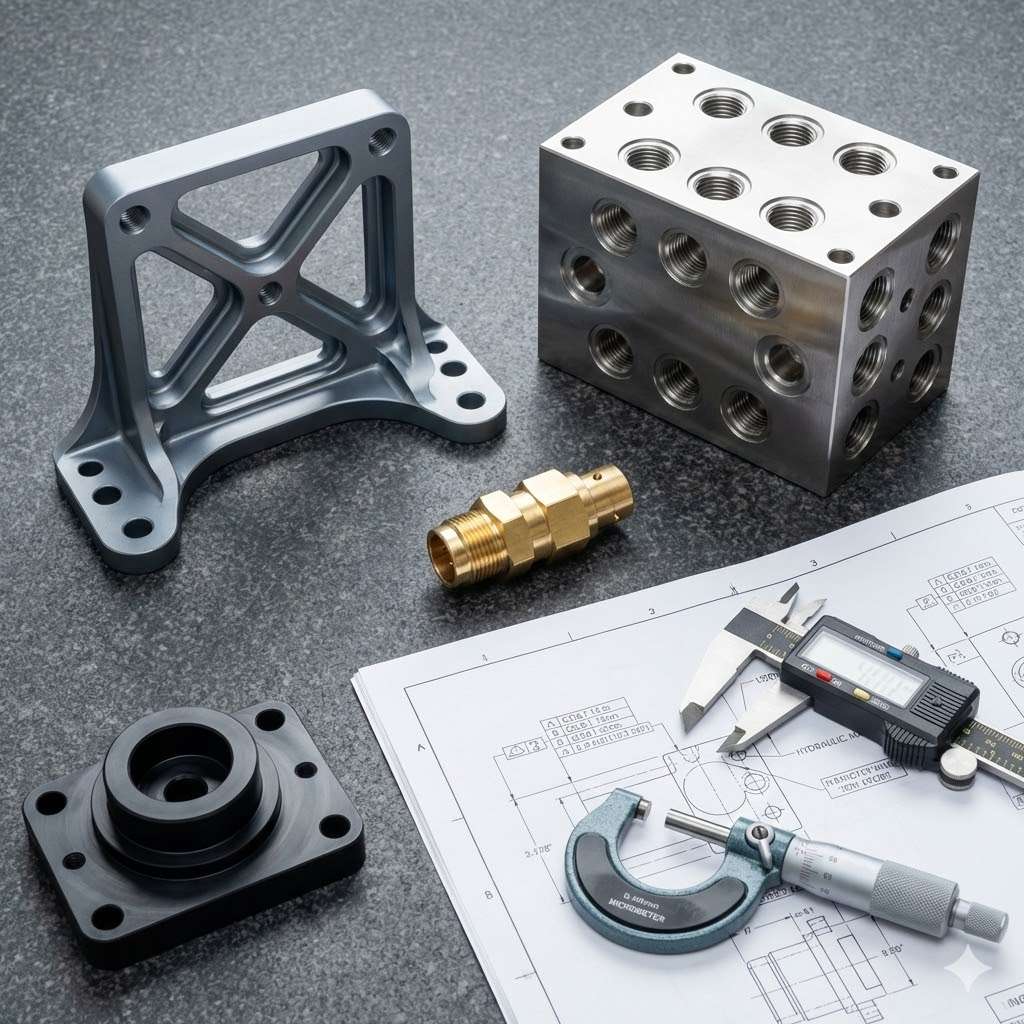
Custom CNC milling parts are components manufactured through the subtractive process of Computer Numerical Control (CNC) milling, specifically tailored to a unique digital design (CAD) provided by the customer. Unlike casting or molding, which require expensive tooling and are suited for massive volumes, CNC milling offers high precision and flexibility for low-to-medium volume production.
The Role of Precision CNC Milling
The core advantage of precision CNC milling is its ability to create complex shapes that are impossible or too costly to produce via other methods. Using rotary cutters to remove material from a workpiece, modern CNC milling machines can operate on 3, 4, or even 5 axes simultaneously. This allows for the creation of intricate features such as:
Complex Contours: 3D surfaces used in aerospace airfoils or automotive molds.
Deep Pockets and Slots: Essential for electronics housings and structural brackets.
Precision Bores: High-tolerance holes required for bearing fits and alignment pins.
Key Industrial Applications
Custom milled parts are the backbone of various high-stakes industries. They are ubiquitous in:
Industrial Automation: Robot arms, gripper fingers, and conveyor system components.
Automotive: Engine components, suspension brackets, and custom prototyping.
Medical Devices: Surgical instruments and diagnostic equipment housings.
Hydraulics and Pneumatics: Manifolds and valve bodies requiring absolute leak-free surface finishes.
Typical CNC Milling Materials for Custom Parts
A competent CNC milling manufacturer must have a robust supply chain capable of sourcing valid, high-quality raw materials. The choice of material dictates the machining strategy, the cost, and the final performance of the part. Here are the most common materials used in custom milling:
Aluminum Alloys (The Industrial Standard)
Aluminum is the most frequently milled material due to its excellent strength-to-weight ratio and machinability.
Aluminum 6061-T6: The industry workhorse. It offers good corrosion resistance, weldability, and is ideal for structural frames, brackets, and electronics enclosures.
Aluminum 7075-T6: Used when high strength is required (comparable to some steels). It is common in aerospace components and high-stress gears but is more expensive than 6061.
Stainless Steel (Corrosion Resistance)
Milling stainless steel requires rigid machine setups and advanced tooling strategies to manage heat and work-hardening.
303 Stainless: Designed for machining, offering lower cost but slightly reduced corrosion resistance.
304/316 Stainless: The standard for food processing, medical, and marine applications. 316 offers superior resistance to chlorides and acids.
Carbon and Alloy Steels (Strength and Wear)
Mild Steel (1018/1045): Used for fixtures, machine bases, and parts that will be welded or painted.
Alloy Steel (4140): Often pre-hardened or heat-treated after machining. It provides exceptional toughness and wear resistance for shafts, gears, and heavy-machinery components.
Brass and Copper (Conductivity and Friction)
Brass: Easy to machine and offers low friction, making it ideal for bushings, fittings, and decorative parts.
Copper: Difficult to machine due to its ductility (gumminess), but essential for thermal heat sinks and electrical contacts.
Engineering Plastics
A versatile custom CNC milling parts supplier should also handle polymers like Delrin (POM), Nylon, PEEK, and PTFE. These are critical for insulators, wear guides, and medical components where metal is unsuitable.
Key Capabilities a Reliable CNC Milling Supplier Should Have
When evaluating a partner, you are not just buying a part; you are buying their process capability. A “garage shop” and a professional CNC milling supplier may look similar on a website, but their output quality differs vastly. Look for these specific capabilities:
1. Advanced Machine Configurations
The complexity of your parts dictates the machinery required.
3-Axis Milling: Sufficient for simple prismatic parts where features are on one or two faces.
4-Axis Milling: Necessary for parts with features on the sides of a cylinder or requiring rotational indexing.
5-Axis Milling: The gold standard for complex geometries. It allows the tool to approach the workpiece from any angle, reducing setup time and improving accuracy by eliminating the need to manually re-fixture the part.
2. Tight Tolerance Control
Precision CNC milling is defined by tolerances. A reliable supplier should comfortably hold standard tolerances of +/- 0.1mm (ISO 2768-m) and precision tolerances down to +/- 0.01mm or tighter for critical features like bearing bores. Ask about their ability to hold geometric tolerances (GD&T), such as flatness, parallelism, and true position.
3. Surface Finishing Options
The milling process leaves visible tool marks. A full-service manufacturer offers post-processing to ensure the part is assembly-ready.
As-Milled: Standard finish (typically Ra 3.2 or 1.6).
Bead Blasting: Creates a uniform matte texture.
Anodizing (Type II & III): Essential for aluminum protection and aesthetics.
Passivation/Electropolishing: For stainless steel parts.
Heat Treatment: For hardening alloy steels.
4. Rigorous Quality Control (QC)
This is the differentiator. Does the supplier have a CMM (Coordinate Measuring Machine)? Do they use calibrated thread gauges and pin gauges? A supplier without advanced inspection equipment cannot verify the parts they manufacture.
How to Evaluate a Custom CNC Milling Parts Supplier
Finding a supplier is easy; finding the right supplier requires due diligence. Use this evaluation framework to vet potential manufacturing partners.
1. Technical Drawing Analysis
Send a Request for Quotation (RFQ) with a moderately complex part.
The Test: Do they ask questions? A good supplier will flag issues, such as sharp internal corners that cannot be milled or tight tolerances that drive up costs unnecessarily. If they quote immediately without technical feedback, be cautious.
2. Capacity and Scalability
Prototyping: Can they handle a single unit or a small batch of 5-10 parts?
Production: Do they have the capacity to scale to 500 or 1,000 units?
Automation: Suppliers with automatic tool changers and pallet systems offer better pricing on larger orders.
3. Quality Documentation
Ask for a sample inspection report. A professional CNC milling manufacturer should be able to provide:
Material Certificates (COA): Proving the raw material is genuine.
Dimensional Inspection Reports: Showing actual measurements vs. nominal dimensions.
First Article Inspection (FAI): Critical for verifying the process before full production.
4. Communication and Responsiveness
In B2B manufacturing, delays in communication equal delays in product launch. Assess their response time to emails. Are their engineers proficient in technical English? Can they explain why a delay might occur? Transparency is often more valuable than speed.
Common Problems When Sourcing Custom CNC Milling Parts
Being aware of potential pitfalls can help you prevent them. Here are the most frequent issues buyers face when sourcing custom CNC milling parts:
1. Inconsistent Quality (The “Golden Sample” Trap)
Some suppliers provide a perfect prototype but fail to maintain consistency during the production run. This usually stems from poor process control or tool wear management.
Solution: Demand process capability data or random sampling reports for larger batches.
2. Tolerance Stack-up Issues
If a supplier manually re-positions a part multiple times to machine different sides, cumulative errors occur.
Solution: Choose suppliers with 4-axis or 5-axis capabilities for complex parts to minimize setup changes.
3. Surface Finish Misunderstandings
“Smooth” is subjective. If you need a specific roughness average (Ra), it must be specified.
Solution: Always specify Ra values on the drawing (e.g., Ra 0.8) rather than vague terms like “fine finish.”
4. Cosmetic Defects
Functional parts can be rejected due to scratches, dents from shipping, or burrs left on edges.
Solution: Define cosmetic standards and packaging requirements (e.g., “individually bubble wrapped”) in your purchase order.
Why Work with a Specialized Custom CNC Milling Manufacturer
In the global supply chain, buyers often choose between trading companies and specialized manufacturers. For custom CNC milling parts, working directly with a specialized manufacturer offers distinct advantages.
1. Focus on Non-Standard Production
Specialized manufacturers are built for “High-Mix, Low-Volume” production. They are not disrupted by the need to change setups frequently. Their workflows are optimized for custom drawings rather than standard catalog items.
2. Direct Technical Communication
When you work with a specialized CNC milling supplier, you are often one step away from the machinist or the manufacturing engineer. This eliminates the “broken telephone” effect where technical nuances are lost in translation through a middleman.
3. Flexibility and Speed
Dedicated manufacturers can often expedite prototyping. Because they control the machine schedule, they can slot in urgent jobs or modify production priority based on your project timeline.
4. Cost Control
Eliminating intermediaries reduces markup. Furthermore, a specialized manufacturer can suggest Design for Manufacturing (DFM) improvements that lower the machining time, directly reducing the part cost without compromising functionality.
Conclusion
Sourcing custom CNC milling parts is a critical function for industrial OEMs. It requires balancing cost, speed, and, most importantly, quality. A part that is cheap but out of tolerance is the most expensive part you will ever buy, as it disrupts assembly lines and damages your brand reputation.
The market is flooded with machining shops, but finding a true partner requires looking beyond the hourly rate. The ideal CNC milling manufacturer invests in precision equipment, maintains robust quality control systems, and communicates like an engineering partner.
For long-term projects, many OEMs find value in building relationships with CNC milling suppliers who understand their design intent, tolerance requirements, and production roadmap. A well-chosen manufacturing partner becomes an extension of your engineering team—not just a source of machined parts.