
Cost Breakdown of CNC Milling Parts Manufacturing: What Industrial Buyers Should Know
Introduction: Why CNC Milling Costs Are Often Misunderstood
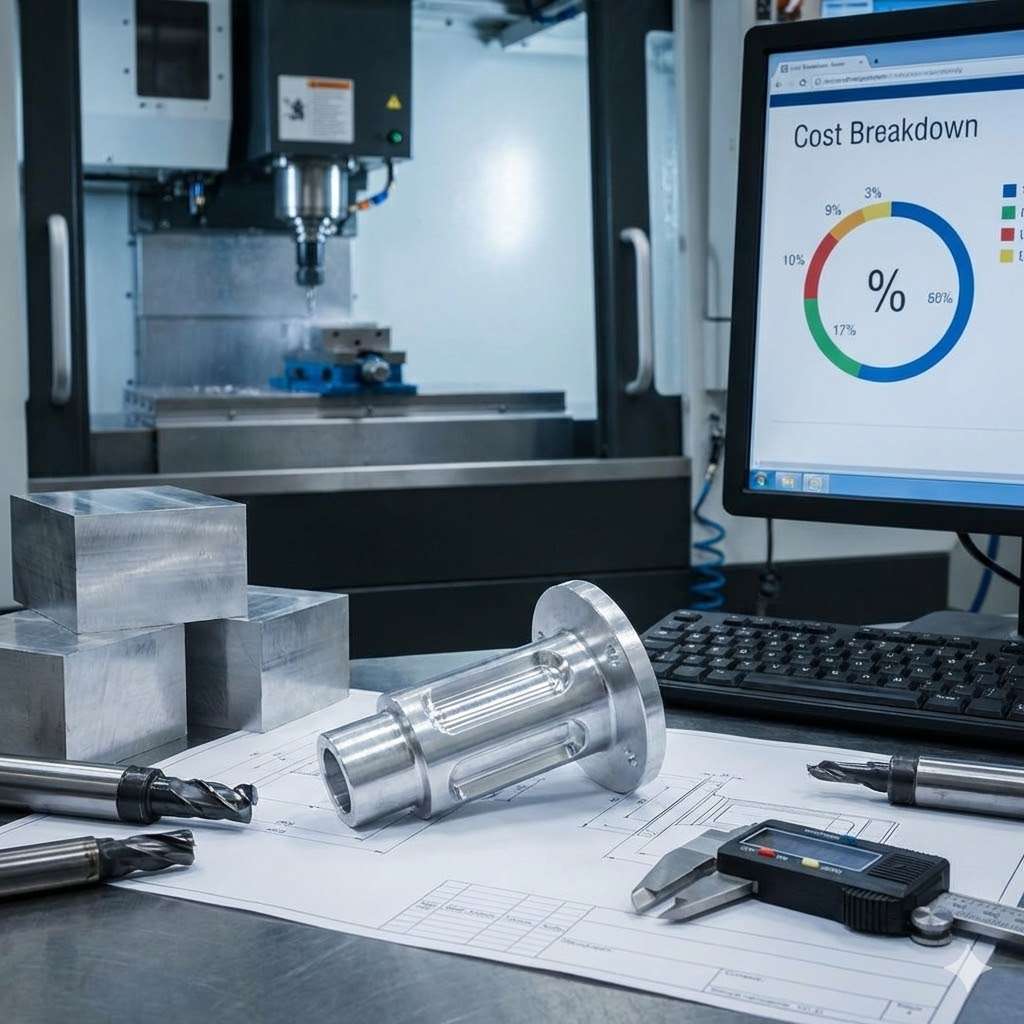
In the procurement of custom CNC milling parts, a common friction point arises when the quoted price diverges significantly from the buyer’s estimation. To the untrained eye, a machined part is simply a block of metal with material removed. However, the cost structure of CNC manufacturing is a complex equation involving physics, time, geometric complexity, and risk management.
The cost of CNC milling parts is rarely linear. A part that is twice as large does not necessarily cost twice as much; conversely, a part that is half the size but requires tight tolerances can cost three times more. For OEM engineers and procurement managers, understanding the drivers behind custom CNC milling cost is essential. It transforms the conversation from a simple price negotiation into a strategic discussion about design optimization and risk mitigation.
This article provides a transparent analysis of the cost structure behind CNC milling, empowering buyers to make informed decisions and optimize their supply chain spend.
Major Cost Components in CNC Milling
The price of a machined part is an aggregate of several distinct cost centers. While material and machine time are the most visible, they are often just the tip of the iceberg.
2.1 Raw Material Cost: The Starting Block
Material cost is determined by the size of the stock block, not the finished part weight. CNC milling is a subtractive process; you pay for the initial block, and you pay for the privilege of turning 60% of it into chips (swarf).
Material Selection: Aluminum 6061 is the baseline for cost-effective machining. Switching to Stainless Steel 304 or Titanium Ti-6Al-4V significantly increases raw material costs due to market volatility and processing difficulty.
Billet Waste Ratio: If a design requires machining a large L-shaped bracket from a solid block, the waste ratio might exceed 80%. The cost of the removed material is embedded in the final part price.
2.2 Machining Time (Cycle Time)
This is the primary driver of CNC milling price factors. It is calculated based on the machine’s hourly rate, which covers depreciation, electricity, tooling wear, and operator labor.
Machine Hourly Rate: Machine hourly rates typically range from $30–$120 per hour depending on machine type, country, and automation level. A standard 3-axis machine is on the lower end, while a high-end 5-axis center commands the premium.
Roughing vs. Finishing: Removing bulk material (roughing) is fast and cheap. Achieving a high-quality surface finish (finishing) requires slow feed rates and multiple passes, consuming significantly more machine time.
3-Axis vs. 5-Axis: 5-axis machining cost is higher due to the complex machinery involved, but it is often necessary for complex geometries to reduce setup time and improve accuracy.
2.3 Programming & Setup Cost (NRE)
Non-Recurring Engineering (NRE) costs are why low-volume manufacturing is expensive per unit.
CAM Programming: A skilled engineer must program every tool path in CAD/CAM software. For complex parts, this can take 4 to 20 hours.
Fixture Design: Holding the part rigidly requires custom jaws or fixtures.
Setup Time: Physically setting up the machine, loading tools, and calibrating offsets takes time. Whether you order 1 part or 1,000 parts, the setup time remains roughly the same, which is why unit costs drop drastically with volume.
2.4 Tooling & Consumables
Cutting tools (end mills, drills, taps) are consumable items.
Tool Wear: Machining abrasive materials like Inconel or hardened steel destroys tools rapidly. The cost of replacing high-performance carbide end mills is factored into the quote.
Specialty Tooling: Deep cavities requiring long-reach tools or non-standard undercuts often necessitate purchasing custom tooling, which is directly charged to the project.
2.5 Surface Treatment & Secondary Processes
Few parts leave the machine ready for assembly.
Finishing: Processes like anodizing, passivation, heat treatment, and powder coating are usually outsourced to specialized vendors. These add logistics costs and lead time.
Manual Finishing: Deburring (removing sharp edges) and polishing are often manual processes, adding labor costs that are frequently underestimated.
2.6 Quality Inspection Cost
Precision requires verification. The deeper the inspection requirements, the higher the cost.
CMM Time: Verifying tight tolerances or complex profiles on a Coordinate Measuring Machine (CMM) is slow and requires a skilled metrologist.
Statistical Process Control (SPC): For high-volume production, monitoring stability is key. It is important to distinguish between control limits (process stability) and tolerance limits (design requirement). Maintaining Cp/Cpk data requires constant sampling and data entry.
Documentation: Generating a First Article Inspection (FAI) report adds engineering hours to the job.
2.7 Scrap Risk & Yield Factor
Manufacturing is never 100% perfect.
Yield Rate: If a part has extremely tight tolerances (e.g., ±0.005 mm), the likelihood of a part being scrapped during production increases. Suppliers must factor in a “yield rate” (e.g., pricing for 110 parts to guarantee 100 good ones) to cover the risk of rejection. Complex parts naturally carry a higher failure probability.
How Geometry and Tolerance Multiply Cost
The relationship between design features and cost is non-linear. A small change in design intent can result in a disproportionate spike in price.
The Cost of Precision
Tolerance impact on machining cost follows an exponential curve. Cost increases exponentially as tolerances tighten beyond the machine’s natural capability window.
Standard Tolerance (±0.1 mm): Achievable with standard machining speeds. Baseline cost.
Tight Tolerance (±0.01 mm): Requires specialized tooling, slower feed rates, temperature control, and frequent in-process inspection. This can easily double the machining cost.
Geometric Dimensioning and Tolerancing (GD&T): Requirements like “True Position” or “Profile of a Surface” require CMM verification, further driving up costs.
Geometric Complexity
Deep Cavities: Deep pockets require long tools, which are prone to deflection. To prevent chatter, the machinist must run the machine very slowly (often at 20% of normal speed), drastically increasing cycle time.
Thin Walls: Machining thin walls requires delicate cutting strategies to avoid deformation, adding time and risk.
Sharp Internal Corners: CNC tools are round. Demanding a sharp internal corner requires Electric Discharge Machining (EDM), a completely separate and expensive process.
Hidden Costs Buyers Often Overlook
Beyond the quote, there are hidden costs associated with procurement efficiency.
Engineering Change Orders (ECO): Changing a design after CAM programming has begun incurs reprogramming fees and potential tooling waste.
Low Volume Logistics: Shipping 5 heavy steel parts via air freight is expensive. Packaging requirements (e.g., individual bubble wrap, vacuum sealing) also add to the unit cost.
Documentation Requirements: Requests for material certifications (MTRs), plating certs, and full dimensional reports are administrative tasks that require time and organized data management.
How to Reduce CNC Milling Costs Without Compromising Quality
Smart buyers can significantly reduce the cost of CNC milling parts by optimizing their designs for manufacturability (DFM).
Standardize Radii: Ensure internal corner radii match standard tool sizes (e.g., 3mm, 6mm). Make the radius slightly larger than the tool (e.g., R3.2mm for a Ø6mm tool) to allow for faster machining.
Relax Non-Critical Tolerances: Only apply tight tolerances to mating surfaces and bearing fits. Leave the rest as “standard open tolerance” (ISO 2768-m).
Limit Setup Counts: Design parts that can be machined in one or two orientations. Every time a part must be flipped and re-clamped, accuracy drops and cost rises.
Optimize Material: Do not specify 7075 Aluminum if 6061 will suffice. Do not specify Stainless Steel if the part is not in a corrosive environment.
Engage in DFM Consultation: Send preliminary drawings to your supplier early. A good supplier will suggest minor geometry changes that can save 20-30% on machining time.
Conclusion: Transparency Creates Better Partnerships
The price of a CNC milled part is fundamentally a calculation of Physics + Time + Risk. While it is always possible to find a cheaper shop, the “lowest price” often comes at the expense of material traceability, inspection rigor, or delivery reliability.
For industrial buyers, the goal should not be to squeeze the supplier’s margin, but to understand the CNC machining cost breakdown and work collaboratively to remove waste from the design. A transparent understanding of these cost drivers allows engineers and procurement teams to make value-based decisions that balance performance with budget.
Collaboration reduces waste. By working with a professional supplier who offers transparent pricing and DFM support, you ensure that you are paying for precision and quality, not for inefficiencies in the manufacturing process.
If you would like a cost review for your current drawing, our engineering team can provide DFM suggestions before quotation.