
Ultimate CNC Machining Knowledge Base for Buyers: Complete Industrial Guide
In industrial projects, a single misunderstanding in machining specifications can lead to catastrophic failure. In high-stakes sectors—spanning oil and gas, mining, and heavy equipment—the purchase of a CNC machined part is never just a transaction. It is a management of risk. For an OEM buyer or an EPC contractor, the difference between a successful project and a multi-million dollar field failure is often found in the microscopic details of a drawing or the traceability of a material certificate.
Sourcing engineers and procurement managers must move beyond a “price-per-part” mindset. In 2026, the global industrial supply chain demands that buyers possess a foundational technical understanding of CNC machining to effectively audit suppliers, control costs, and ensure operational safety. This guide serves as a comprehensive knowledge base, designed to empower buyers with the technical rigor and strategic insights required to navigate the complexities of modern precision manufacturing.
2. What is CNC Machining?
The Core Concept
CNC (Computer Numerical Control) Machining is a subtractive manufacturing process. Unlike 3D printing (additive), which builds parts layer-by-layer, CNC machining starts with a solid block of material (a billet) and removes metal or plastic using high-speed cutting tools to achieve the final geometry.
The Subtractive Advantage
In industrial applications, subtractive manufacturing is preferred for its ability to maintain superior structural integrity. Because the part is carved from a wrought or forged block, it retains the grain structure and mechanical properties required for high-pressure or high-torque environments.
Key Industrial Processes
Turning (Lathes): The workpiece rotates while a stationary cutting tool removes material. Ideal for cylindrical parts like shafts and flanges.
Milling (Mills): The workpiece remains stationary while a rotating cutting tool moves along multiple axes. Used for prismatic parts like manifolds and housings.
5-Axis Machining: Advanced milling where the tool moves along five different axes simultaneously. This allows for complex geometries in a single setup, drastically reducing geometric errors.
3. CNC Machining Workflow Explained
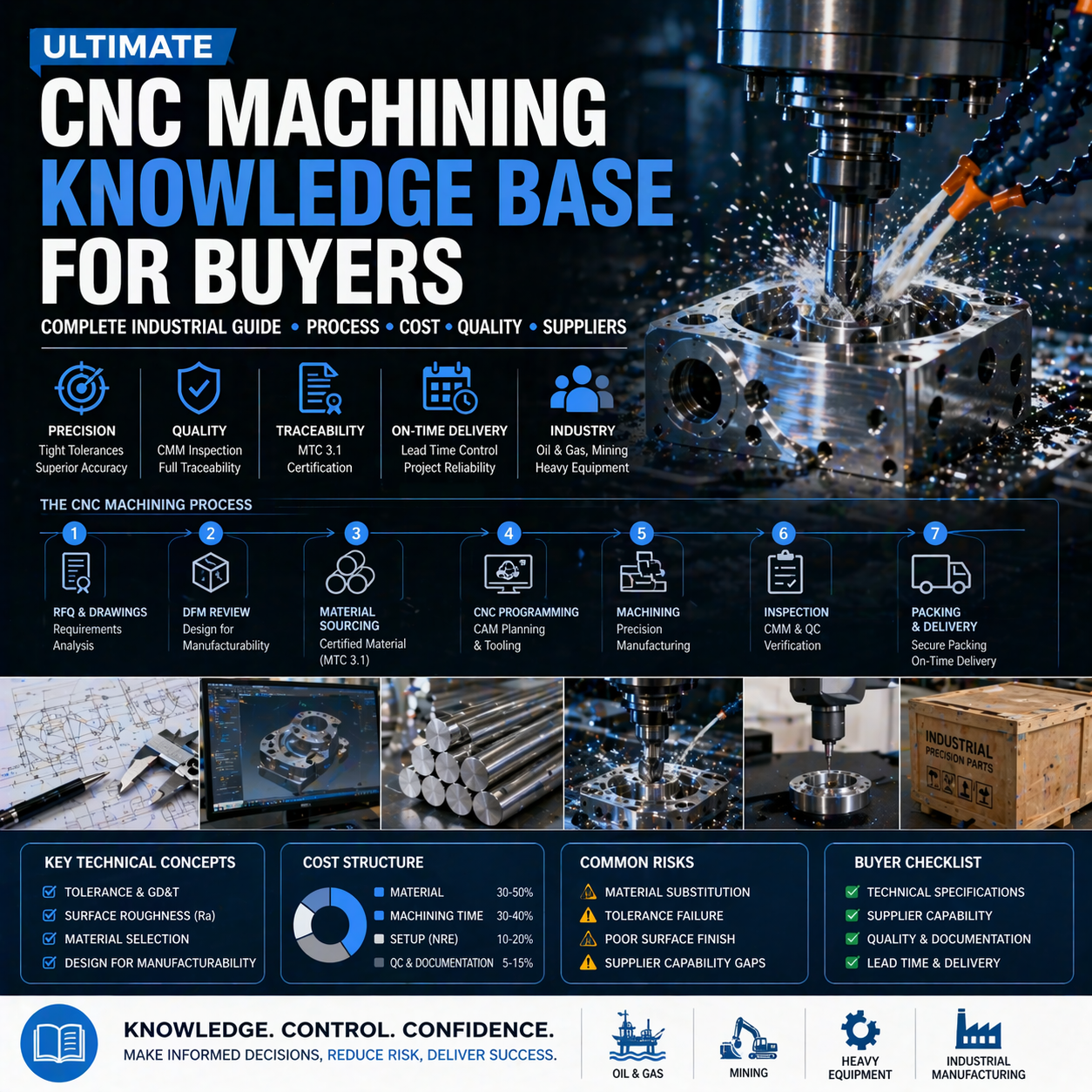
The lifecycle of a CNC project involves seven critical stages. For a buyer, understanding this flow is essential for machining lead time control.
RFQ (Request for Quote): The process begins with the buyer providing 2D drawings (PDF) and 3D models (STEP/IGES). The 2D drawing is the legal document defining tolerances and surface finishes.
DFM (Design for Manufacturability): A professional supplier performs a technical review to identify features that are needlessly expensive or difficult to machine.
Material Sourcing: The supplier secures the raw material, verifying the Heat Number and ensuring the mill provides an MTC 3.1 certificate.
Programming: Engineers use CAM software to generate G-code. This is where setup strategies are finalized to minimize “re-fixturing” errors.
Machining: The physical removal of material, divided into “Roughing” (fast removal) and “Finishing” (high-precision passes).
Secondary Processes: Includes heat treatment for hardness, plating for corrosion resistance, or anodizing.
Inspection & Delivery: Final QC using CMMs, followed by the compilation of the full Documentation Package.
4. Key Technical Concepts Buyers Must Understand
Tolerance: The Cost Driver
Tolerance is the allowable deviation from a nominal dimension.
Standard Tolerance: ±0.1mm (Cost-effective).
Tight Tolerance: ±0.01mm to ±0.005mm (Requires high-end machinery and climate-controlled QC).
Buyers should avoid “over-tolerancing” as it can increase costs by 300% to 500% without adding functional value.
Surface Roughness (Ra)
Surface roughness (Ra) defines the microscopic texture of a surface.
Ra 3.2: Standard industrial finish.
Ra 0.8: Sealing surface for O-rings.
Ra 0.4: Precision bearing seat.
GD&T (Geometric Dimensioning and Tolerancing)
Linear dimensions are not enough for assemblies. GD&T symbols define relationships such as Concentricity (for shafts), Parallelism, and Flatness (critical for high-pressure flanges).
5. CNC Machining Cost Structure
Understanding where your money goes is the first step in CNC cost optimization.
| Cost Component | Percentage | Key Drivers |
| Material | 30% – 50% | Alloy type, billet weight vs. finished weight. |
| Machining Time | 30% – 40% | Complexity, material hardness, feature count. |
| Setup (NRE) | 10% – 20% | Number of orientations, custom fixtures. |
| QC & Documentation | 5% – 15% | CMM requirements, FAI reports, MTC 3.1. |
6. Lead Time & Production Planning
Industrial lead times are a combination of three distinct segments.
Pre-Production (1-2 Weeks): RFQ review, material sourcing, and CAM programming.
Machining (1-4 Weeks): Actual time on the spindle. If a supplier is overbooked, your “queue time” increases.
Post-Production (1-2 Weeks): Heat treatment, plating, final CMM inspection, and international packaging.
7. Quality Control & Inspection
In the B2B industrial sector, the part is only as good as the report that accompanies it.
FAI (First Article Inspection): The supplier machines one part and performs a 100% dimensional audit for buyer approval before mass production.
CMM (Coordinate Measuring Machine): A ruby-tipped probe maps the part in 3D space. It is the only way to accurately verify complex GD&T callouts.
Traceability (MTC 3.1): The material’s “birth certificate.” Without this, a part cannot be installed in regulated environments like Oil & Gas.
8. Common Risks in CNC Machining
Material Substitution: Using “local equivalent” alloys that fail fatigue tests in the field.
Tolerance Failure: Using manual calipers instead of a calibrated CMM for tight tolerances.
Poor Surface Finish: “Chatter marks” on sealing surfaces that cause high-pressure leaks.
Capability Gaps: A shop attempting high-precision work without rigid machinery or metrology infrastructure.
9. How to Choose a CNC Supplier
Selecting a partner for industrial CNC supplier selection requires an audit of systems:
Metrology Lab: Is it climate-controlled?
ERP Integration: Do they use digital scheduling to manage capacity?
Technical Communication: Can they explain DFM suggestions clearly in English?
Traceability: How do they prevent material mix-ups on the shop floor?
10. OEM vs. EPC CNC Requirements
OEM (Original Equipment Manufacturer): Focus on Stability. Long-term contracts, blanket orders with monthly releases, and cost-down initiatives through DFM.
EPC (Engineering, Procurement, Construction): Focus on Execution. Project-based procurement where speed and documentation are more important than the absolute lowest unit price.
11. Cost vs. Quality vs. Lead Time Trade-off
The “Iron Triangle” of manufacturing:
Fast & Cheap: Quality will suffer (Incomplete inspection).
Fast & High Quality: It will be expensive (Expedited material, overtime labor).
Cheap & High Quality: It will take a long time (No priority in the queue).
12. Buyer Checklist: The “Final Gate”
[ ] Technical: Is the material grade and Ra value clearly defined?
[ ] Supplier: Does the shop have the rigidity for this material?
[ ] Documentation: Are MTC 3.1 and CMM reports required as deliverables?
[ ] Delivery: Is the packaging sufficient for sea/air transit?
13. Conclusion
In the industrial world, a “cheap part” is the most expensive mistake you can make if it leads to equipment failure or project delay. CNC machining knowledge is the primary tool of the professional buyer. By understanding the workflow, cost drivers, and metrology required for verification, you move from being an “order taker” to a “strategic partner.”
CNC machining is not just a manufacturing process — it is a system of risk control.
14. Secure Your Industrial Supply Chain Today
Use this knowledge base as your reference standard. At the intersection of engineering rigor and procurement logic, Lebometal provides the technical defense your projects require.
Send your drawings to receive:
Full technical review (DFM + tolerance validation).
Cost and lead time optimization insights.
Supplier capability evaluation based on industrial standards.
Make informed decisions before production starts. Contact Sherry at Lebometal.com today.