
CNC Machining vs Casting vs Forging – Full Comparison Guide for Engineers and Buyers
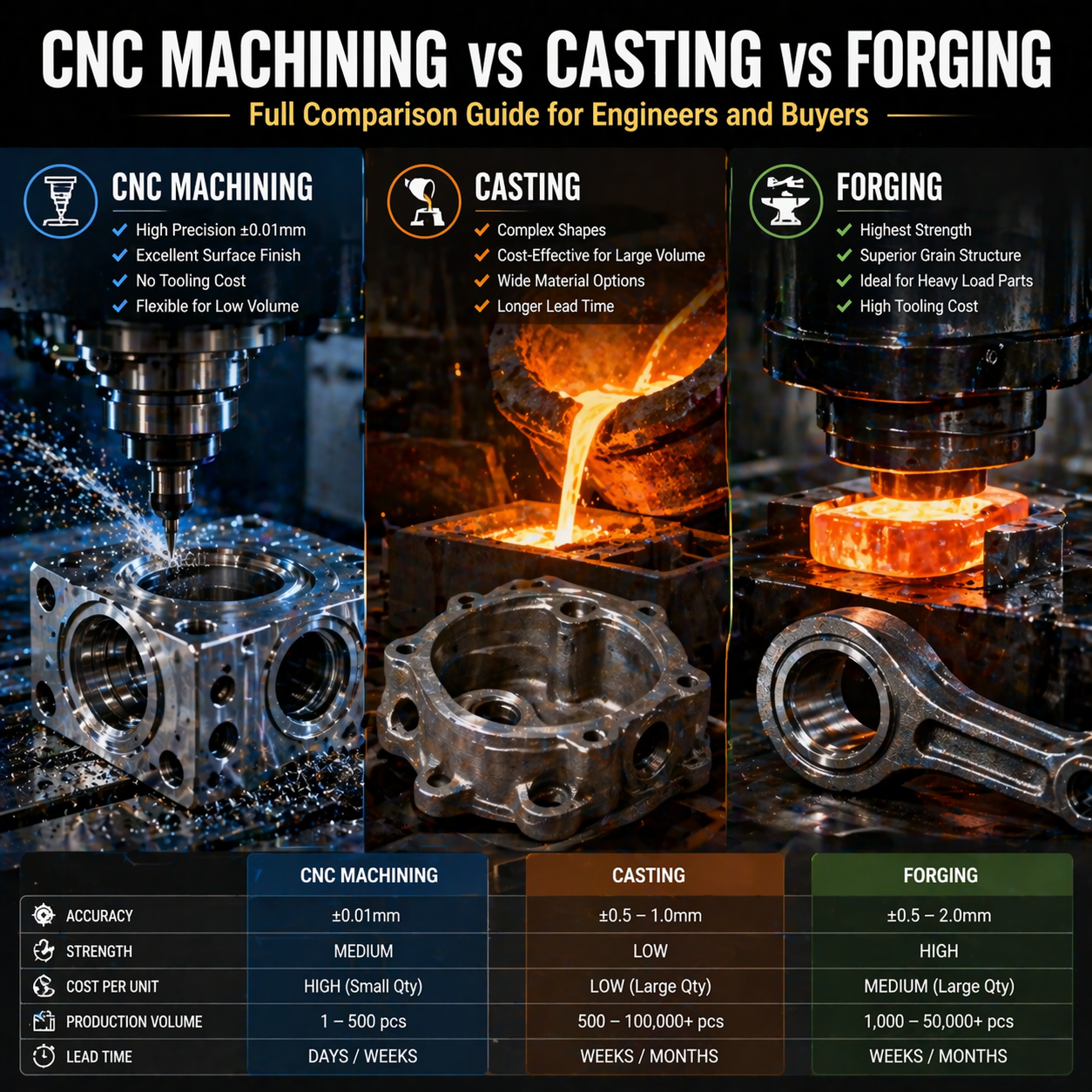
When comparing CNC machining vs casting vs forging, OEM buyers and engineers are not just choosing a manufacturing process—they are making a critical decision that affects cost, strength, precision, and long-term reliability. In heavy industries like oil and gas, mining, and construction, selecting the wrong method can lead to more than just budget overruns; it can cause catastrophic field failures and unplanned downtime.
Success in industrial procurement comes from matching the physics of the manufacturing process to the physics of the application. This guide provides an in-depth technical and commercial comparison to help you select the optimal route for your specific industrial components.
CNC Machining vs Casting vs Forging: Quick Answer
CNC Machining offers the highest precision (+/- 0.01mm) and flexibility for low-to-medium volumes.
Casting is best for highly complex shapes and large production volumes where unit cost is the priority.
Forging provides the highest mechanical strength and fatigue resistance due to its internal grain structure.
The right choice depends on your tolerance requirements, production volume, and specific application conditions.
2. Overview of the Three Major Processes
To make an informed decision, you must first understand the fundamental mechanics of each method.
CNC Machining (Subtractive)
CNC machining is the process of cutting away material from a solid block (billet) to reach the final shape. It is a high-precision, digital process. Because it does not require a mold or a die, it is the most flexible method for prototypes and parts requiring extreme accuracy.
Casting (Molten Metal)
Casting involves melting metal into a liquid state and pouring it into a mold cavity. As the metal cools, it solidifies. It is the go-to process for highly complex, organic geometries—like engine blocks or pump housings—that would be too expensive to cut from a solid block.
Forging (Plastic Deformation)
Forging shapes metal using localized compressive forces. The metal is heated until it is “plastic” and then hammered or pressed. This process aligns the internal grain of the metal to the shape of the part, creating superior mechanical properties.
3. Key Differences at a Glance
| Feature | CNC Machining | Casting | Forging |
| Precision | Highest (+/- 0.01mm) | Moderate (+/- 0.5mm) | Moderate (+/- 1.0mm) |
| Structural Strength | Medium (Stable) | Lowest (Random grain) | Highest (Aligned grain) |
| Tooling Cost | None / Very Low | High (Molds) | Very High (Dies) |
| Lead Time | Short (Days/Weeks) | Long (Months) | Long (Months) |
| Best Volume | 1 – 500 pcs | 500+ pcs | 1,000+ pcs |
4. CNC Machining: The Precision Standard
In casting vs cnc machining discussions, CNC is the winner for speed and accuracy. It acts as the bridge between design and production.
Pros:
No Tooling Costs: Production can start as soon as the CAD file is ready. You don’t have to wait months for a mold to be built.
Exceptional Surface Finish: CNC delivers an Ra 0.8um to 3.2um finish straight off the machine, which is essential for bearing seats and seals.
Material Integrity: Parts are machined from certified billets, ensuring consistent material properties without the risk of internal gas bubbles.
Limitations:
Subtractive Waste: You pay for the material you cut away. For high-volume, simple shapes, this can be less efficient than forming processes.
5. Casting: Complexity at Scale
Casting is the primary choice for mass production and complex “un-machinable” shapes.
Pros:
Complex Internal Cavities: Casting allows for internal passageways and ribs that are weight-optimized.
Low Unit Cost: For volumes in the thousands, the price per part is significantly lower than CNC.
Large Part Capability: It is the only viable method for producing massive components (e.g., structural frames for heavy machinery).
Limitations:
Porosity Risks: As metal cools, gas can get trapped, creating internal “voids.” This can cause leaks in high-pressure hydraulic manifolds.
Lower Impact Strength: The random crystalline structure makes cast parts more brittle than forged alternatives.
6. Forging: For Severe Service Environments
In the forging vs machining debate, strength is the deciding factor. If the “cost of failure” is high, forging is usually the answer.
Pros:
Fatigue Resistance: Forging aligns the internal grain flow to the shape of the part, providing roughly 20-30% more strength than other methods.
Structural Safety: No internal voids or porosity. Forging is the industry standard for lifting hooks, drive shafts, and high-load gears.
Limitations:
Geometric Limits: Forging cannot produce complex internal cavities. It usually requires secondary CNC machining to reach final tolerances.
7. Casting vs CNC Machining vs Forging: Which Is Better?
There is no single “best” manufacturing process. The optimal solution depends on your priorities:
CNC machining is best for precision and flexibility when you need parts quickly or have tight tolerances.
Casting is best for cost efficiency at scale for complex, non-structural housings.
Forging is best for mechanical strength in high-load, safety-critical applications.
The optimal industrial solution often combines processes, such as using forged blanks for strength and finishing them with CNC machining for precision.
8. Cost and Application Logic
When is CNC Cheaper?
When the order volume is low. Without the $5,000 – $20,000 upfront cost for molds or dies, CNC is the clear winner for prototypes and batches under 200 units.
When is Casting/Forging Worth the Cost?
When you reach the “Economic Break-Even Point.” Once the tooling cost is amortized over 1,000 units, the lower per-part price makes casting or forging more attractive.
Application Match:
Shafts: Should be Forged for strength and CNC Machined for bearing fit.
Manifolds: CNC Machined from solid billet to ensure zero porosity under high pressure.
Housings: Cast to save weight and cost in mass production.
9. Quick Selection Checklist
[ ] Precision: Do you need +/- 0.01mm? -> Choose CNC.
[ ] Strength: Is this a high-load, safety-critical part? -> Choose Forging.
[ ] Complexity: Does the part have complex internal chambers? -> Choose Casting.
[ ] Lead Time: Do you need parts in less than 4 weeks? -> Choose CNC.
[ ] Volume: Are you ordering more than 1,000 pieces? -> Consider Casting or Forging.
10. Conclusion: Strategic Performance
Choosing between cnc machining vs casting vs forging is a strategic decision that balances upfront investment against long-term reliability. Making the wrong choice can increase costs or, worse, lead to failure in the field.
At Lebometal, we help OEM buyers and engineers navigate these choices with technical precision. We don’t just “make parts”—we ensure the manufacturing process matches the mechanical reality of your application.
Not sure which process is right for your project?
Send us your drawings or specifications, and our engineering team will provide:
Process comparison (CNC vs casting vs forging) tailored to your design.
Cost breakdown and optimization suggestions.
Material and tolerance recommendations to ensure manufacturability.
Risk analysis to prevent field failures before production begins.
Get a technical evaluation within 24 hours. Visit Lebometal.com today and secure your industrial supply chain with confidence.