
CNC Machined Parts for Special Purpose Machinery: Custom OEM Solutions with High Precision and Fast Turnaround
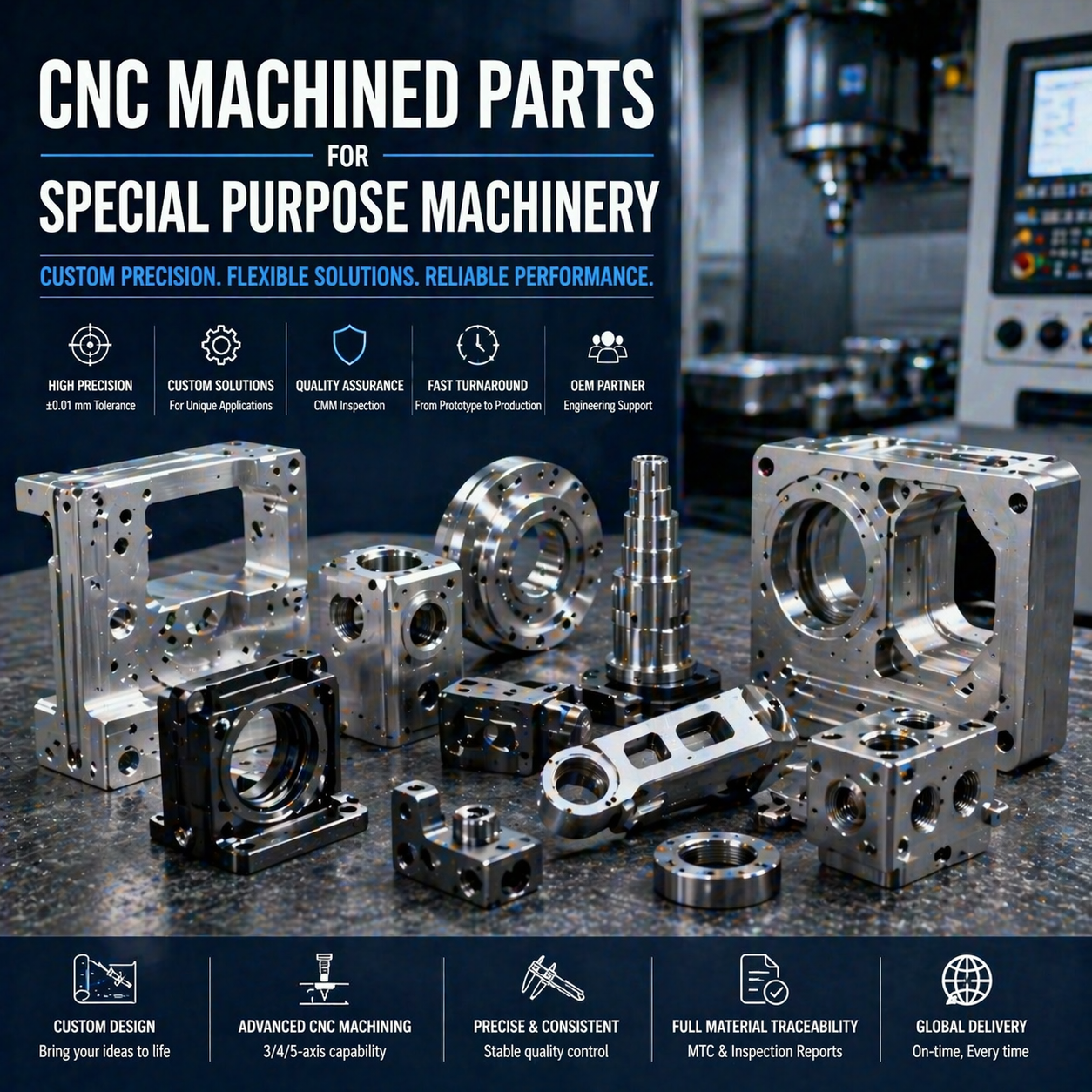
For OEM manufacturers and automation engineers, sourcing CNC machined parts for special purpose machinery is not just a technical requirement—it is a critical factor in ensuring production efficiency, system reliability, and long-term equipment performance. In the landscape of modern manufacturing, standard off-the-shelf components often fail to meet the unique requirements of highly specialized industrial equipment. Special Purpose Machinery (SPM) is designed to perform specific tasks with high efficiency, requiring geometries, materials, and tolerance levels that catalog parts simply cannot provide.
The success of a custom equipment build rests on the structural and mechanical integrity of its individual components. When a machine is designed for a unique assembly line or specialized testing environment, every bracket, shaft, and housing must interface perfectly. This is where custom CNC machining services from a professional CNC machining manufacturer become the backbone of the sector, providing the bridge between theoretical engineering and physical reality.
2. Why CNC Machining is Critical for Special Purpose Machinery
Special purpose machinery is the result of rigorous research and development aimed at optimizing a specific production cycle. Because these machines are not mass-produced, the manufacturing approach for their components must be inherently adaptable.
Customization vs. Standard Parts
Standard parts lead to compromises in space and weight. For an OEM building custom industrial equipment, a standard motor mount might lack necessary mounting points. Custom CNC parts allow engineers to consolidate multiple components into a single monolithic part, reducing assembly time and the risk of fasteners loosening under vibration.
Precision and System Performance
In SPM, the margin for error is minimal. High-precision machining ensures that the tolerance stack-up in a complex assembly remains within acceptable limits, maintaining the machine’s kinematic accuracy over millions of cycles.
3. Key CNC Machined Parts for Industrial Equipment
While the overall design varies, certain categories of CNC machined parts for special purpose machinery are universal across the manufacturing landscape.
Custom Brackets and Frames: The structural skeleton of any machine. These custom CNC parts must be rigid enough to support loads without deflection while providing precise mounting surfaces.
Housings and Enclosures: Protecting sensitive gear sets or fluid manifolds. A specialized CNC machining manufacturer ensures surface finish and sealing integrity for gaskets or O-rings.
Shafts and Motion Components: Drive shafts, eccentric cams, and lead screw mounts require absolute concentricity and cylindricality to ensure smooth rotation.
Fixtures and Connectors: End-of-arm tooling (EOAT) and custom manifolds often require complex internal channels and high-accuracy hole patterns.
4. Material Selection: Balancing Performance and Machinability
As an OEM CNC parts manufacturer, we recognize that material choice is the first step in engineering reliable industrial equipment.
Aluminum (6061-T6, 7075-T6): The primary choice for automation due to its superior strength-to-weight ratio.
Stainless Steel (304, 316L): Mandatory for food processing or pharmaceutical machinery where washdown cycles and chemical resistance are required.
Carbon Steel (1045, A105): Used for heavy-duty pedestals and components where durability is more important than weight reduction.
Engineering Plastics (Delrin, PEEK): Used for wear strips, bushings, and gears requiring high dimensional stability or chemical resistance.
5. Precision Requirements: The Numbers Behind the Machine
The reliability of a custom machine is a direct result of the tolerance levels achieved. In custom CNC machining services, we focus on:
Tolerances: We regularly achieve $\pm 0.01$ mm to $\pm 0.02$ mm for bearing seats, press-fit pins, and sliding interfaces.
Surface Finish (Ra): Sealing and bearing surfaces often require $Ra 0.8$ to $1.6$ to reduce friction and improve fatigue life.
Assembly Fit: We utilize Geometric Dimensioning and Tolerancing (GD&T) to ensure base plates and frames support a “plug-and-play” assembly for the OEM.
6. CNC Machining Challenges in the Custom Machinery Sector
Providing CNC machined parts for special purpose machinery involves technical hurdles that standard production shops are rarely equipped to handle.
Complex Geometries: Custom industrial equipment often requires internal fluid channels or deep undercuts. This requires advanced 5-axis milling to machine all features in as few setups as possible.
Small Batch Production: Most custom machinery projects require runs of 1 to 10 units. An OEM CNC parts manufacturer must be optimized for “High-Mix, Low-Volume” production.
Design Iterations: Our workflow is designed to accommodate design revisions, ensuring the latest CAD model is what hits the factory floor.
7. Engineering Support: Design for Manufacturability (DFM)
A high-value CNC supplier for custom machinery provides more than just machining; they provide engineering insight.
Cost Optimization: Identifying “over-toleranced” dimensions that drive up cost without adding value to the assembly.
Manufacturability: Suggesting toolpath optimizations or material substitutions that offer similar performance at a lower price point.
8. Why OEM Buyers Choose a Reliable CNC Supplier
For special purpose machinery, choosing the right CNC supplier for custom machinery is not just about machining capability—it is about long-term project reliability.
A professional CNC machining manufacturer provides:
Stable quality across multiple production batches.
Fast response to engineering and design changes.
Strong DFM support to reduce total project and assembly costs.
Consistent lead times to meet equipment delivery schedules.
For OEM manufacturers, this partnership directly impacts machine performance, delivery timelines, and end-customer satisfaction.
9. Case Study: High-Speed Pharmaceutical Packaging Cell
The Challenge:
An automation OEM was building a custom packaging machine requiring a high-speed cam-driven indexing system. The original components failed due to vibration. The tolerance of the bearing seats was inconsistent, causing the drive shaft to bind.
The Solution:
Lebometal provided custom CNC machining services for the housing and shafts. We suggested switching to a monolithic aluminum 7075-T6 block to improve rigidity and held a $\pm 0.01$ mm tolerance on bearing bores.
The Result:
The binding and vibration issues were eliminated. The machine achieved its target rate of 120 cycles per minute, and the OEM delivered the project two weeks ahead of schedule.
10. How to Choose a CNC Supplier for Custom Machinery
When selecting a partner for your custom industrial equipment, look for:
Technical Expertise: Understanding of industry-specific standards.
Quality Control: Ability to provide CMM reports and Material Test Certificates (MTC 3.1).
Responsiveness: Fast quoting and prompt answers to technical queries.
Capacity: Multi-axis equipment required for complex custom geometries.
11. Conclusion: Precision as a Competitive Advantage
Special purpose machinery represents the peak of industrial engineering. In an industry where one custom machine can revolutionize a production line, the quality of every custom CNC parts is a direct reflection of the machine’s reliability. By prioritizing precision and engineering support, OEM manufacturers can de-risk their projects and ensure their equipment performs exactly as designed.
Send your drawings today and get:
✔ Custom machining evaluation
✔ Cost optimization suggestions
✔ Fast quotation within 24 hours
Work with a reliable CNC supplier for custom machinery.
Start building high-performance equipment with Lebometal.