
CNC Parts for Food Processing Machinery: Food-Grade Materials, Precision, and Hygienic Design
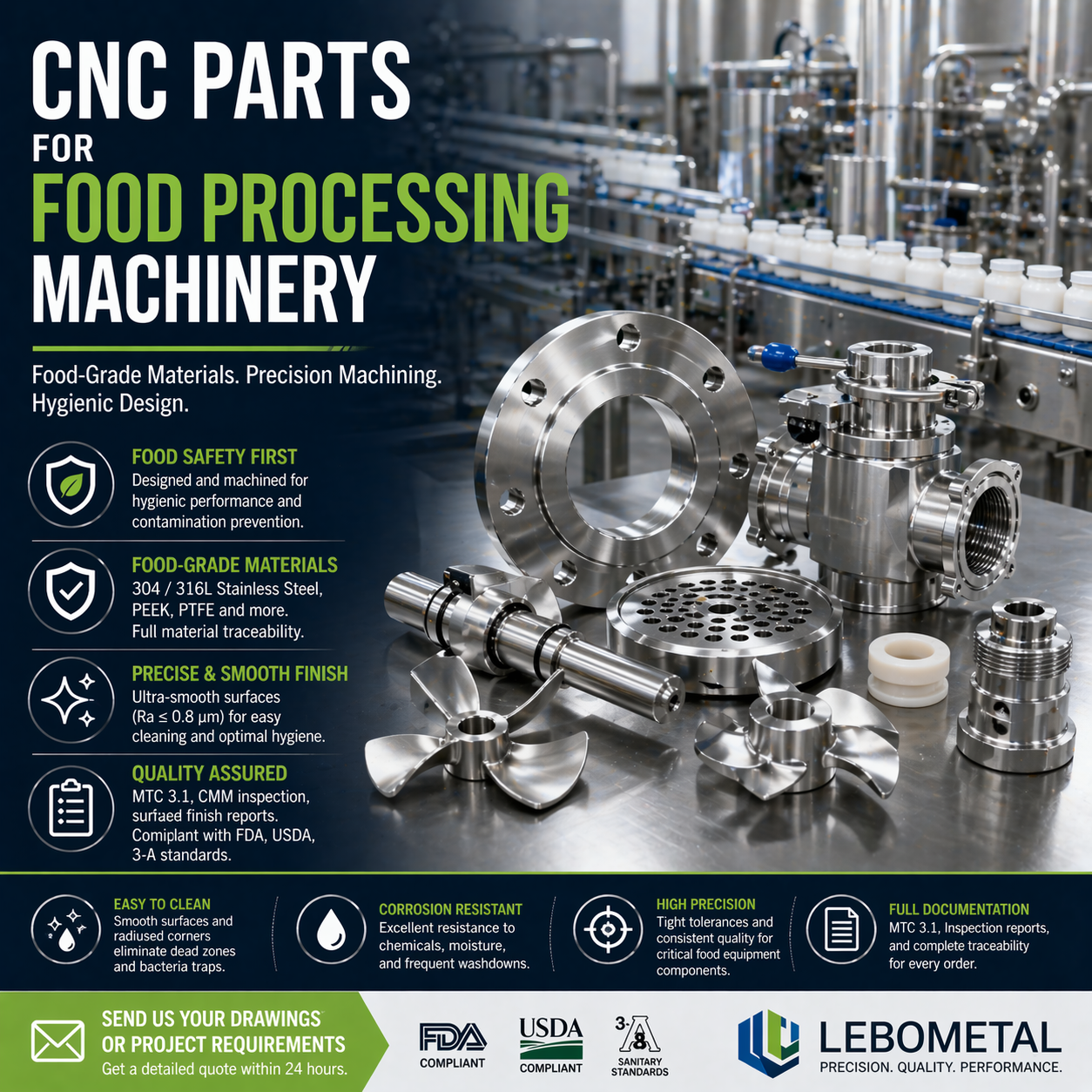
In the food processing industry, failure is not measured in downtime—it is measured in public health risk. A single poorly machined component can create hidden contamination zones, leading to product recalls, regulatory penalties, and irreversible brand damage. That’s why CNC Parts for Food Processing Machinery are not just mechanical components—they are critical control points for food safety.
Choosing the right partner for food grade CNC machining is a strategic decision. Substandard machining leads to bacteria traps, accelerated corrosion from harsh cleaning chemicals, and expensive downtime. In food processing equipment, machining quality directly determines hygienic safety and cleaning efficiency.
2. Why CNC Machining is Critical in Food Equipment
Food processing environments are brutal. In 2026, global safety standards have reached an all-time high. Machines face constant “washdown” cycles with caustic chemicals, high moisture, and volatile temperature shifts.
Contamination Prevention
Traditional casting or manual machining often leaves porous surfaces. These pores are breeding grounds for Listeria and E. coli. Precision CNC machining creates non-porous, mirror-smooth surfaces that pathogens cannot cling to.
Cleaning Efficiency (ROI)
The easier a machine is to clean, the faster it returns to production. Hygienic CNC machining components are designed with smooth transitions and large radii. This eliminates the “dead zones” where food particles accumulate, reducing water and chemical consumption during sanitation.
3. Key CNC Parts in Food Processing Machinery
Every component that touches food is a “Critical Control Point.” Precision machining ensures these parts remain compliant under heavy use.
Mixing Equipment Components: Paddles, scrapers, and agitator hubs require complex 5-axis milling. These parts must be perfectly balanced to prevent vibration-induced wear that could shed metal particles into the food stream.
Conveyor Parts: Hygienic rollers, shafts, and drive sprockets. These components handle constant motion in high-moisture zones and must resist “pitting” corrosion.
Sanitary Valves and Fittings: Flow control is vital for liquid foods. Valve stems and seats require ultra-smooth finishes for a leak-free, bacteria-proof seal.
Filling and Packaging Components: Nozzles and dosing pistons move with high frequency. Precision machining ensures exact portion control and prevents waste from “dripping.”
4. Material Selection for Food-Grade Applications
In the food industry, “stainless” is not enough. The chemistry of the food dictates the metallurgy of the part.
Stainless Steel 316L: The gold standard for stainless steel CNC parts for the food industry. The addition of molybdenum provides resistance to salt, vinegar, and acidic sauces. The “L” (low carbon) prevents corrosion after welding.
Food-Grade Plastics (PEEK, PTFE): For high-heat or low-friction zones. PTFE (Teflon) is virtually inert, while PEEK offers the strength of metal with total chemical resistance, ideal for bushings and wear rings.
5. Hygienic Design and Precision Requirements
Hygienic design moves beyond “making it fit” to “making it safe.”
Surface Finish (Ra < 0.8 µm)
Bacteria are 1 to 2 microns in size. If your surface roughness (Ra) is higher than 0.8 µm, bacteria can hide in the microscopic valleys of the metal. We achieve finishes of Ra 0.4 µm to ensure total “cleanability.”
Smooth Edges and Internal Radii
Sharp 90-degree internal corners are “bacteria traps.” Precision CNC machining allows us to implement “generous radii” (usually 3 mm or larger). This ensures that cleaning fluids flow freely over every surface during washdowns.
Precision Tolerances
We maintain tolerances of +/- 0.01 mm for critical dosing and filling parts. This precision ensures that seals remain tight and no “micro-leaks” occur during pressurized processing.
6. Challenges in CNC Machining for Food Equipment
Ultra-Smooth Finishes: This requires high-RPM spindles and specialized polishing passes. It cannot be rushed by general job shops.
Cross-Contamination: If a shop machines carbon steel and stainless steel on the same equipment without strict protocols, iron particles embed in the stainless. These particles will eventually rust. We maintain strict “Stainless Only” zones.
Passivation: After machining, every stainless part must undergo chemical passivation to enhance the protective chromium-oxide layer. This is the final defense against corrosion.
7. The Real Cost of Failure: A Case Scenario
The Situation: A dairy processing OEM sourced mixing blades from a low-cost supplier without verified Ra reports.
The Failure: The blades had a surface finish of Ra 1.6 µm. Biofilm accumulated in the microscopic valleys. Despite daily cleaning, a Listeria outbreak occurred.
The Business Impact:
Recall Cost: $1.2 million
Production Shutdown: 14 days
Brand Value Loss: Estimated $5 million in stock value and reputation.
The Solution: Switching to high-precision CNC blades with verified Ra 0.4 µm surfaces and MTC 3.1 documentation eliminated the contamination source and reduced cleaning time by 30%.
8. What Defines a Food-Grade CNC Machining Supplier
A qualified CNC supplier for food processing must deliver:
Verified hygienic surface finishes (Ra <= 0.8 µm)
Certified food-grade materials (316L, PEEK, PTFE)
Full material traceability (MTC 3.1)
Clean machining environments (no cross-contamination from carbon steel)
Compliance with FDA, USDA, or 3-A standards
Anything less introduces risk into your production line.
9. How to Choose a CNC Supplier for Food Machinery
Selecting a supplier is a strategic risk decision. Look for these four pillars:
Hygienic Design Knowledge: Do they understand “washdown” requirements and bacteria traps?
Material Integrity: Can they provide 100% material traceability and heat-number tracking?
Metrology Capability: Do they have profilometers to verify Ra values and CMMs for geometry?
Stable Documentation: Can they provide full Manufacturing Data Books for your auditors?
10. Cost vs. Lifecycle Value (TCO)
| Feature | Low-Quality Part | Professional Component |
| Initial Price | $200 | $350 |
| Surface Finish | Ra 1.6 (Rough) | Ra 0.4 (Mirror) |
| Cleaning Time | 60 mins/day | 35 mins/day |
| Audit Risk | High | Zero |
| Lifespan | 2 Years | 8+ Years |
11. Conclusion
The food industry is built on the integrity of its hardware. Precision CNC machining provides the bridge between innovative food engineering and long-term public safety. By prioritizing food grade CNC machining, OEM buyers ensure their machines are safe, efficient, and compliant.
12. Start Your Food Equipment Project with Confidence
If you are sourcing CNC parts for food processing machinery, hygienic safety and precision are non-negotiable. At Lebometal, we help OEM manufacturers eliminate contamination risks, improve cleanability, and ensure full compliance with food-grade standards.
At Lebometal, we provide:
Micron-Level Precision: +/- 0.01 mm for critical filling and dosing parts.
Hygienic Surface Finish: Verified Ra 0.4 to 0.8 µm finishes for all “wetted” surfaces.
Full Traceability: 100% MTC 3.1 and CMM inspection reports with every order.
Expert Passivation: Specialized treatment to ensure 100% corrosion resistance in washdown environments.
Before placing your next order, let us identify potential risks in your design. Let’s build components that protect your product, your brand, and your customers.
📩 Send us your drawings or specifications today.
→ Get a hygienic design review and quotation within 24 hours.
Master your manufacturing timeline. Secure your food system’s performance with Lebometal.