
CNC Machining for Custom Equipment OEM: Engineering Support, Precision, and Scalable Production
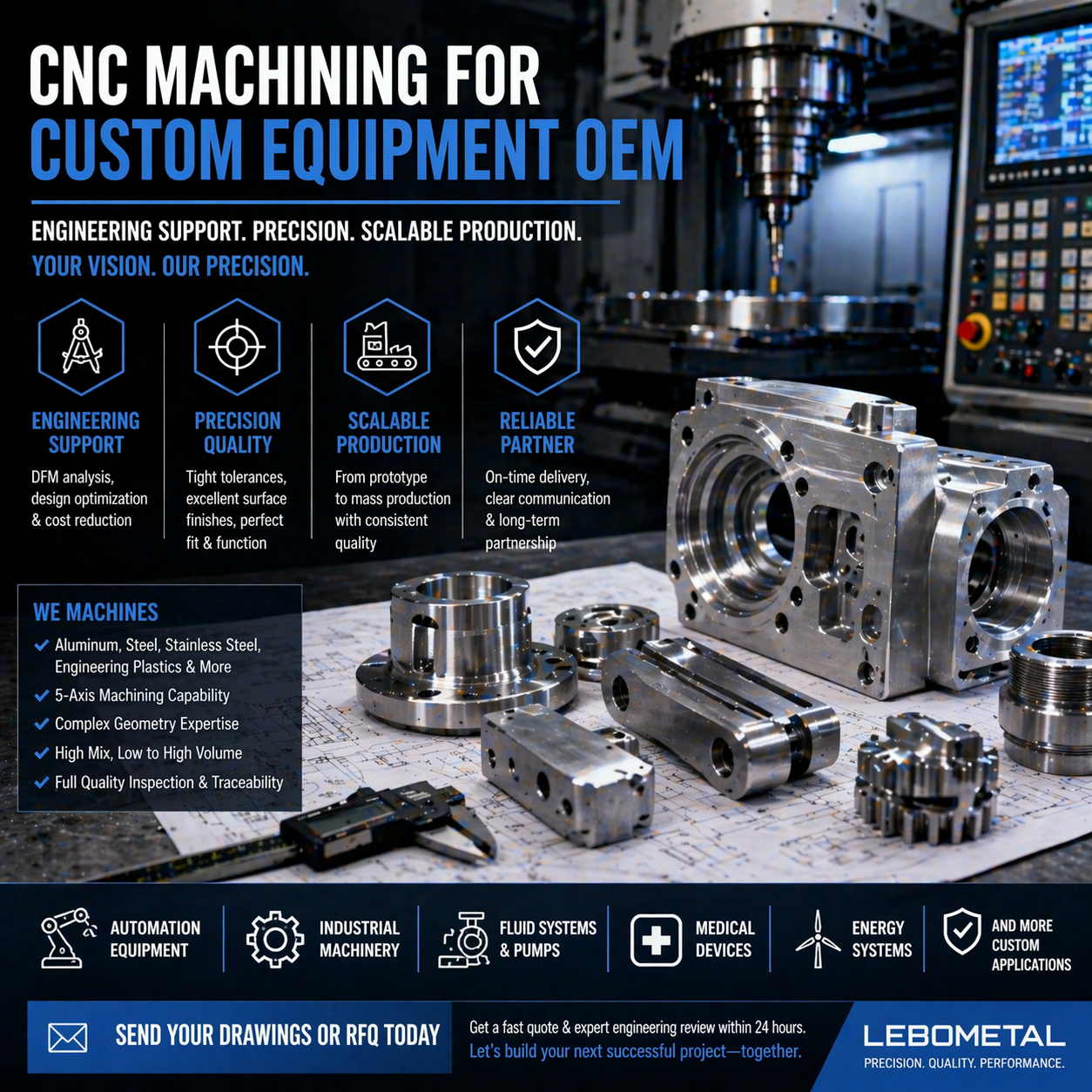
In the competitive landscape of original equipment manufacturing (OEM), a design is only as good as its execution. For OEM manufacturers, automation integrators, and equipment builders, the transition from a CAD model to a high-performance machine is fraught with risk. A single misunderstood tolerance, a poor material choice, or a supplier’s inability to scale can lead to project delays, cost overruns, and compromised market reputation.
Sourcing CNC Machining for Custom Equipment OEM from a reliable OEM CNC machining supplier is no longer a simple procurement of parts. It is a strategic partnership. In 2026, where equipment is becoming more specialized and production cycles are shortening, OEM buyers need more than a vendor; they need a CNC machining partner for OEM that provides robust engineering support, micron-level precision, and a production roadmap that scales from the first prototype to global rollout.
This comprehensive guide explores how high-tier contract CNC machining services de-risk the OEM lifecycle and ensure that custom equipment performs reliably in the field—cycle after cycle.
1. The OEM Challenge: Beyond Standard Components
Standard, off-the-shelf components have their place, but they rarely drive innovation. For builders of custom industrial machinery, “close enough” is often a recipe for systemic failure.
The Limitations of Standard Parts
Relying on standard components forces engineers to design around the parts rather than optimizing the machine for its intended function. This leads to:
Excessive Weight and Footprint: Using oversized standard brackets or housings because a custom one wasn’t available.
Performance Bottlenecks: Sub-optimal fluid flow or mechanical torque because the part wasn’t tailored to the specific application.
Increased Assembly Time: Standard parts often require manual “tweaking” or shimming to fit into a custom assembly, driving up labor costs.
The Advantage of Custom Design
By partnering with a specialized custom equipment CNC manufacturer, OEM engineers are free to optimize for performance, weight, and durability. Custom-machined parts allow for integrated features—such as internal cooling channels or complex mounting geometries—that reduce the overall part count and simplify the final assembly.
2. Strategic Engineering Support: Design for Manufacturability (DFM)
The most expensive mistakes in OEM projects are made on the drawing board. A high-value OEM CNC machining supplier provides critical “Design for Manufacturability” (DFM) feedback before the first chip is cut.
Cost Optimization Through DFM
DFM is the process of reviewing a design to make it easier, faster, and cheaper to produce without sacrificing functionality.
Tooling Access: Ensuring that the CNC tools can reach all features in a single setup, which significantly reduces labor costs.
Tolerance Realism: Identifying dimensions that are “over-toleranced.” If a surface doesn’t need to be 0.005 mm, loosening it to 0.05 mm can cut the unit cost by 30%.
Standardizing Radii: Recommending corner radii that match standard end-mill sizes to avoid slow, specialized tooling paths.
Shortening the Development Cycle
When a CNC machining partner for OEM provides proactive engineering support, they identify potential “fail points”—such as thin wall sections or stress-concentration zones—early. This prevents the “prototype-fail-redesign” loop, getting the custom equipment to market significantly faster.
3. Types of Custom OEM Equipment Supported
Industrial equipment is rarely a single component; it is an assembly of interdependent parts. A qualified custom equipment CNC manufacturer must understand the diverse requirements of different sectors.
Automation Equipment: High-speed pick-and-place systems, robotic cells, and conveyor assemblies require lightweight, high-strength aluminum parts.
Industrial Machinery: Heavy-duty frames, gearboxes, and structural mounts where rigidity and fatigue resistance are paramount.
Fluid and Pressure Systems: Valve bodies, manifolds, and pump housings requiring absolute sealing integrity and corrosion resistance.
Mechanical Assemblies: Complex multi-part systems where the “fit and finish” determine the final user experience.
4. High-Performance Materials for Custom OEM Solutions
In custom equipment, material selection is driven by the operating environment. A reliable provider of contract CNC machining services must be an expert in the metallurgy of both common and “exotic” alloys.
| Material Category | Typical Application | Key Benefit |
| Aluminum Alloys (6061-T6, 7075) | Automation frames, EOAT, lightweight housings | High strength-to-weight ratio, excellent thermal conductivity. |
| Stainless Steel (304, 316L, 17-4 PH) | Fluid systems, food-grade equipment, medical builds | Corrosion resistance and high tensile strength. |
| Carbon & Alloy Steels (1045, 4140) | High-torque shafts, structural mounts, gears | Exceptional durability and response to heat treatment. |
| Engineering Plastics (PEEK, Delrin) | Wear strips, electrical insulators, chemically inert parts | Low friction, lightweight, and non-conductive. |
Application-Based Recommendations
A strategic partner doesn’t just cut the material you specify; they ask why you specified it. They might suggest 316L stainless steel over 304 for a maritime application or suggest a stress-relieved 6061-T651 plate to prevent warping in a large-scale precision base.
5. Precision, Repeatability, and the “Assembly Fit”
For OEM equipment builders, the primary concern is “Tolerance Stack-up.” When you assemble 50 custom parts, the minor errors in each part can add up, leading to a machine that binds, leaks, or vibrates.
Managing Tolerance Stack-up
High-tier contract CNC machining services focus on geometric truth. This means ensuring that bores are not just the right size, but also perfectly concentric and perpendicular to the mounting faces.
Linear Tolerances: Regularly achieving 0.01 mm for critical mating parts.
Geometric Dimensioning and Tolerancing (GD&T): Utilizing 5-axis machining to maintain complex relationships between features in a single setup.
Surface Finish Requirements
The surface finish (Ra) of a part often determines its longevity.
Sealing Surfaces: Requiring Ra 0.4 to 0.8 for leak-free fluid systems.
Bearing Seats: Mirror-like finishes to reduce friction and heat generation.
Aesthetic Finishes: Consistent bead blasting or anodizing for equipment that needs to look as professional as it performs.
6. Production Capability: From “One-Off” to “Rollout”
Custom OEM projects typically follow a specific trajectory. A supplier must be flexible enough to handle each stage of the product lifecycle.
Phase 1: Rapid Prototyping
At the start, you need parts “yesterday.” You need a partner who can prioritize a “one-off” prototype to prove the concept, providing the same material integrity as a production part.
Phase 2: Small-Batch Bridge Production
Once the design is verified, you may need 10 to 50 sets for a pilot rollout. This requires production flexibility—the ability to run small batches without the massive overhead of high-volume setup fees.
Phase 3: Mass Production and Scalability
When the design is finalized, your custom equipment CNC manufacturer must be able to scale. This means having the machine capacity (multi-spindle, automated cells) to produce 1,000+ units with the exact same consistency as the first prototype.
7. Quality Control and Technical Documentation
In the B2B OEM world, the part is only half of the deliverable. The other half is the Data Book. Reliability is built on a foundation of verified quality.
Material Traceability (MTC 3.1): Proof that the aluminum or steel meets the chemical and physical specifications of the mill.
CMM Dimensional Inspection: Coordinate Measuring Machine reports that provide a digital footprint of every critical dimension.
Process Control: Ensuring that the same tool paths and QC checks are used for every batch, preventing “quality drift” over time.
Final Functional Verification: For complex assemblies, a supplier may perform “test-fits” to ensure that mating components interface correctly before shipping.
8. Case Study: Solving the “Assembly Bottleneck”
The Problem: An OEM manufacturer of high-speed sorting equipment was experiencing recurring delays during final assembly. The motor mounts and the drive housings, sourced from a low-cost vendor, required significant manual shimming to achieve the necessary alignment. This added 4 hours of labor to every machine build.
The Solution: A specialized OEM CNC machining supplier took over the project. They performed a DFM review and identified that the mounting holes and the bearing bore were being machined in two separate setups, leading to a perpendicularity error. By switching to a single-setup 5-axis strategy, they eliminated the alignment error.
The Result: * Assembly Time: Reduced from 4 hours of shimming to a 15-minute “bolt-on” process.
Total Build Cost: Decreased by 12% despite a slightly higher part price.
Machine Reliability: Field failures due to vibration dropped by 30%.
9. What OEM Buyers Should Prioritize
When selecting a CNC machining partner for OEM for custom equipment projects, OEM buyers should focus on:
Engineering support, not just machining execution.
Ability to scale from prototype to production seamlessly.
Consistent dimensional accuracy across batches to avoid assembly issues.
Clear communication and fast response times to keep project timelines on track.
The right supplier is not just a vendor—it is a long-term engineering partner that adds value to your design.
10. How to Choose a Strategic Partner for OEM Projects
To avoid the “lowest-bidder trap,” evaluate potential contract CNC machining services on these four pillars:
Engineering Depth: Do they ask smart questions about your design, or do they just “cut to the print”?
Material Authority: Do they provide verified MTCs and have experience with your specific industrial alloy?
Production Flexibility: Can they handle your “emergency prototypes” as well as your “mass production” rollouts?
Technical Transparency: Do you have direct access to the engineers who are actually managing your project?
11. Conclusion: Precision as a Competitive Advantage
In the world of custom equipment OEM, the hardware is the physical manifestation of your brand’s engineering brilliance. Inconsistent parts lead to inconsistent performance. By prioritizing CNC Machining for Custom Equipment OEM that emphasizes engineering support and scalable production, OEM manufacturers protect their margins and their reputation.
Reliability is not an accident; it is the result of choosing a partner that understands the stakes of custom equipment building.
12. Build Your Custom Equipment with Confidence
If you are looking for contract CNC machining services that prioritize engineering support, precision, and scalability, you need a CNC machining partner for OEM that understands the OEM lifecycle.
Send your custom equipment drawings or RFQ today.
→ Get a full DFM review + cost optimization report within 24 hours
→ Receive material and tolerance recommendations from experienced engineers
→ Ensure seamless transition from prototype to mass production
Build your custom equipment with a custom equipment CNC manufacturer you can rely on. Let’s turn your drawings into production-ready reality—accurately, efficiently, and at scale.
📩 Contact Sherry at Lebometal.com today.
→ Receive a comprehensive Technical Review and Quotation within 24 hours.
Master your manufacturing timeline. Secure your equipment’s performance with our OEM CNC machining solutions.