
CNC Machined Parts for Export Projects: Quality, Documentation, and Reliable Global Delivery
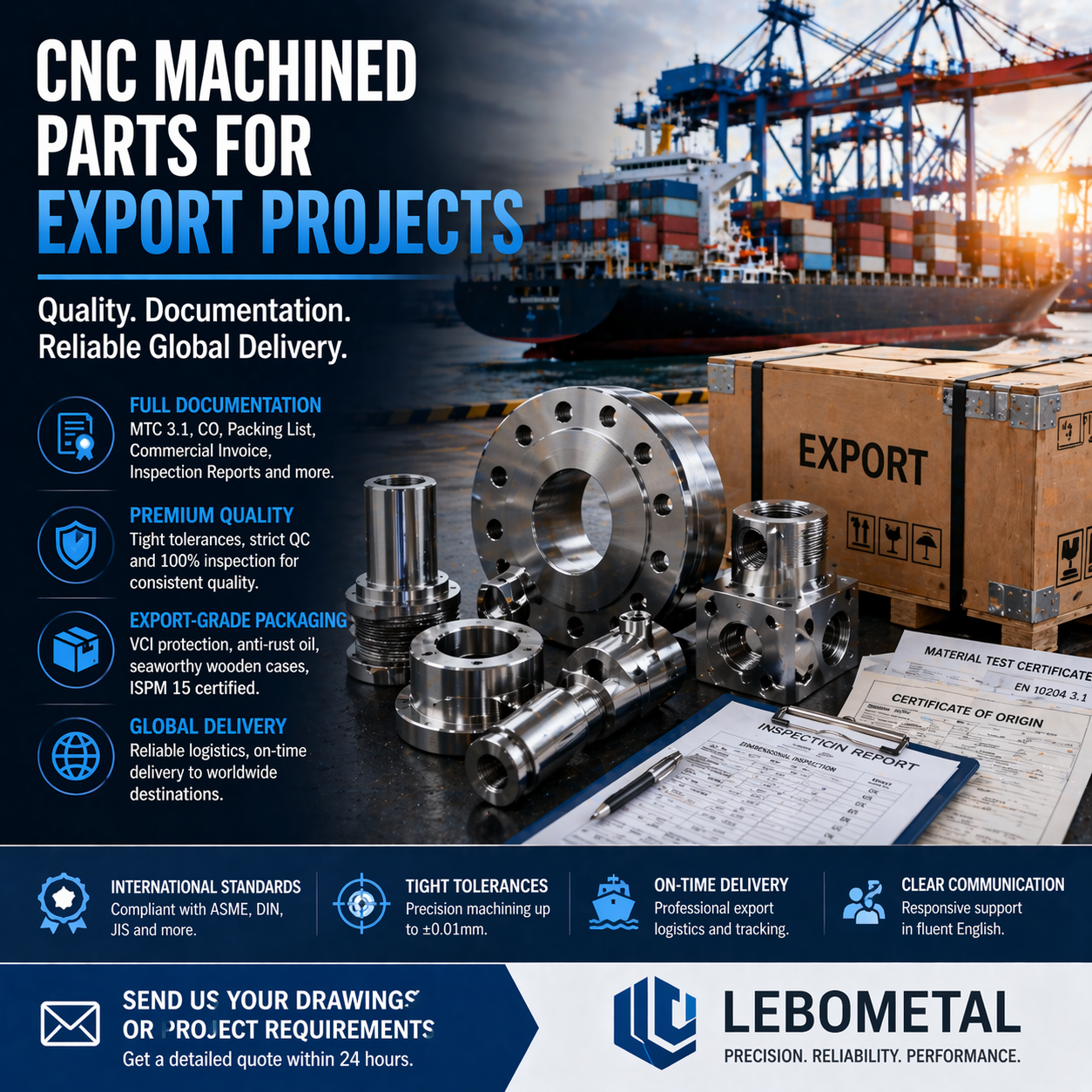
In international projects, the biggest risk is not price—it is failure. A missing certificate, a delayed shipment, or a small machining error can stop a production line, delay project timelines, and create significant financial losses. Unlike OEM machining solutions that focus primarily on engineering and production capability, export projects require strict control over documentation, logistics, and international delivery.
For overseas buyers, CNC Machined Parts for Export Projects are about more than just the metal; they are about the reliability of the supply chain. High-quality parts are worthless if they arrive rusted, delayed, or without the necessary certifications to clear customs. This guide provides a comprehensive analysis of how a professional CNC machining export supplier de-risks your project through precision manufacturing and rigorous documentation.
2. The Real Challenges of International CNC Sourcing
Sourcing CNC parts for international projects involves navigating a complex landscape of technical and logistical hurdles. Distance introduces a layer of risk that domestic sourcing does not have.
The Cost of Documentation Failure
In international trade, the paperwork is the “passport” for your parts. Without a Material Test Certificate (MTC 3.1) or a Certificate of Origin (CO), parts can be seized by customs or rejected by site engineers. This leads to thousands of dollars in storage fees and project penalties.
The Risk of Shipping Damage
A part that leaves the factory in perfect condition can arrive at an overseas port unusable. Salt air, high humidity, and rough handling during transshipment are constant threats. A supplier that doesn’t understand “Export Grade” protection is a liability to your project.
The Need for Batch Consistency
For large-scale infrastructure or industrial orders, such as a shipment of 3,000 sets of bolts or flanges, consistency is mandatory. If the first 500 parts fit but the next 500 deviate by 0.05 mm, your assembly line stops.
3. Key Requirements for Export-Grade CNC Parts
To serve as a reliable CNC supplier for overseas buyers, a factory must align its processes with international standards and the physical realities of global transit.
Compliance with International Standards
Whether your project follows ASME (US), EN (Europe), or JIS (Japan) standards, the supplier must have the technical depth to interpret these specifications correctly. This includes:
Thread Designations: Understanding the nuances of UNC vs. UN threads for heavy-duty fasteners.
Material Equivalencies: Correctly identifying grades like ASTM A105 vs. S235JR.
Tolerance Classes: Adhering to ISO 2768 or specific project-defined limits.
Proper Packaging and Surface Protection
For export projects, we apply a multi-layer protection strategy:
VCI (Vapor Corrosion Inhibitor) bags: To prevent rust during 30–60 days of sea freight.
Anti-rust oil: A specialized thin layer that protects the surface without interfering with assembly.
ISPM 15 Wooden Cases: Heat-treated and fumigated cases to meet international biological safety standards.
4. Documentation: The Foundation of International Projects
In the world of CNC machining with full documentation, the paperwork is as important as the part. For project managers, the “Manufacturing Data Book” is a mandatory deliverable.
Material Test Certificate (MTC 3.1)
This is the most critical document. It proves the chemical composition and mechanical properties of the raw material. We provide 100% heat-number traceability, linking every part back to its original mill certificate.
Certificate of Origin (CO)
The CO is essential for customs clearance and for obtaining preferential duty rates under free trade agreements. We ensure the paperwork is accurate and ready before the vessel departs.
Detailed Inspection Reports
Every export shipment includes a dimensional report verified by our QC team:
Measurement Data: Actual vs. Nominal values for all critical dimensions.
Surface Roughness: Verification of Ra values (e.g., Ra 0.8 for sealing faces).
Hardness Testing: To prove compliance with heat-treatment specifications.
5. Quality Control for Overseas Peace of Mind
How do you trust a part you haven’t touched? We use a “Zero-Defect” protocol designed for overseas buyers.
Pre-Shipment Inspection (PSI)
We welcome third-party inspectors (such as SGS or BV) or provide a comprehensive internal PSI report. This allows you to “sign off” on the quality before the goods leave the factory floor.
Visual and Surface Integrity
For export parts, aesthetics matter. We inspect for burrs, scratches, and machining marks that could compromise sealing surfaces. For parts like valve bodies, we maintain tolerances within 0.01 mm to 0.02 mm to ensure perfect site assembly.
6. Logistics and Global Delivery Capability
A professional CNC machining export supplier must be an expert in international shipping coordination and Incoterms.
Lead Time Control: We manage production with a “Shipping-First” mindset. A two-week delay in production can lead to a missed vessel, adding a month to the total lead time.
Export Packaging Standards: We use reinforced wooden crates and internal bracing for heavy-duty components like rolling mill shafts or large-diameter flanges.
Shipping Coordination: Whether you prefer FOB (Free on Board), CIF (Cost, Insurance, and Freight), or DAP (Delivered at Place), we handle the coordination to ensure a smooth handoff.
7. Case Study: High-Volume Export Project Success
The Project: An export order for an industrial project in South America involving over 3,000 sets of CNC machined stud bolts and flanges with a total value of approximately $58,000.
The Challenge: The client required strict adherence to ASTM A193 B7 standards for threads and ASME B16.5 for flanges. Full material traceability was a mandatory requirement for the final site audit.
Our Solution:
Technical Clarification: We identified a potential thread mismatch in the initial RFQ and confirmed the requirement for 7-UNC threads for specific 1-1/8 inch bolts before production.
Documentation Package: We prepared a comprehensive data book including MTC 3.1, CO, and heat-number tracking for every batch.
Seaworthy Logistics: Parts were treated with VCI anti-rust protection and packed in ISPM-15 compliant wooden cases for the long sea voyage.
The Result: The goods arrived at the project site with zero rust and 100% dimensional compliance. The client cleared customs without a single documentation query.
8. What Makes a Reliable CNC Export Partner
A professional CNC machining export supplier provides more than parts; they provide risk control:
Consistent quality across large batches (1st part = 3,000th part).
Complete and accurate documentation that clears customs on the first try.
Export-grade packaging that survives 60 days of humidity and salt air.
Stable delivery timelines to prevent project delays.
Clear and responsive communication in fluent technical English.
This combination ensures that your project runs smoothly from our factory to your final installation site.
9. How to Choose a CNC Export Supplier
When evaluating a CNC supplier for overseas buyers, ask these three questions:
Have they shipped to my region before? They should understand your local customs requirements.
Can they provide a sample MTC 3.1 and packing list? Their documentation should be as precise as their machining.
How do they handle anti-rust protection? VCI bags and anti-rust oil are mandatory for sea freight.
10. Conclusion: Your Partner in Global Infrastructure
In the world of international procurement, precision is only half the battle. The other half is the professional management of documentation and logistics. CNC Machined Parts for Export Projects require a partner who understands that “quality” includes the part, the paper, and the delivery.
At Lebometal, we specialize in being the technical and logistical bridge for overseas buyers. We understand that your project’s success depends on the stability and reliability of our components.
11. Start Your Export Project with Confidence
If you are sourcing CNC machined parts for export projects, reliability is critical—from production to delivery. At Lebometal, we help overseas buyers eliminate risks, ensure documentation compliance, and deliver precision components worldwide.
At Lebometal, we provide:
Technical Risk Assessment: We identify design ambiguities before they become export mistakes.
Complete Documentation: MTC 3.1, CO, and detailed inspection reports with every shipment.
Seaworthy Protection: VCI packaging and reinforced wooden cases for global transit.
Responsive Communication: Expert English-language support for international contractors.
Stop worrying about your overseas supply chain. Start scaling your projects.
📩 Send us your drawings, specifications, or RFQ today.
→ Receive a detailed engineering review and export quotation within 24 hours.
Master your manufacturing timeline. Secure your global performance with Lebometal.
Let’s make your international project smooth, predictable, and successful.