
CNC Parts for Construction Equipment: Complete Guide for Industrial Buyers
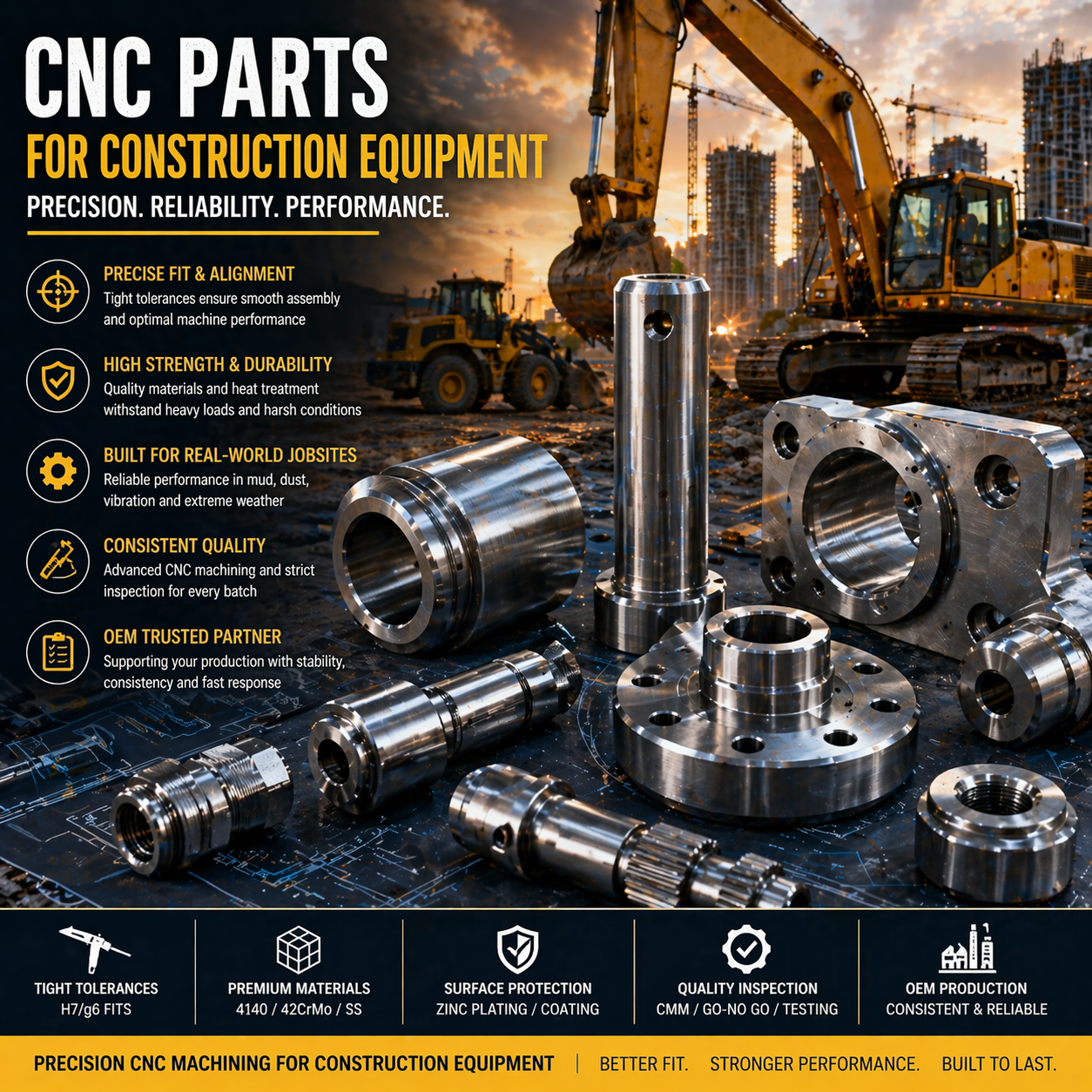
In the construction industry, time is the most expensive commodity. Whether it is a high-rise development in a city center or a massive infrastructure project in a remote region, every hour of equipment downtime is a direct hit to the bottom line. On a construction site, one misaligned component can stop an entire project. Construction projects live and die by the reliability of their machinery.
For an OEM (Original Equipment Manufacturer) buyer or a procurement manager, the challenge is not just finding a part that fits. It is about finding a part that maintains its structural integrity through thousands of hours of repetitive stress in real-world jobsite conditions. High-quality CNC parts for construction equipment must ensure perfect fit and alignment. Rain, mud, extreme heat, and heavy dynamic loads are the baseline, not the exception.
High-quality CNC parts for construction equipment are the difference between a machine that finishes the project and one that requires a mid-site emergency repair. While the frame of a bulldozer or a crane might be made of heavy castings or weldments, the precision-machined joints, hydraulic interfaces, and structural pins are what allow the machine to move with accuracy and power.
2. Why CNC Parts are Critical in Construction Equipment
Construction machinery is a paradox of brute force and delicate precision. A modern excavator must be able to lift several tons of earth while maintaining the control to dig within a few centimeters of a buried utility line. This balance is only possible through high-precision manufacturing.
Structural Load Requirements
Every pivot point, mounting bracket, and hydraulic manifold in a piece of construction equipment is a load-path. These parts must handle massive static loads when the machine is still and even larger dynamic loads when it is in motion. CNC machining provides the consistent internal grain structure and dimensional accuracy required to handle these stresses without cracking.
Continuous Operation in Field Conditions
Unlike a factory machine that operates in a controlled environment, construction equipment is exposed to the elements 24/7. Components must be machined to tolerances that allow for thermal expansion and contraction without seizing. Precision CNC components ensure that even after months in the mud, a joint remains tight and an assembly remains aligned.
Need for Precise Assembly and Alignment
On an OEM assembly line, speed is critical. If a batch of pivot pins or hydraulic connectors is even slightly out of spec, the entire line stops. CNC machining ensures that every part in a batch of 5,000 is identical. This “plug-and-play” reliability is essential for maintaining production schedules and ensuring that replacement parts in the field fit perfectly every time.
Section Summary: In construction applications, CNC machining is the hidden architecture of heavy equipment stability; it ensures that massive structural components work together with clockwork precision.
3. Common CNC Parts in Construction Machinery
To manage a supply chain effectively, buyers must recognize the functional roles of different CNC parts for construction equipment. Each category has unique requirements for fit and structural performance.
Hydraulic Components: Manifold blocks, valve bodies, and piston ends require extreme internal precision. Even a microscopic burr can lead to seal failure, paralyzing the machine’s movement.
Flanges and Connectors: Used to connect hydraulic lines and structural booms. These require flat, smooth mating surfaces and perfectly aligned bolt patterns to ensure a leak-free connection under vibration.
Shafts and Pins: Pivot pins and drive shafts are the most common machined parts. They require high-precision ground finishes and tight tolerances (often in the microns) to ensure a perfect fit with bushings.
Housings and Brackets: Provide the structural “anchor” for rotating equipment. Misalignment of even 0.5mm can cause harmonic vibrations that lead to engine or transmission failure.
Joint Components: Articulated joints, found in wheel loaders or graders, rely on machined components for smooth steering and oscillation.
Section Summary: Reliability in construction depends on the microscopic accuracy of these joint and interface points; if the CNC parts for construction equipment fail here, the whole system fails.
4. Materials Used in Construction CNC Parts
Choosing the right material is a balance of cost, weight, and structural performance.
Carbon Steel (1045 / 1020)
Carbon steel is the workhorse for structural parts that require strength but are not subject to extreme wear. It is cost-effective and machines well, making it ideal for large brackets, base plates, and simple housings.
Alloy Steel (4140 / 42CrMo)
When a part must handle high loads and fatigue, alloy steel is the industry standard. 4140 provides excellent toughness and can be heat-treated to high strength levels. It is the go-to material for pivot pins and high-stress hydraulic ends.
Stainless Steel
Used for sensors, specialized connectors, and equipment operating in highly corrosive environments, such as coastal infrastructure projects or wastewater treatment facility construction.
Section Summary: Material selection is a balance between initial strength and long-term fatigue resistance; selecting a Tier-1 industrial CNC supplier ensures the material’s DNA matches the spec.
5. Tolerance & Assembly Fit Requirements
In construction equipment, “fit” is everything. High-quality CNC parts for construction equipment must maintain specific clearances to allow for lubrication while preventing “pounding.”
Importance of Alignment
Construction booms and arms are often several meters long. A 0.1mm misalignment at the base pivot can translate into a several-centimeter error at the bucket. Precision CNC machining ensures that the centerlines of bores and shafts are perfectly aligned.
Shaft and Hole Tolerance (Fits)
Most construction joints use specific “fits” like H7/g6.
H7 (Hole): Provides a precise internal diameter.
g6 (Shaft): Provides a clearance that allows for a thin film of grease.
Impact of Misalignment
Misalignment creates “point loading.” Instead of a load being spread across the entire surface of a bearing, it is concentrated on one edge, leading to rapid metal fatigue and catastrophic failure of the joint.
Section Summary: In construction machinery, precision fit directly determines equipment stability and lifespan; even a minor deviation can lead to rapid mechanical failure.
6. Structural Strength & Load Bearing
Construction parts are subject to “Cyclic Loading.” They are stressed and released tens of thousands of times over the life of the machine.
Static vs. Dynamic Load
Static load is the weight while sitting still; dynamic load is the “shock” force when a bucket hits a pile of gravel. CNC machined parts must handle these peak dynamic loads without permanent deformation.
Fatigue Under Repeated Motion
Tool marks or sharp corners on a machined part act as “stress risers” where cracks begin. High-quality CNC machining uses “radius transitions” and smooth surface finishes to maximize the fatigue life of the part.
Section Summary: Structural integrity is maintained only when machining eliminates the microscopic stress risers that lead to premature fatigue.
7. Surface Treatment & Corrosion Protection
Construction equipment spends its life in rain, snow, and mud.
Galvanizing and Zinc Plating: Provides a sacrificial layer against rust for fasteners and small connectors.
Specialized Coatings: Paint and powder coatings protect large weldments. The machining process must account for “coating allowances” to ensure parts still fit after being painted.
Outdoor Exposure: Journal surfaces are often protected with rust-preventative waxes (like Tectyl) for shipping, ensuring they arrive at the assembly plant in pristine condition.
Section Summary: Effective surface treatments turn a precision part into a durable, field-ready component that survives years of outdoor exposure.
8. Quality Control & Inspection
In the B2B construction sector, a supplier’s Quality Control (QC) lab is more important than their machine list.
Dimensional Inspection: Using CMMs (Coordinate Measuring Machines) to verify complex geometric tolerances like perpendicularity and concentricity.
Assembly Fit Verification: Using “Go / No-Go” gauges to simulate mating parts and ensure smooth assembly on the OEM line.
Functional Testing: Pressure testing for hydraulic manifolds to ensure no internal leaks or material porosity.
Section Summary: Quality control in construction is about simulating assembly reality and verifying structural dimensions before the parts ever leave the shop.
9. Challenges in Machining Construction Parts
Construction parts present unique challenges due to their size and manufacturing complexity.
Large-Size Components
Machining long boom sections requires large-scale CNC mills and exceptional thermal management to maintain precision over several meters.
Production Consistency
Maintaining identical quality across thousands of parts in a multi-year OEM contract requires automated tool-wear monitoring and stable production processes.
Welding + Machining Integration
Many parts are “Weldments”—welded pieces that are then machined. This requires specialized knowledge to manage the internal stresses introduced by welding, often requiring “stress-relieving” before the final precision cuts.
Section Summary: Managing thermal distortion and weldment stress is what separates high-end industrial CNC suppliers from standard job shops.
10. Supplier Selection for Construction CNC Parts
Choosing a supplier for CNC parts for construction equipment is a strategic decision that impacts the brand reputation of the OEM.
Production Consistency: Does the supplier have the systems to ensure the 1,000th part is identical to the 1st?
Tolerance Control: Does the shop understand the engineering behind H7/g6 fits and GD&T?
OEM Support: Can the supplier scale production up or down based on seasonal market demands?
Section Summary: A strategic supplier provides more than just units; they provide production capacity and a technical defense for your assembly line.
11. Common Risks for Buyers
Procurement in the construction sector is about de-risking the assembly line and the field service department.
Poor Fit: Parts that won’t assemble because the supplier didn’t understand the mating interface.
Tolerance Deviation: Pins that are 0.02mm too large, requiring they be hammered into bushings, which destroys grease seals.
Structural Weakness: Improper material grade or poorly controlled heat-treatment leading to a boom failure.
Inconsistent Batch Quality: Lot-to-lot variance that leads to massive rework costs at the assembly plant.
Section Summary: Most industrial construction risks are rooted in batch inconsistency and improper interpretation of mating tolerances.
12. Case Scenario: The Cost of a 0.1mm Error
The Problem: A manufacturer sourced a new batch of boom pivot pins from a supplier that was 15% cheaper.
The Failure: The new pins were within the linear tolerance but had an “ovality” (out-of-round) error of 0.08mm. They fit the assembly, but were only making contact at two points inside the bushing.
The Impact: Within 300 hours of field operation, the grease film broke down due to “point loading.” The pins seized, and the friction was so high that it cracked the mounting ears on the excavator boom.
The Cost:
Warranty Recall: 20 machines.
Field Service: $3,000 per machine for on-site welding.
Total Loss: Over $250,000—all to save $10 per pin.
The Lesson: Precision in construction equipment is the structural insurance policy for the machine.
13. Buyer Checklist: De-Risk Your Construction Project
[ ] Material: Verified carbon or alloy steel (e.g., 4140) with MTC required?
[ ] Tolerance: Are H7/g6 or similar fit classes clearly marked on the drawings?
[ ] Surface Treatment: Specified coating thickness and machining allowance?
[ ] QC: Supplier confirmed CMM reports and assembly fit verification?
[ ] Weldments: Supplier explained their stress-relief process for welded parts?
14. Conclusion
In the world of construction, brute strength is nothing without mechanical coordination. CNC parts for construction equipment are the invisible joints that allow massive machines to operate safely, accurately, and reliably.
A high-quality industrial CNC supplier does more than just follow a drawing; they understand how the part will be assembled and how it will perform in the mud and the heat. By prioritizing precision, structural integrity, and production consistency, OEM buyers can ensure that their equipment remains the gold standard on every jobsite.
15. Avoid Assembly Issues Before Production Starts
Don’t let a “cheap” part jeopardize your equipment’s reliability. High-quality CNC parts for construction equipment must be built for real operating conditions. Ensure every component fits correctly on the first assembly.
Send your drawings to Lebometal today to receive:
Tolerance and fit analysis for critical joint components.
Assembly feasibility review to optimize production speed.
CNC machining capability assessment for large-scale structural parts.
Master your manufacturing timeline. Contact Lebometal.com to get parts that fit—first time, every time.