
CNC Machining Solutions for Heavy Engineering Projects: Reliability, Precision, and Large-Scale Capability
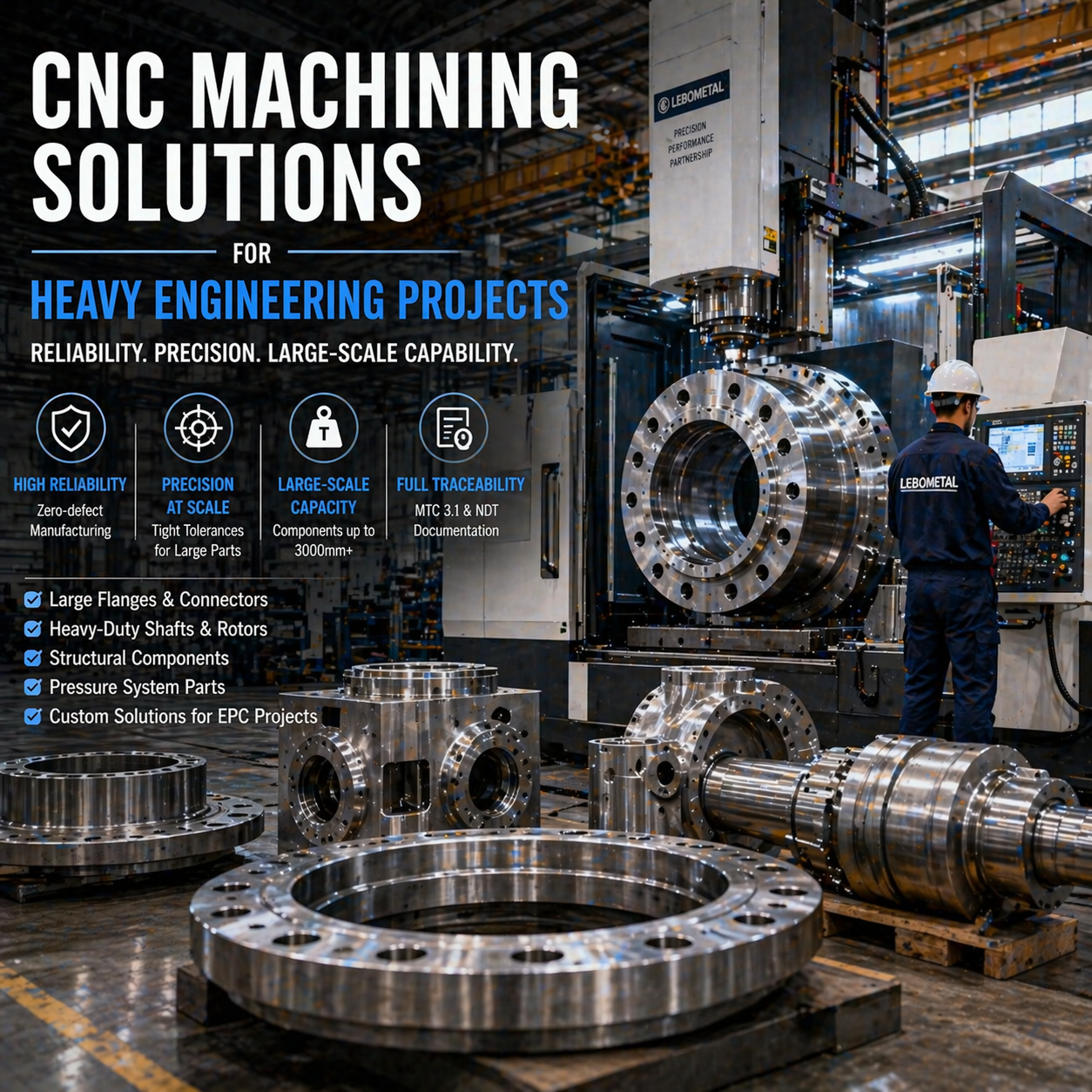
In heavy engineering projects, failure is not an option—and delays are not acceptable. A single non-conforming component can stop an entire EPC (Engineering, Procurement, and Construction) project, triggering contractual penalties, logistical disruptions, and costly rework. That’s why CNC Machining Solutions for Heavy Engineering Projects must deliver not only precision, but proven reliability and large-scale execution capability.
In the landscape of global infrastructure, the components are massive, the risks are high, and the environments are hostile. Whether you are managing the construction of an offshore oil platform, a high-pressure chemical refinery, or a large-scale power plant, the hardware you source is the foundation of your project’s performance. In heavy engineering, a “close enough” fit is just an expensive way to say “failure.” This guide provides an authoritative look at how precision machining at scale secures your project’s timeline and reputation.
2. Why CNC Machining is Critical in Heavy Engineering
In the past, heavy industry relied on manual machining and casting that often required extensive field adjustment. Today, the complexity of modern industrial systems demands “Zero-Error” delivery.
Precision as a Risk-Mitigation Tool
Precision is often associated with small parts, but in heavy engineering, Precision at Scale is the ultimate risk-mitigation tool. Achieving a tolerance of +/- 0.05 mm on a part that weighs five tons is a specialized feat. This accuracy ensures:
Sealing Integrity: High-pressure fluids and gases are contained without leaks in multi-mile piping networks.
Assembly Velocity: Components “drop in” at the project site, eliminating thousands of hours of expensive field labor and shimming.
Structural Safety: Exact geometric alignment ensures that multi-directional loads are distributed as the engineers intended, preventing localized fatigue.
Long-Term Operational Reliability
Heavy engineering components are expected to last for decades. CNC machining ensures that the structural integrity of the part is not compromised by residual stresses or micro-cracks during manufacturing. A reliably machined component is the best insurance policy against the “catastrophic downtime” that keeps project managers awake at night.
3. Key CNC Components in Heavy Engineering
Heavy industrial projects require a specific class of high-strength hardware. We specialize in the heavy engineering CNC components that handle the most demanding loads.
Large-Diameter Flanges and Connectors
Whether they are built to ASME B16.5, EN 1092-1, or ISO 2531 standards, large-scale flanges (up to 2500mm and beyond) are critical interface points.
Requirement: Perfect flatness and bolt-hole alignment to ensure a gas-tight seal in high-pressure systems.
Scenario: Connecting a 1200mm pipeline in a water treatment plant where even a 1mm gap leads to a system-wide failure.
Structural Nodes and Heavy Connectors
In offshore platforms or bridge construction, structural nodes are the meeting points of multi-ton beams.
Requirement: 5-axis machining capability to ensure that every attachment face is geometrically linked to the project’s coordinate system.
Heavy-Duty Shafts and Rotating Parts
Mining mills, turbine rotors, and large-scale gear hubs.
Focus: Concentricity and dynamic balance. Even a minor imbalance in a massive rotating part can lead to harmonic vibrations that destroy the entire drive train.
Pressure System Components
High-pressure manifolds, valve bodies, and pump housings. These parts often require deep-hole boring and complex internal geometries to manage high-velocity fluid flow.
4. Material Selection for High-Stress Projects
In heavy engineering, the metallurgy is as important as the machining. A supplier must be an expert in the “Heavyweights” of the material world.
Carbon Steel (A105 / 1045): The standard for large-scale structural parts and flanges, offering the best strength-to-cost ratio.
Alloy Steel (4140 / 4340): Reserved for high-torque shafts and heavy gears where toughness and fatigue resistance are non-negotiable.
Stainless Steel (316L / Duplex / Super Duplex): Essential for offshore, chemical, and desalination projects where corrosion would destroy carbon steel in months.
Nickel Alloys (Inconel): Used in the “Hot Zones” of power plants where thermal stability and oxidation resistance are required.
5. Precision and Performance Requirements
Heavy engineering components are not just “big”; they are “precise.”
| Requirement | Heavy Engineering Standard | Impact on Project |
| Linear Tolerance | +/- 0.02 mm to +/- 0.05 mm | Prevents “tolerance stack-up” in massive assemblies. |
| Surface Finish | Ra 0.8 to 3.2 | Ensures seal integrity in high-pressure flanges. |
| Flatness | Within 0.05 mm over 1000 mm | Eliminates leaks in large-diameter connectors. |
| Hardness | HB/HRC verified per spec | Ensures durability in abrasive industrial environments. |
6. What Defines a Qualified CNC Supplier for Heavy Engineering Projects
A reliable CNC supplier for large-scale industrial projects must deliver:
Proven experience with large-size and high-tonnage components.
Stable machining accuracy across multi-meter parts.
Full material traceability (MTC 3.1) and NDT (Non-Destructive Testing) capability.
Ability to manage international project delivery and 500-page “Data Books.”
Consistent communication and reliable, documented lead times.
Without these capabilities, project risks increase significantly, often leading to on-site assembly failures and massive financial losses.
7. Large-Scale Capability: Handling the Tonnage
Machining a 10-ton component is not just a larger version of a small job; it is a different engineering discipline. CNC machining for heavy industry requires specialized infrastructure.
Vertical Boring Mills (VBM)
Large-diameter components like flanges and hubs are machined on VBMs. These machines can handle parts up to 3000 mm in diameter with the rigidity needed to remove massive amounts of material while maintaining micron-level precision.
Heavy-Duty Gantry Milling
For structural plates and long frames, gantry mills provide the massive work envelope needed. These machines allow us to machine all faces of a large component in a single coordinate system, ensuring geometric truth across the entire part.
Material Handling and Logistics
Heavy engineering is a logistical operation. A qualified supplier must have the overhead crane capacity and the specialized transport partnerships to move multi-ton parts safely from the spindle to the project site.
8. Technical Challenges of Scaling Up
Deformation Management: A large steel forging will actually “sag” under its own weight. We use specialized fixturing and “gravity compensation” techniques to ensure the final part is straight when installed.
Stress Relief: Large parts contain internal stresses. We implement thermal stress-relief cycles between rough and finish machining to prevent the part from “warping” after it leaves the machine.
Thermal Control: A 5-degree change in factory temperature can shift a 2000mm dimension significantly. Our facilities use climate-controlled zones for final finishing passes to ensure accuracy.
9. Quality Control: The “Manufacturing Data Book”
For an EPC contractor, the part is only half of the deliverable. The other half is the Verification Documentation.
Material Test Certificate (MTC 3.1): 100% heat-number traceability to prove the steel meets the mill spec.
Non-Destructive Testing (NDT): We offer Ultrasonic Testing (UT) to detect internal cracks in large forgings and Magnetic Particle Inspection (MPI) for surface integrity.
Dimensional Inspection Reports: Every critical-to-quality (CTQ) dimension is measured using calibrated large-scale metrology tools.
Third-Party Inspection (TPI): We regularly coordinate with inspectors from SGS, BV, or ABS to provide the final “sign-off” for international export.
10. Case Study: Solving the High-Pressure Export Challenge
The Project: An export order for a major industrial infrastructure project in South America involving 120 sets of PN-rated large-diameter flanges.
The Crisis: The client’s previous vendor was delivering flanges that were “out-of-flat” by 0.3 mm across the face. Under high-pressure site testing, the gaskets were failing, resulting in a project-wide stop-work order.
The Solution: Lebometal took over the project. We utilized our heavy-duty Vertical Boring Mills and implemented a specialized “low-stress” machining path. We achieved a flatness within 0.03 mm and provided full SGS-verified inspection reports.
The Result: Every flange passed the on-site pressure test. The project resumed, and the client avoided an estimated $150,000 in liquidated damages.
11. How to Choose a CNC Supplier for Large-Scale Projects
For heavy engineering, the “lowest bid” is usually the most expensive choice once you factor in the risk.
Does the supplier have the machines? Ask for their machine list—specifically their Vertical Boring and Large Gantry Mill capacities.
Can they handle the paperwork? Ask to see a sample “Manufacturing Data Book.”
Do they understand EPC timelines? A partner must understand that a one-week delay in a component is a one-week delay for the entire site.
12. Conclusion: Reliability is the Core of Infrastructure
The success of our global refineries, power plants, and bridges depends on the structural integrity of their massive components. CNC Machining Solutions for Heavy Engineering Projects provide the technical defense and manufacturing precision that these high-stakes environments demand.
At Lebometal, we don’t just “make parts”; we support the successful delivery of your project.
13. Secure Your Heavy Engineering Project with Confidence
If you are sourcing CNC machining solutions for heavy engineering projects, reliability and execution capability are critical to your project success. At Lebometal, we support your EPC and industrial projects with large-scale machining, full traceability, and reliable delivery.
At Lebometal, we provide:
Large-Scale Capability: Machining capacity for components up to 3000 mm and multi-ton mass.
Uncompromising Reliability: 100% Material Traceability (MTC 3.1) and NDT testing.
Expert Project Support: Documentation management and coordination for international EPC projects.
Technical Authority: DFM reviews for ASME, EN, and ISO standard compliance.
Let’s ensure your project stays on schedule—without risk or compromise.
📩 Send your large-scale RFQ or drawings to Sherry at Lebometal.com today.
→ Receive a comprehensive Technical Project Review and Quotation within 24 hours.
Master your manufacturing timeline. Secure your heavy engineering performance with Lebometal.