
Common Quality Issues in CNC Bushings and Solutions
Introduction
CNC bushings are critical components in industrial machinery, responsible for ensuring smooth motion, bearing heavy loads, and protecting expensive parts. However, when these components suffer from quality defects, they can become a primary source of equipment failure, leading to unplanned downtime and a higher Total Cost of Ownership (TCO). For industrial buyers and procurement managers, understanding the most common CNC bushing quality issues is the first step toward evaluating a supplier’s capabilities and mitigating supply chain risks. This guide provides an in-depth look at the top quality problems and the practical solutions that reliable manufacturing partners should provide.
Issue 1: Dimensional & Tolerance Errors
This is the most frequent and critical of all CNC bushing quality issues. An out-of-spec dimension means the part will not fit or function as intended.
- Causes:
- Tool Wear: Cutting tools naturally wear down during a production run, which can cause part dimensions to gradually drift out of tolerance.
- Thermal Drift: CNC machines heat up during operation, causing the machine frame to expand by a few micrometers. If not compensated for, this can lead to dimensional inaccuracies.
- Machine Rigidity: Low-quality or poorly maintained machines can have “play” or flex under cutting forces, resulting in inconsistent dimensions.
- Risks for Buyers: Improper fits (too loose or too tight), excessive vibration in the assembly, and dramatically accelerated wear on both the bushing and the mating shaft.
- Solutions from a Quality Supplier:
- High-Rigidity CNC Machines: Using modern, well-maintained equipment that minimizes deflection.
- Climate-Controlled Machining: Operating in a temperature-controlled workshop to prevent thermal drift.
- In-Process Probing & Tool Compensation: Using automated systems to measure parts during machining and adjust for tool wear in real-time.
- CMM Verification: Final inspection using a Coordinate Measuring Machine (CMM) to provide objective proof that all dimensional and tolerance errors in bushings have been eliminated.
Issue 2: Surface Finish Defects
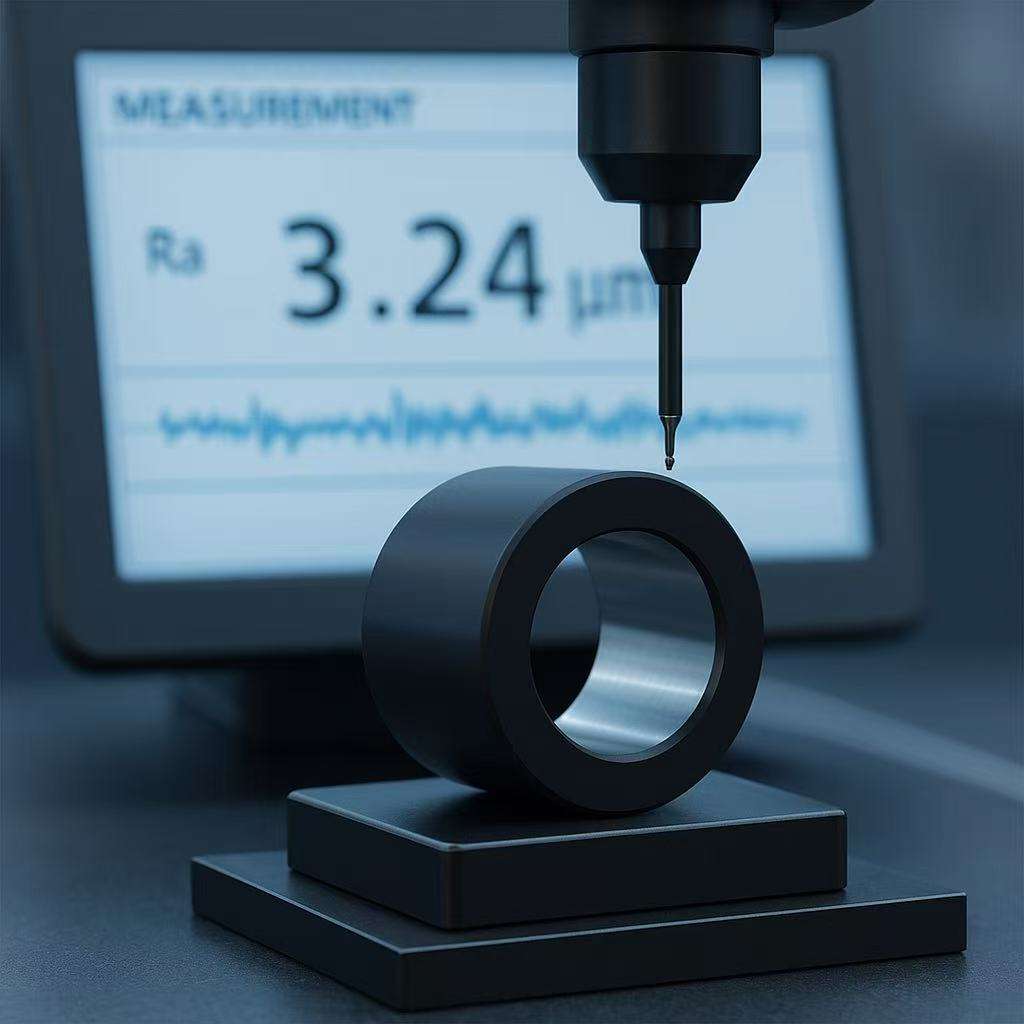
The microscopic texture of a bushing’s surface is crucial for its performance. Surface finish defects can lead to major operational problems, especially in lubricated applications.
- Common Problems:
- Roughness Outside Specification: The Ra value is higher or lower than the specified range (e.g., Ra 0.8–1.6 µm).
- Chatter Marks: Visible, wavy patterns on the surface caused by vibration during machining.
- Tool Lines: Noticeable lines or grooves left by the cutting tool.
- Impact on Performance: Bushing surface roughness problems lead to poor lubrication retention (if too smooth) or a breakdown of the oil film (if too rough). This results in faster wear, increased friction, and operational noise.
- Solutions from a Quality Supplier:
- Secondary Processes: For very fine finishes, suppliers must use secondary processes like grinding, honing, or superfinishing after the initial CNC turning.
- Process Optimization: Using the correct cutting speeds, feed rates, and tool geometries to prevent chatter.
- Profilometer Checks: Verifying the final surface finish with a calibrated surface roughness tester (profilometer) and providing the test report to the buyer.
Issue 3: Heat Treatment Distortion
Heat treatment is essential for hardening steel bushings, but the process of heating and rapidly cooling the metal can cause it to warp or change shape.
- The Problem: After quenching or carburizing, a perfectly round bushing can become slightly oval-shaped, or it may shrink or expand unpredictably. This is one of the most challenging heat treatment distortion solutions to manage.
- Consequences for Buyers: A distorted part will no longer meet its dimensional or geometric tolerances, leading to significant assembly issues.
- Solutions from a Quality Supplier:
- Leaving a Machining Allowance: A skilled manufacturer will intentionally leave a small amount of extra material on the part before sending it for heat treatment.
- Post-Heat Treatment Grinding or Hard Turning: After the part is hardened, it undergoes a final, light machining pass (grinding or hard turning) to remove the allowance and correct any distortion, bringing the final dimensions back into the specified tolerance.
Issue 4: Material & Hardness Non-Conformance
Receiving a bushing made from the wrong material grade or with incorrect hardness is a major quality failure.
- The Issues:
- Incorrect Material Grade: A supplier might substitute a cheaper, lower-grade alloy to cut costs.
- Insufficient Hardness: An improper heat treatment process can result in a part that is too soft to withstand its operational loads.
- Inconsistent Heat Treatment: Poor process control can lead to variations in hardness across a single batch.
- Risks for Buyers: Early catastrophic failure, cracking under load, and a complete loss of the component’s intended wear resistance.
- Solutions from a Quality Supplier:
- Material Test Certificates (MTC): Providing an MTC with every batch of raw material to certify its chemical composition.
- Hardness Testing: Conducting Rockwell (HRC) tests on a sample of parts from each heat treatment batch to verify they are within the specified range.
- Full Traceability: Maintaining a quality system that allows a finished part to be traced back to its raw material batch and heat treatment records.
Issue 5: Coating & Corrosion Resistance Problems
For coated bushings, the quality of the protective layer is paramount.
- The Issues:
- Uneven Plating or Insufficient Thickness: This leaves areas of the part vulnerable to corrosion.
- Poor Adhesion: The coating may flake or peel off during assembly or operation.
- Risks for Buyers: Premature corrosion and failure of the component in its service environment.
- Solutions from a Quality Supplier:
- Coating Thickness Gauges: Using digital gauges to verify that the plating meets the specified thickness.
- Salt Spray Testing: Performing standardized salt spray tests (e.g., ASTM B117) to provide objective data on the coating’s corrosion resistance.
- RoHS/REACH Compliance: Ensuring that all coating and passivation processes meet international environmental standards.
Issue 6: Packaging & Handling Damage
Even a perfect part can be ruined by poor packaging.
- The Issues: Dents, dings, and scratches caused by parts colliding during shipment. Corrosion can also occur during long sea voyages if not properly protected.
- Solutions from a Quality Supplier:
- Individual Protection: Using VCI (Vapor Corrosion Inhibitor) bags, applying anti-rust oil, and using foam separation or individual wrapping.
- Robust Export Crates: Using sturdy, ISPM 15 compliant wooden crates and reinforced pallets to prevent physical damage during transit.
Case Example
An automotive supplier was sourcing bushings for a suspension system. They were experiencing a high rate of field failures due to premature wear. An investigation revealed that their previous supplier had poor quality control for CNC bushings
They switched to a new supplier who demonstrated a more robust QC process. The new partner provided a First Article Inspection Report with a CMM layout, a surface roughness report from a profilometer, and salt spray test reports for the coating with every shipment. The result was a 70% reduction in their defect rate and a significant improvement in the component’s reliability and lifespan.
Conclusion & Buyer’s Checklist
Understanding common CNC bushing quality issues empowers buyers to ask the right questions and select suppliers who are truly committed to quality. A proactive approach to quality assurance at the sourcing stage is the most effective way to prevent costly problems. Partnering with a supplier who has mastered the solutions to these common CNC bushing quality issues ensures you receive reliable components that lower your Total Cost of Ownership.
Before approving a shipment, buyers should always demand:
- ✅ CMM reports for critical dimensions and tolerances.
- ✅ MTC and hardness reports to verify material integrity.
- ✅ Surface roughness and coating validation reports.
- ✅ Proof of robust, export-ready packaging.
Partnering with a supplier who proactively solves these issues ensures reliability and lower TCO. Contact our team today to discuss how our robust quality control processes deliver reliable, high-performance CNC bushings that reduce downtime and TCO.