
Pipe Fittings for Industrial Machinery: Design Principles and Reliability Considerations
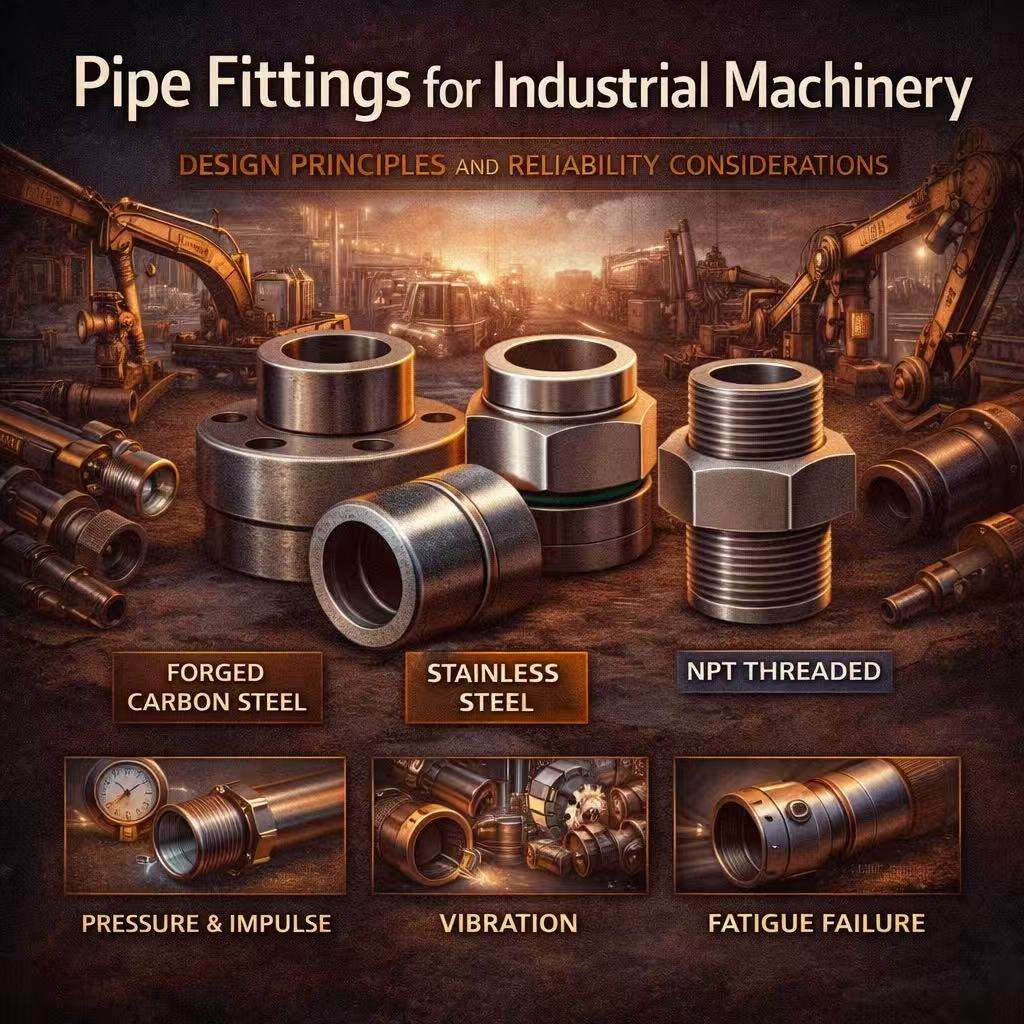
1. Introduction – Why Pipe Fittings Matter in Industrial Machinery
In the architecture of modern industrial machinery—whether injection molding units, hydraulic presses, or automated conveyor systems—pipe fittings are often viewed as secondary components. However, from a reliability engineering perspective, pipe fittings for industrial machinery are critical pressure boundary components and structural nodes.
Unlike static facility plumbing, machinery fluid systems are dynamic. A single fitting failure does not merely result in a maintenance ticket; it causes unplanned downtime, environmental contamination (oil leaks), and potential safety hazards for operators.
For OEM engineers, the selection of fittings is an exercise in risk management. The integrity of the entire machine relies on the ability of these connectors to withstand impulse loads, thermal cycling, and continuous vibration without losing sealing compression.
2. Operating Conditions in Industrial Machinery Systems
Industrial machinery subjects piping components to a unique set of stressors that differ significantly from process piping or residential plumbing.
High Pressure and Impulse Loading
Hydraulic systems in heavy machinery frequently operate at pressures ranging from 3,000 to 6,000 PSI (210–420 bar). However, the static rating is often insufficient. Rapid valve actuations create “water hammer” effects, generating transient pressure spikes (impulses) that can exceed 150% of the nominal system pressure. Fittings must be designed with adequate fatigue strength to survive millions of these cycles.
Mechanical Vibration
Pumps, electric motors, and gearboxes generate harmonic vibration. Because pipe fittings act as rigid connection points between flexible hoses and manifolds, they often become stress concentrators. If the fitting’s natural frequency aligns with the machine’s operation, resonance can lead to rapid fatigue failure at the thread roots or loosening of the connection torque.
Thermal Cycling and Space Constraints
Machinery is often designed with dense, skid-mounted layouts where airflow is limited. Continuous duty cycles generate heat, causing thermal expansion in metal components. When the machine cools, contraction occurs. This cycle puts stress on metal-to-metal seals. Furthermore, compact designs often require custom pipe fittings with tight bend radii or non-standard geometries to fit within the machine envelope.
3. Common Types of Pipe Fittings Used in Industrial Machinery
Engineers must select connection standards that balance pressure capability, leak resistance, and serviceability.
Threaded Fittings (NPT / BSPT)
Application: General utility lines, low-pressure pneumatics, and lubrication.
Engineering View: While universally available, tapered threads rely on deformation to seal. In high-vibration machinery, they are prone to spiral leak paths and can damage expensive manifold blocks if over-torqued. They are generally discouraged for high-pressure hydraulic circuits in modern designs.
O-Ring Face Seal (ORFS)
Application: High-pressure hydraulic lines in excavators, presses, and mobile equipment.
Engineering View: ORFS is increasingly the standard for OEM industrial fittings. The seal is created by compressing an elastomer against a flat face, separate from the threading torque. This provides excellent resistance to vibration and allows for “zero clearance” disassembly, meaning a component can be removed without springing the line.
Flanged Fittings (SAE Code 61/62)
Application: Large bore lines (>1 inch) and extremely high pressures.
Engineering View: Flanges decouple the holding force (bolts) from the sealing force. This allows for high-pressure containment without requiring massive torque to assemble. They are standard in heavy presses and oil & gas machinery.
Welded Fittings (Socket / Butt Weld)
Application: Permanent, high-integrity lines where leakage is zero-tolerance.
Engineering View: Welding eliminates the mechanical leak path entirely. However, it creates a permanent joint that complicates field maintenance. It is typically used for the main headers of a machine rather than replaceable actuator lines.
4. Sealing Methods and Leakage Risk
The mechanism by which a fitting prevents fluid escape is the primary determinant of its reliability.
Metal-to-Metal Sealing
Used in JIC 37° Flare and compression fittings, this method relies on coining two metal surfaces together.
Risk: It is highly sensitive to surface finish. A single scratch or tool mark on the sealing cone can create a leak path. Furthermore, repeated assembly/disassembly works-hardens the metal, reducing its ability to seal over time.
Elastomeric (O-Ring) Sealing
Used in ORFS, SAE Straight Thread, and ISO 6149.
Advantage: The seal is “pressure energized”—as system pressure rises, it pushes the O-ring tighter against the groove wall. Elastomers also absorb vibration better than metal contact.
Risk: The primary engineering challenge is “extrusion.” If the gap between metal components is too large (due to poor machining tolerances), high pressure will shred the O-ring.
5. Materials Used for Industrial Machinery Pipe Fittings
Material selection dictates the fitting’s strength and compatibility with the operating environment.
Carbon Steel
Carbon steel (e.g., 12L14, 1045) is the industry standard for hydraulic pipe fittings. It offers high yield strength and ductility, essential for withstanding pressure impulses. It requires plating (Zinc or Zinc-Nickel) for corrosion protection.
Alloy Steel
For extreme applications involving high shock loads (e.g., pile drivers or stamping presses), alloy steels like 4140 are used. These are heat-treated to maximize fatigue life and tensile strength.
Stainless Steel
In food processing, pharmaceutical, or chemical processing machinery, 316 Stainless Steel is mandatory to prevent product contamination and corrosion. Engineers must be careful not to mix stainless fittings with carbon steel ports in wet environments to avoid galvanic corrosion.
6. Why CNC Machining Improves Fitting Reliability
For industrial machinery, the method of manufacturing is as important as the material. CNC pipe fittings machined from solid bar stock offer distinct advantages over forged or cast alternatives.
Concentricity: In a single-setup CNC process, the threads and the sealing surface (cone or flat face) are machined without unclamping the part. This ensures perfect concentricity. If a thread is slightly off-axis from the seal, the nut will tighten, but the seal will be uneven, leading to leaks.
Surface Roughness ($R_a$): Sealing surfaces require specific texture ranges (typically 16–32 $\mu$in). CNC turning centers can hold these values consistently. Castings often have pitted surfaces that are difficult to seal against high-pressure gas or thin fluids.
Structural Integrity: Bar stock lacks the internal porosity often found in castings. In high-pressure applications, porosity can lead to “weeping” leaks through the body of the fitting itself.
7. Common Failure Modes in Industrial Machinery Pipe Fittings
Understanding how fittings fail allows OEM designers to engineer more robust systems.
Fatigue Cracking: Occurs at the root of the thread, usually the first engaged thread. This is caused by cyclic impulse loading or unconstrained vibration.
Thread Loosening: Vibration reduces effective thread friction, allowing preload loss. This is common in NPT fittings; lock washers or O-ring/washer combinations help mitigate this.
Seal Extrusion: Caused by excessive clearance gaps or O-rings that are too soft (low durometer) for the pressure.
Assembly Damage: Overtorquing tapered threads can crack valve blocks or pump housings, a costly failure mode often seen during assembly.
8. How OEM Engineers Select Pipe Fittings for Industrial Machinery
When specifying industrial machinery pipe fittings, use the following engineering checklist:
Pressure Profile: Does the fitting meet the peak impulse pressure, not just the working pressure?
Vibration Environment: Is the equipment mobile or stationary? High vibration dictates O-ring face seals over flares or tapered threads.
Media Compatibility: Is the hydraulic fluid compatible with the O-ring material (Buna-N vs. Viton)?
Maintenance Frequency: Will this connection be disconnected frequently? If so, metal-to-metal seals should be avoided.
Lifecycle Cost: A cheaper NPT fitting that leaks during factory acceptance testing costs far more in rework than a premium CNC-machined fitting.
9. Standard vs. Custom Pipe Fittings in Machinery Design
There is a growing trend among OEMs to utilize custom pipe fittings rather than relying solely on standard catalogs.
In complex machinery, space is at a premium. Using standard fittings often requires “stacking” adapters (e.g., a reducer + an elbow + a swivel) to connect two ports. This stack-up introduces three potential leak points and extends the assembly length, increasing the moment arm for vibration leverage.
By designing a custom CNC fitting that combines these geometries into a single component, OEMs can:
Reduce leak points by 50% or more.
Fit piping into tighter machine envelopes.
Improve assembly speed on the production line.
Control the exact material and plating specifications for extended warranties.
10. Conclusion – Pipe Fittings as System-Level Components
In the realm of industrial machinery, pipe fittings are not mere accessories; they are vital system-level components that define the machine’s reliability. A leak-free machine is perceived as a high-quality machine.
For OEM buyers and engineers, the goal is to shift the focus from “price per piece” to “reliability per cycle.” By selecting high-quality materials, prioritizing CNC pipe fittings with superior geometric tolerances, and matching the connection type to the operating environment, manufacturers can significantly reduce warranty claims and field service costs. Reliability is engineered, not accidental.