Non-Standard Pipe Fittings Solutions: Engineering Design, Manufacturing Control, and Application Scenarios
1. Introduction – Why Standard Pipe Fittings Are Often Not Enough
In the ideal world of industrial design, every fluid connection would be solved by an off-the-shelf component from a standard catalog. However, real-world engineering constraints—tight machine envelopes, complex hydraulic circuits, and extreme operating conditions—often render standard fittings inadequate.
While standards like SAE, ASME, and ISO provide the necessary baseline for interoperability, they are designed for general-purpose applications. They do not account for specific OEM constraints such as a lack of clearance for a standard elbow radius, or the need to adapt a legacy BSPP port to a modern ORFS hose end in a single component. In these scenarios, forcing a standard fitting into the design often leads to “adapter stacking,” increased leakage points, and compromised structural integrity.
Non-standard pipe fittings are not merely “special” items; for many OEMs, they are an engineering necessity. They represent a shift from designing a machine around the fittings to designing fittings that serve the machine. This article explains how non-standard pipe fittings are engineered, manufactured, and applied in real OEM hydraulic systems.
2. What Are Non-Standard Pipe Fittings?
A non-standard pipe fitting is defined as any connector that deviates from the fixed dimensions or configurations found in standard industrial catalogs (such as Parker, Eaton, or Gates standard series). These are not “off-spec” parts; rather, they are precision-engineered components designed to meet a unique set of requirements.
Common deviations that classify a fitting as non-standard include:
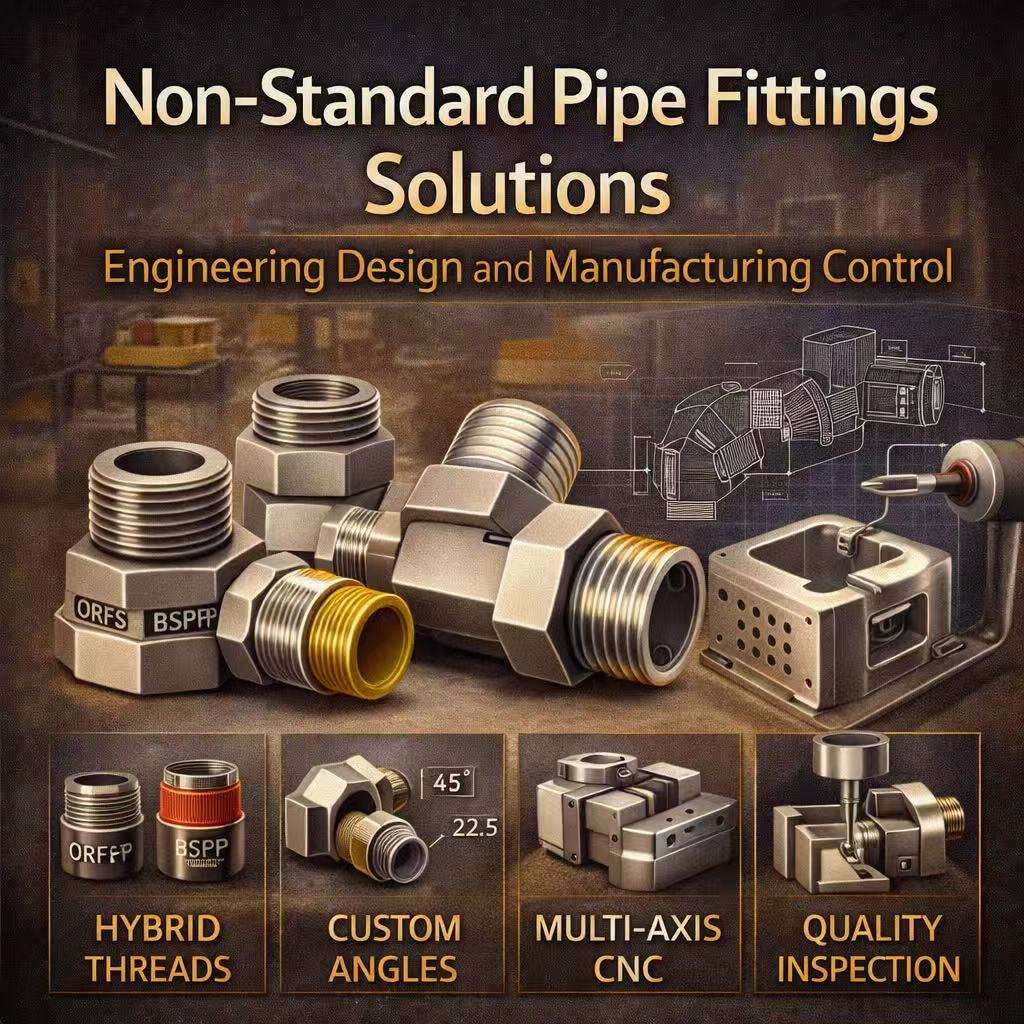
Hybrid Interfaces: A single body featuring mismatched connection standards, such as a Metric ISO 6149 male stud on one end and an NPT female port on the other, eliminating the need for an intermediate adapter.
Non-Standard Angles: Elbows bent at 45°, 22.5°, or custom compound angles to clear engine blocks or frame rails.
Asymmetric Structures: Tees or crosses with varying bore sizes or connection types on different ports to balance flow and pressure drop.
Custom Sealing Surfaces: Modifications to the sealing cone angle or O-ring groove geometry to accommodate higher pressures or specific fluid viscosities.
It is crucial to note that non-standard pipe fittings are not “non-compliant.” They must still adhere to rigorous engineering principles and material standards (such as ASTM material grades and ASME pressure ratings) to ensure safety.
3. Typical Scenarios That Require Non-Standard Pipe Fittings
The decision to move away from commodity parts is usually driven by specific systemic failures or constraints.
Space Constraints (Compact Machinery)
Modern mobile hydraulics—such as in skid steers or mini-excavators—prioritize power density. There is often zero clearance for a standard “adapter + elbow + swivel” stack-up. A custom one-piece fitting can reduce the assembly height by 50%, allowing piping to fit within tighter frame envelopes.
High Vibration and Shock Load Systems
In rock crushers or demolition shears, every threaded connection is a potential failure point. Stacking three standard adapters to make a connection introduces three separate leak paths and increases the moment arm, amplifying vibration stress. A single-piece custom fitting eliminates two-thirds of the leak paths and offers a rigid, low-profile structure resistant to vibrational loosening.
Assembly Efficiency
On a high-volume OEM assembly line, time is money. If a technician must thread three separate adapters together to connect a pump to a manifold, it introduces variability and torque errors. A custom fitting that drops directly into place reduces assembly time and minimizes the risk of cross-threading.
Global Export Compliance
OEMs exporting equipment often face the “interface mismatch” problem (e.g., a German pump with Metric ports, US-made valves with SAE ports, and a client in Asia requiring BSPP hose ends). Custom hydraulic pipe fittings act as the “universal translator,” adapting all these standards in a single, clean component.
4. Engineering Design Logic Behind Non-Standard Solutions
Designing a custom fitting requires a holistic view of the fluid system. The primary goal is usually integration.
Design Goal: Integration Instead of Adaptation
Rather than forcing standard components to work together via adapters, non-standard design seeks to integrate multiple functions into a single body. This approach reduces the total part count, eliminates potential leak paths, and simplifies the Bill of Materials (BOM).
Reducing Pressure Drop (Flow Optimization)
Standard 90° forged elbows often have sharp internal corners that create turbulence and heat. A custom CNC pipe fitting can be designed with a swept radius or optimized internal bore that matches the flow characteristics of the hydraulic fluid, minimizing pressure drop $(\Delta P)$ and improving system efficiency.
Sealing Logic Selection
When designing a custom interface, the engineer can select the best sealing method for the application rather than what is available in the bin:
Metal-to-Metal (JIC/NPT): Acceptable for static loads but poor for vibration.
O-Ring Face Seal (ORFS): Preferred for high pressure and vibration.
Bonded Seals: Used where face real estate is limited.
The design must also balance structural strength (wall thickness) with manufacturing feasibility. A design that looks perfect in CAD but cannot be machined due to tool clearance issues is a failed design.
5. Materials Used in Non-Standard Pipe Fittings
Material selection is critical because non-standard parts are often used in the most demanding areas of the machine.
Carbon Steel (12L14 vs. 1045/1215): While 12L14 is a common “free-machining” steel, it contains lead and sulfur inclusions that reduce fatigue strength. For high-pressure custom fittings, structural grades like 1045 are preferred, despite being harder to machine, because they offer superior impulse fatigue resistance.
Alloy Steel (4140): For extreme pressure applications (>6000 PSI) or shock loading, Quenched and Tempered (Q&T) alloy steel provides the necessary tensile strength.
Stainless Steel (304/316): Mandatory for corrosive environments, food processing, or marine applications.
Engineering Note: Non-standard designs often require thicker walls than standard fittings to compensate for complex geometries. Engineers must calculate the hoop stress and specify materials that provide a 4:1 safety factor against burst pressure.
6. CNC Manufacturing Challenges for Non-Standard Pipe Fittings
Producing a custom fitting is significantly more complex than churning out standard hex nipples. It requires advanced CNC pipe fittings manufacturing capabilities.
Multi-Axis CNC Machining
Standard fittings are often produced on simple 2-axis lathes. Custom fittings with complex angles or off-center ports require 5-axis mill-turn centers. This allows the part to be machined on multiple faces in a single operation.
The Importance of Single-Setup Machining
To ensure leakage-free performance, the thread axis must be perfectly concentric with the sealing axis. If a part is removed from the machine and re-clamped (multiple setups), runout errors are introduced. Single-setup machining guarantees that the geometric relationship between the threads and the sealing cone/groove is perfect.
Surface Finish ($R_a$)
Sealing reliability depends on surface texture. Custom designs often feature deep internal bores or recessed O-ring grooves. Reaching these features requires specialized tooling to maintain a smooth $R_a$ finish (typically 16-32 $\mu$in). Rough surfaces lead to immediate seal abrasion and leakage.
7. Quality Control & Inspection for Custom Pipe Fittings
Because these parts are not standard, off-the-shelf gauges often cannot be used. Quality control must be adapted to the specific design.
Critical to Quality (CTQ) Points: The engineering drawing must define which dimensions are CTQ. Usually, these are the thread pitch diameters, sealing angles, and concentricity.
Custom Gauging: For a non-standard thread length or custom bore, standard Go/No-Go gauges may not work. The manufacturer may need to machine custom check gauges or rely on CMM (Coordinate Measuring Machine) inspection.
Process vs. Final Inspection: For custom pipe fittings, relying solely on final inspection is risky. In-process inspection (checking the part while it is still in the machine) is vital to catch tool wear or thermal drift before an entire batch is scrapped.
8. MOQ & Lead Time Considerations
OEM buyers often struggle with the commercial side of custom fittings: Minimum Order Quantity (MOQ) and Lead Time.
Why MOQ Exists: CNC machining requires programming, tooling setup, and material sourcing. For a custom part, this setup time might take 4-8 hours. Spreading this fixed cost over 10 parts results in an exorbitant unit price. Spreading it over 1,000 parts makes the price competitive.
Prototype vs. Production: Buyers should expect to pay a “lot charge” or engineering fee for prototypes (1-10 pieces). Once the design is frozen and moves to production volume, the pricing model shifts to a unit-cost basis.
Design for Standardization: To reduce MOQ, engineers can sometimes design a “modular” custom fitting that can be used across multiple machine models, aggregating the volume.
9. How OEM Buyers Should Evaluate Non-Standard Pipe Fitting Suppliers
Sourcing non-standard pipe fittings is not a commodity transaction; it is a partnership. When evaluating potential suppliers, OEM buyers should look for:
Engineering Engagement: Does the supplier simply quote the print, or do they ask questions? A partner will flag issues like “this wall is too thin” or “this radius will cause tool chatter” during the RFQ stage.
Manufacturing Capability: Do they have multi-axis CNC machines? Do they have in-house tooling capabilities? A supplier relying on simple 2-axis lathes will struggle with complex custom geometries.
Traceability: Can they provide Mill Test Reports (MTRs) for the specific batch of steel used? For custom parts, material verification is the buyer’s safety net.
Case Studies: Have they successfully produced complex OEM pipe fitting solutions for similar industries?
There is a fundamental difference between a “job shop” that cuts metal and a specialized fittings manufacturer that understands hydraulic sealing logic.
10. Conclusion – Non-Standard Pipe Fittings as Engineering Solutions
In the landscape of industrial machinery, non-standard pipe fittings should be viewed not as a logistical headache, but as a powerful tool for system optimization. They allow OEM engineers to overcome spatial constraints, eliminate leak paths, and improve assembly line efficiency.
While they require more upfront engineering and a strategic procurement approach regarding MOQs and lead times, the return on investment is clear: a cleaner, more reliable, and more robust hydraulic system. By partnering with a capable industrial pipe fitting manufacturer who understands the intersection of design logic and CNC precision, OEMs can turn their fluid power connections from a weak link into a competitive advantage. The best non-standard solution is one that solves a specific problem so effectively that it eventually becomes the new standard for that machine. For OEM buyers, the right non-standard pipe fitting solution is not a cost increase, but a reduction of system-level risk.
