
Industrial Bushings vs Bearings: A Selection Guide for Engineers
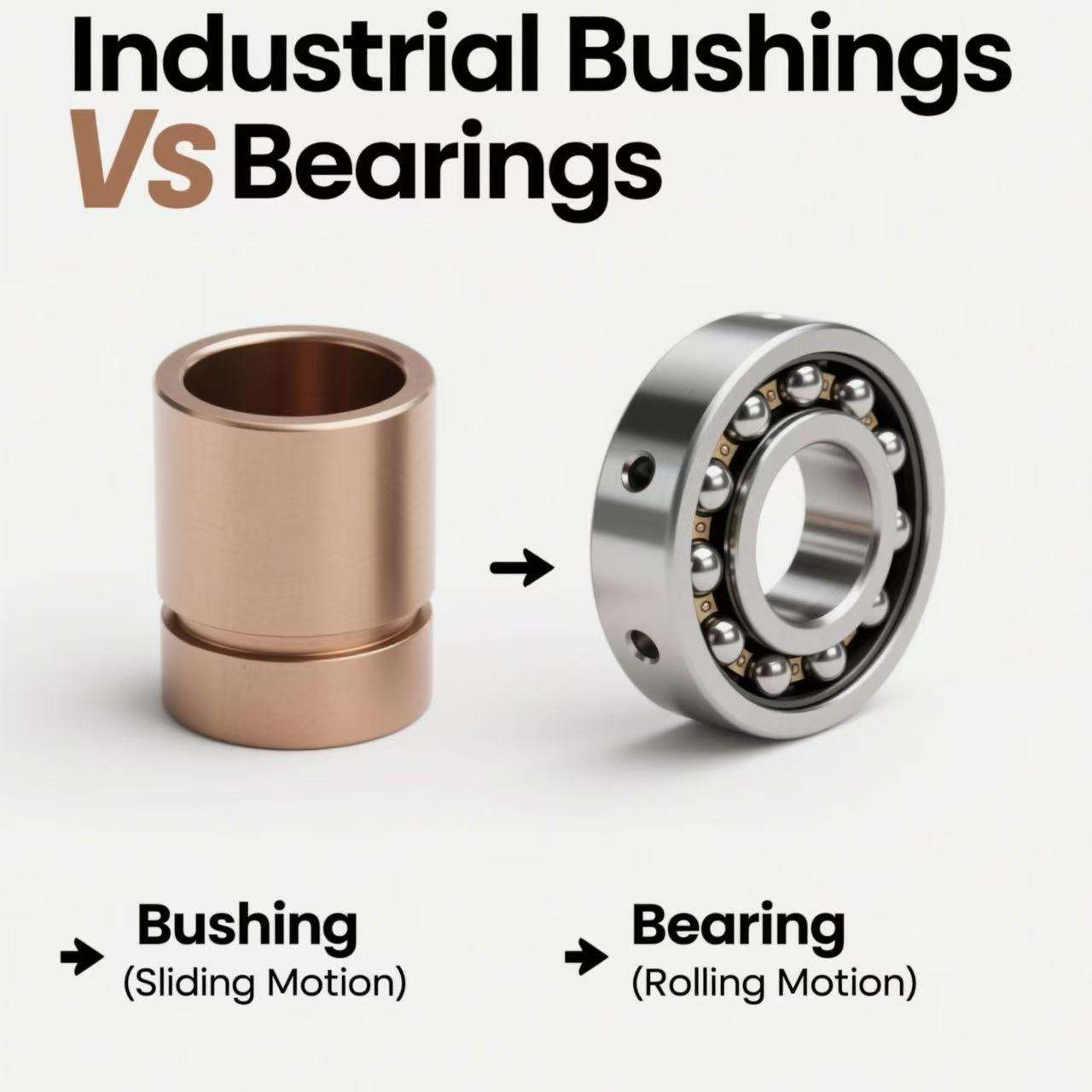
Industrial Bushings vs Bearings is a critical choice for engineers designing precise machines. Selecting the right component ensures performance. It also prevents premature failures. Both manage friction, but they are not interchangeable. Their designs and functions differ. This guide explains the distinctions, mechanisms, and use cases. It helps engineers and managers make informed decisions.
What Are Industrial Bushings?
A bushing is a type of plain bearing. It is usually a single-component sleeve. Bushings provide a low-friction surface for parts. They work through sliding motion. One surface simply glides over another. This creates a large contact area to distribute loads.
Their construction is simple but effective. Industrial Bushings are often made from bronze, brass, or steel alloys. Many also use advanced polymers. Some are self-lubricating for maintenance-free operation. For unique needs, custom parts are created. CNC machining allows for precise dimensions and special features. This ensures a perfect fit for any design.
Key Features of Bushings:
- Simple, one-piece construction.
- Operate via sliding motion.
- Large surface area for load distribution.
- Excellent shock and vibration absorption.
- Often self-lubricating.
What Are Bearings?
Bearings also reduce friction between parts. However, they use a different mechanism. Most industrial Bearings are rolling-element bearings. They contain spheres (ball bearings) or cylinders (roller bearings). These elements roll between two smooth rings called races.
This rolling action creates very little friction. It allows for smooth, efficient motion, especially at high speeds. Bearings are complex assemblies. They have an inner race, an outer race, rolling elements, and a cage. A cage holds the rolling elements in place.
Key Features of Bearings:
- Complex, multi-part assembly.
- Operate via rolling motion.
- Extremely low friction at high speeds.
- Support precise rotational movement.
- Require proper sealing and lubrication.
Key Differences: Bushing vs. Bearing
Understanding the core differences is key to proper selection. Each component excels under specific conditions.
| Feature | Industrial Bushings | Bearings (Rolling-Element) |
|---|---|---|
| Mechanism | Sliding Motion | Rolling Motion |
| Structure | Simple (Single piece) | Complex (Multi-part assembly) |
| Friction | Higher static friction | Very low rolling friction |
| Speed | Best for low to moderate speeds | Excellent for high speeds |
| Load Capacity | High (especially shock & impact loads) | Moderate (sensitive to shock loads) |
| Precision | Good for alignment | High rotational precision |
| Maintenance | Often low to zero (self-lubricating) | Requires lubrication and sealing |
| Cost | Generally lower | Generally higher |
| Noise Level | Very quiet operation | Can be noisier at high speeds |
Selection Guide for Engineers
Choosing the right component requires analyzing your application’s needs. Ask these five questions to guide your decision.
1. What are the load and speed requirements?
This is the most important factor.
- Use a Bushing: For high-load, low-speed applications. Bushings excel at handling heavy static loads and shock. The large contact area distributes forces. For example, think of a pivot point on an excavator arm.
- Use a Bearing: For high-speed, moderate-load applications. Rolling elements provide smooth, low-friction rotation. This is ideal for electric motors, fans, and gearboxes.
2. What is the operating environment?
Consider contaminants and moisture.
- Use a Bushing: In dirty, dusty, or corrosive environments. Their simple design has no internal parts to jam. Polymer and bronze bushings are naturally corrosion-resistant. They are perfect for agricultural and construction equipment.
- Use a Bearing: In clean, controlled environments. Bearings need effective seals to protect internal parts. Contamination can quickly lead to failure.
3. What are the precision and alignment needs?
Think about the type of motion.
- Use a Bushing: For applications that need vibration damping. They also tolerate some misalignment. Their sleeve design can accommodate slight shaft imperfections.
- Use a Bearing: For applications demanding high rotational accuracy. Precision tools and machine spindles rely on the rigidity of bearings.
4. What are the maintenance and lifespan goals?
Consider the total cost of ownership.
- Use a Bushing: For maintenance-free or low-maintenance systems. Many modern bushings are self-lubricating. They can last the product’s entire life without service. This reduces service costs.
- Use a Bearing: When periodic lubrication is possible. Some bearings are sealed for life. Yet, many high-performance systems need regular maintenance.
5. What are the project’s cost constraints?
Balance performance with budget.
- Use a Bushing: When cost is a primary driver. Their simpler design makes them more economical. Creating custom parts via CNC machining
- Use a Bearing: When high-speed performance is a must. The efficiency and capability justify the higher initial cost.
Conclusion
The choice between Industrial Bushings and Bearings is not about which is better. It is about which is right for the job. Bushings are robust, simple, and cost-effective. They work best in high-load, low-speed, and harsh environments. Bearings are precision components. They enable efficient, high-speed rotation in clean environments.
Carefully evaluate your application’s needs. Consider load, speed, environment, and cost. This will help you select the component with the best performance, reliability, and value.
If your application requires non-standard dimensions or specific materials, consider sourcing custom parts. Contact a specialist for expert advice on material selection and design.
Contact us today to discuss your custom CNC machining needs for industrial bushings and other precision components.