
Future Trends in CNC Sleeve Manufacturing: What Buyers Need to Know
1. Introduction
The global manufacturing landscape is in a period of rapid transformation. Driven by digitalization, automation, and a global push for sustainability, the factories of tomorrow will look vastly different from those of today. In this evolving ecosystem, even the most fundamental components, like CNC sleeves, are being reimagined. While small in size, these critical parts are essential for the precision and durability of industrial machinery, and their manufacturing processes are at the forefront of this industrial evolution.
For procurement managers and engineers, understanding these future trends in CNC sleeve manufacturing is not just an academic exercise—it is a strategic necessity. A forward-thinking procurement strategy can mitigate future risks, optimize long-term costs, and secure a supply chain that is both resilient and competitive. This guide provides an in-depth look at the key trends shaping the industry and what buyers need to know to make informed, future-proof sourcing decisions.
2. Automation & Smart Manufacturing
The move towards Industry 4.0 is the most significant trend in modern manufacturing. The traditional CNC workshop is being transformed into a connected, data-driven “smart factory.”
- The Technology:
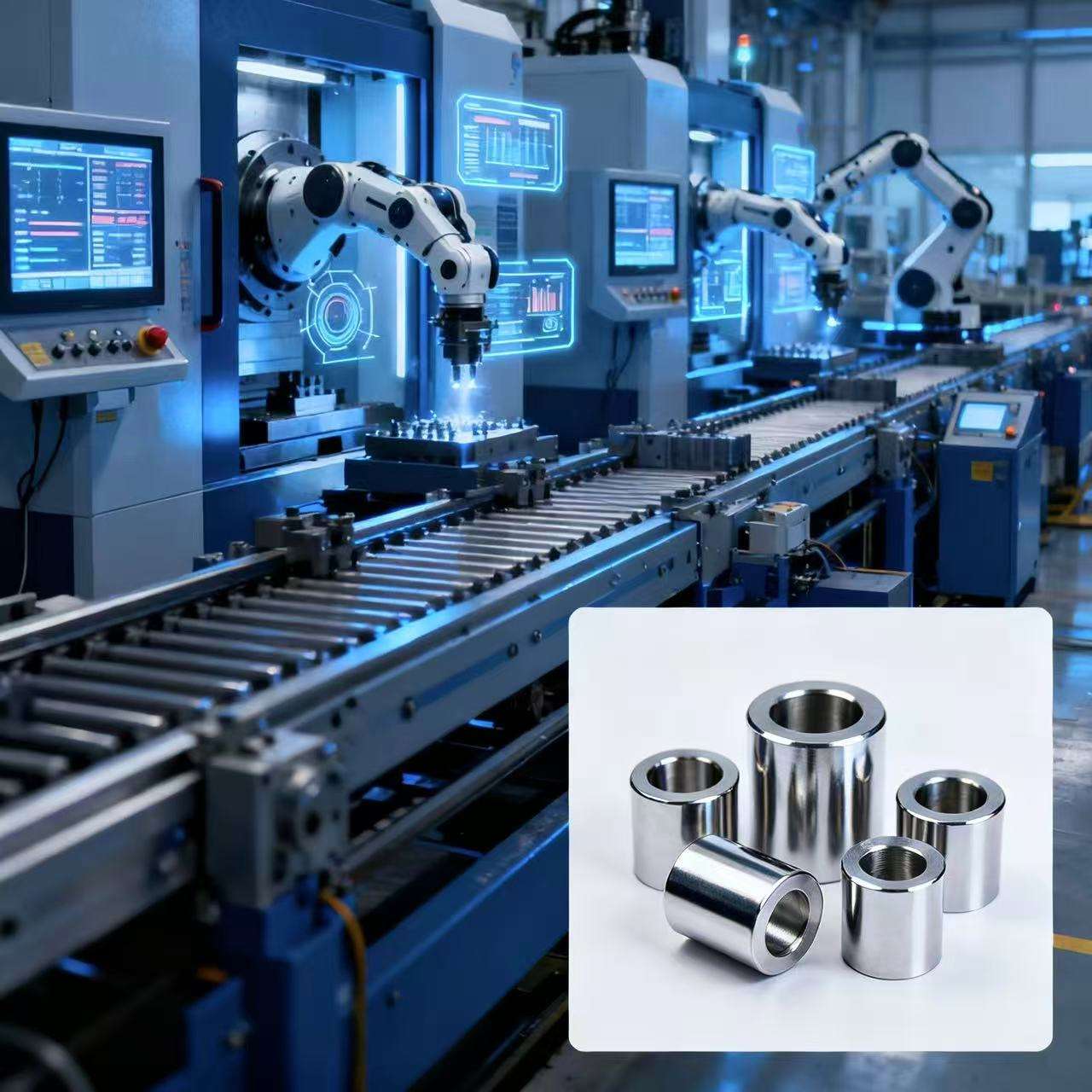
- Automation and Robotic Loading: Increasingly, CNC factories are adopting full automation. Robotic loading arms feed raw materials into CNC machines and unload finished parts, enabling “lights-out machining” and 24/7 unmanned production.
- Digital Twins & AI: Manufacturers are creating virtual replicas (digital twins) of their production lines. Combined with AI-assisted programming, this allows them to simulate and optimize the entire machining process before it begins, improving precision and efficiency.
- The Impact for Buyers: This high level of automation leads to two key benefits: more consistent quality and more reliable lead times. With reduced human intervention, the process becomes highly repeatable, and the risk of error diminishes. This is a critical factor for buyers managing high-volume, just-in-time supply chains.
3. Advanced Materials in CNC Sleeves
While traditional materials will always have their place, the future lies in advanced materials in bushings
- The Material Trends:
- High-Performance Alloys: New steel and nickel-based alloys are being developed to offer higher strength, better toughness, and superior performance at extreme temperatures.
- Advanced Composites: Self-lubricating composite materials, often with a metal backing and a PTFE or graphite-filled liner, are becoming a go-to solution for maintenance-free applications where regular greasing is impractical.
- Engineering Plastics: Lightweight and corrosion-proof plastics like PEEK are increasingly being used as metal replacements in lower-load applications, driven by the trend toward energy efficiency and lightweighting.
- What Buyers Need to Know: The machinability of these new materials is very different from that of traditional metals. When sourcing, buyers should confirm that a supplier has proven experience and the right tooling to properly machine these advanced materials. Ask for case studies or performance data related to these specific material types.
4. Precision & Tolerance Evolution
As industrial equipment becomes more sophisticated, the demand for ever-tighter tolerances on its components continues to grow.
- The Trend: The requirement for tolerances in the ±0.005 mm range is becoming more common, especially in industries like robotics and aerospace.
- New Inspection Technologies: To meet this demand, manufacturers are moving beyond manual checks. In-process measurement probes can check dimensions automatically during the machining cycle, while automated CMM (Coordinate Measuring Machine) data feedback can be used to adjust the process in real-time.
- The Value for Buyers: Tighter, more consistent tolerances mean fewer assembly issues, a better fit between mating parts, and a longer operational life for the entire assembly. This directly contributes to a lower Total Cost of Ownership (TCO).
5. Surface Treatments & Coatings Innovation
The innovation in surface treatments is focused on achieving better performance through more environmentally friendly processes.
- The Trend: Traditional processes like hard chrome plating are facing increasing regulatory scrutiny due to their use of hazardous chemicals. The industry is moving towards greener alternatives.
- New Technologies: PVD (Physical Vapor Deposition) coatings and advanced thermal spray coatings can provide superior wear and corrosion resistance without the environmental impact of older methods. These eco-friendly coatings are becoming a key part of sustainable CNC machining.
- What Buyers Should Look For: When sourcing, it is important to consider a supplier’s compliance with international environmental regulations like RoHS and REACH. A supplier who is investing in green coating technologies is not only being environmentally responsible but is also future-proofing their business against upcoming regulations.
6. Sustainability & Green Manufacturing
Sustainability is no longer a buzzword; it is a core business requirement for global supply chains.
- Energy Efficiency: Modern CNC factories are investing in energy-efficient machines and using green power sources to reduce their carbon footprint.
- Circular Economy: There is a growing emphasis on the use of recycled materials, such as recycled steel and copper alloys, in the production chain.
- The Impact for Buyers: Partnering with a supplier who has a strong sustainability program can enhance your own company’s brand reputation and help you meet your corporate social responsibility (CSR) goals.
7. Digital Supply Chains & Globalization
The way buyers and suppliers interact is being revolutionized by digital technology.
- The Trend: Supply chains are becoming fully digitized. Integrated systems like ERP and MES allow for real-time tracking of an order from raw material to final shipment. Some companies are even exploring blockchain for ultimate traceability.
- Logistics Transparency: Cross-border logistics are becoming more transparent, with systems that provide real-time tracking and predictive arrival times.
- The Value for Buyers: For a procurement manager, this means a dramatic reduction in uncertainty. You gain better visibility into your supply chain, allowing for more accurate planning and a lower risk of unexpected delays.
8. Buyer Implications & Strategic Takeaways
These future trends have direct implications for how buyers should approach procurement. The focus must shift from a short-term, price-based decision to a long-term, value-based one.
- Look Beyond Unit Price: The cheapest supplier today may not be the most cost-effective in the long run if they are not investing in these future trends. A focus on TCO is essential.
- Partner with Forward-Thinking Suppliers: The best long-term partners will be those who can demonstrate their capabilities in these key areas. When evaluating a new supplier, ask them:
- “What is your level of automation, and how does it benefit my lead times and quality?”
- “What is your experience with advanced self-lubricating or composite materials?”
- “What are your sustainability initiatives, and can you provide RoHS/REACH compliance?”
9. Conclusion
The future of CNC sleeve manufacturing is being shaped by powerful forces of digitalization, automation, material science, and sustainability. For industrial buyers, these trends are not abstract concepts; they are the new benchmarks for what defines a high-quality, reliable, and strategic supplier.
To build a resilient supply chain for the future, you must start today. By proactively seeking out partners who are embracing these trends, you can ensure that the components you source will continue to meet the ever-increasing demands for performance, reliability, and compliance.
Contact our engineering team to discuss how our CNC sleeve solutions align with future manufacturing trends. Let us help you build a supply chain that is not just reliable today, but ready for tomorrow.