
Cost Factors in CNC Pipe Fittings Production: What Drives Price Beyond Unit Cost
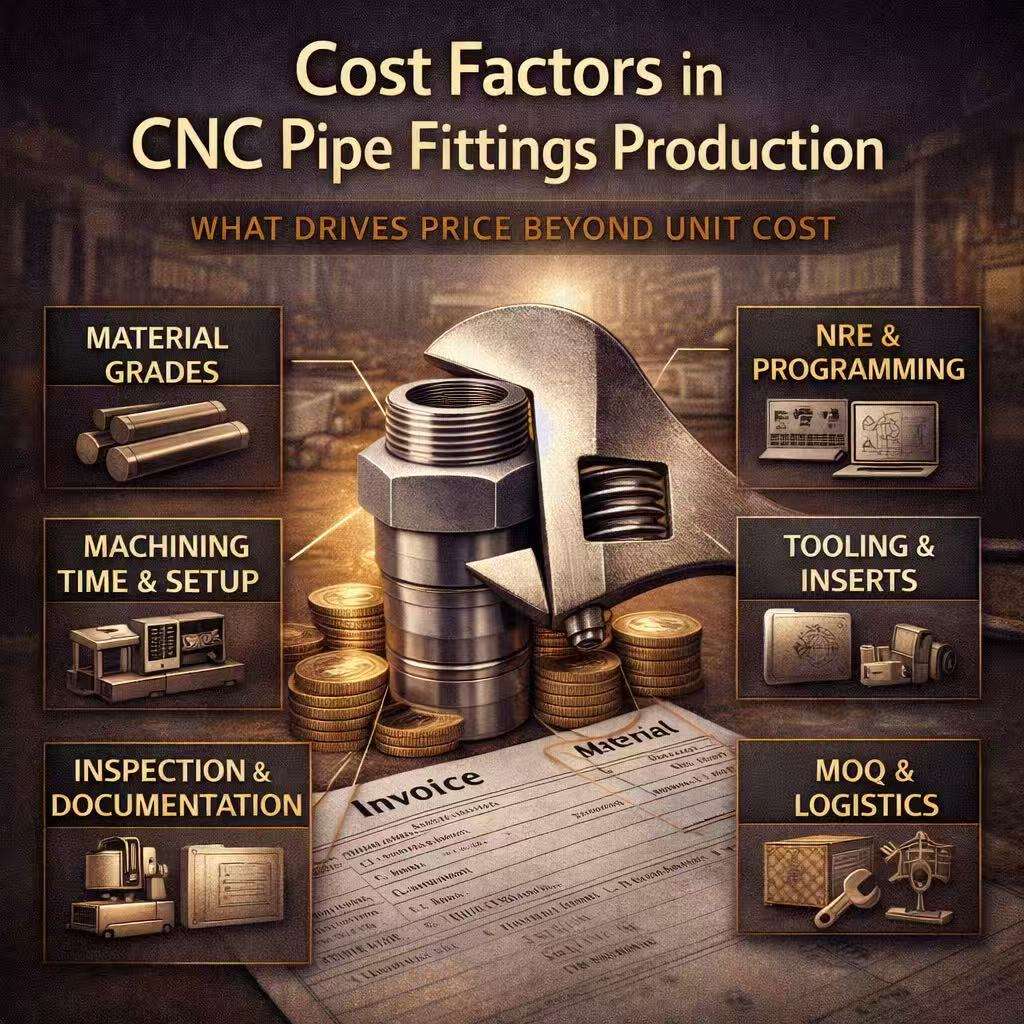
1. Introduction – Why CNC Pipe Fittings Are Not “Commodity Parts”
In the world of industrial procurement, there is often a disconnect between the expected price of a “fitting” and the actual cost of a custom CNC pipe fitting. While standard cast plumbing fittings are produced by the millions and sold as commodities by weight, CNC-machined fittings for OEM applications are engineered precision components.
For an OEM engineer or procurement manager, understanding the pricing model requires looking beyond the finished geometry. The cost is not merely a reflection of the metal used; it is an aggregate of the manufacturing time, process control, risk management, and quality verification required to ensure that the fitting performs safely under high pressure.
A price variance of 30% between two suppliers is rarely arbitrary. It typically signals a difference in machining strategy, material traceability, or inspection depth. This article analyzes the key cost factors in CNC pipe fittings production, helping OEM buyers understand why CNC pipe fittings cost varies far beyond raw material price.
2. Raw Material Cost Factors
The most visible component of cost is the raw material, but for industrial pipe fittings manufacturing cost, the calculation goes deeper than the market price per kilogram.
Material Grade & Machinability: Carbon steel (e.g., 12L14 or 1045) is cost-effective and machines rapidly. However, specifying 316L Stainless Steel or High-Strength Alloys (4140) triples the raw material cost and significantly slows down machining speeds, further inflating the price.
Form Factor (Bar Stock vs. Forging): CNC fittings are typically machined from solid hexagonal or round bar stock. This process offers superior structural integrity but generates high scrap rates (often 40-60% of the material becomes chips). Forgings have better yield but require expensive upfront tooling dies, making them cost-prohibitive for quantities under 5,000 pieces.
Traceability Premiums: “Mystery metal” is cheap. Material that comes with a verified Mill Test Report (MTR) and heat traceability carries a premium. This documentation is mandatory for safety-critical applications, ensuring the steel meets ASTM/ASME standards for chemical composition and mechanical strength.
3. CNC Machining Time & Complexity
The primary driver of CNC pipe fittings cost is “spindle time”—the actual duration the machine takes to cut the part.
Cycle Time: A simple straight adapter might take 2 minutes to machine. A complex tee or elbow requiring multi-axis milling could take 15 minutes. Every minute of machine time has a fixed hourly rate (covering labor, electricity, and machine depreciation).
Setup Complexity: Single-setup machining (using multi-tasking turn-mill centers) ensures perfect concentricity between threads and sealing faces but requires expensive machinery. Multi-setup machining (moving parts between a lathe and a mill) is cheaper in terms of machine rate but adds handling time and increases the risk of tolerance stacking errors.
Tolerances: Tighter tolerances (e.g., ±0.0005”) require “spark-out” passes (repeating a cut to remove material deflection) and frequent in-process measurements, both of which extend cycle time.
4. Engineering & Programming Costs (NRE)
Non-Recurring Engineering (NRE) costs are the “hidden” fees that impact low-volume orders significantly. Before metal is cut, significant engineering work occurs:
CAD/CAM Programming: An engineer must convert the 2D print into a 3D model and generate the G-code toolpaths for the CNC machine.
Fixture Design: Custom jaws or collets may be needed to hold odd-shaped fittings securely.
Process Validation: The first part off the machine (First Article) is never perfect. The machinist must tweak offsets and cut parameters.
For a 10-piece prototype run, these hours might exceed the cost of manufacturing the parts themselves. On a 10,000-piece order, this NRE cost is amortized to pennies per unit.
5. Tooling & Tool Wear
CNC machining is a destructive process; cutting tools wear out and must be replaced. This “consumable” cost is factored directly into the unit price.
Material Hardness: Machining Inconel or heat-treated alloy steel destroys carbide inserts much faster than machining brass or mild steel. A high-volume stainless steel order may require thousands of dollars in replacement inserts.
Precision Features: Specialized features like O-ring grooves or specific sealing cone angles often require custom-ground form tools.
Surface Finish Requirements: To maintain a sealing surface finish of Ra 16 $\mu$in, the machinist cannot run an insert until it fails. They must change the tool early to prevent surface degradation. The stricter the surface finish requirement, the higher the tooling cost.
6. Surface Treatment & Secondary Processes
Once machining is complete, the fitting is rarely finished. Secondary processes for corrosion protection add a fixed cost per batch.
Plating Type: Standard Trivalent Zinc is the baseline. Upgrading to Zinc-Nickel (for 1,000+ hour salt spray resistance) or Electroless Nickel Plating (ENP) can increase the finishing cost by 50–200%.
Batch Minimums: Plating lines run on volume. Sending 50 parts to a plater costs the same “minimum lot charge” as sending 500 pounds of parts. This is a major factor in custom pipe fittings pricing for small batches.
Masking: If a fitting requires plating on the body but no plating on the threads or sealing face (to maintain precision), manual masking is required. This labor-intensive step is expensive.
7. Quality Inspection & Documentation
In the OEM sector, you are paying for the data as much as the part. Inspection is a distinct cost center.
Inspection Depth: A standard AQL (Acceptable Quality Limit) sample check is standard. If a buyer requires 100% thread gauging or CMM verification of every sealing face, the labor cost rises dramatically.
Documentation: Generating and compiling MTRs, Certificates of Conformance (CoC), and dimensional inspection reports requires administrative time.
Equipment: The amortization of calibrated metrology equipment (CMMs, profilometers, thread gauges) is built into the shop rate. High-precision verification capabilities justify a higher shop rate than a shop using only calipers.
8. Order Quantity & Production Efficiency
The logic of MOQ (Minimum Order Quantity) is purely mathematical.
Setup Amortization: Setting up a CNC machine takes 2–4 hours. If the setup cost is $300:
For 10 parts: $30 per part added to the unit cost.
For 1,000 parts: $0.30 per part added.
Running Efficiency: Once a machine is “dialed in” and running thermally stable, operators can run lights-out (unmanned) manufacturing, significantly reducing labor costs. This is why OEM pipe fittings supplier pricing drops sharply at volume breakpoints (e.g., 500, 1,000, 5,000 pieces).
This is why reputable OEM pipe fittings suppliers often hesitate to quote very small quantities — not because they are inflexible, but because consistent quality below a certain volume is statistically harder to guarantee.
9. Logistics & Export-Related Costs
For international buyers, the factory gate price is not the landed cost.
Packaging: Precision threads and sealing faces cannot be thrown into a bin. They require individual plastic mesh caps, layer separators, or vacuum sealing to prevent damage during transit.
Marking: Laser etching part numbers, heat codes, and logos is a machine process that adds cycle time.
Third-Party Inspection: If an OEM requires SGS or TUV inspection before shipment, the direct cost of the inspector and the indirect cost of staging the parts are billable.
10. Conclusion – Understanding Cost vs. Reducing Risk
Ultimately, the cost of a CNC pipe fitting is an aggregation of the effort required to eliminate failure risks. A “cheap” fitting often achieves its price point by using unverified material, skipping deburring, extending tool life beyond optimal limits, or ignoring final inspection.
For OEM buyers, the goal should not be simply to find the lowest quote, but to find the quote that offers the correct balance of process capability and cost. By understanding these manufacturing drivers, buyers can engage in meaningful value engineering discussions—such as adjusting tolerances or consolidating batch sizes—to reduce costs without compromising system safety. For OEM buyers, transparent cost breakdowns are often a stronger indicator of supplier reliability than the lowest unit price.