
CNC Spacers vs Washers: Buyer’s Selection Guide
1. Introduction – Why Spacers and Washers Are Not Interchangeable
In the realm of industrial mechanical design, the distinction between a spacer and a washer is often blurred by their visual similarity. Both are cylindrical, contain a central hole, and are placed under a fastener head. However, for OEM engineers and procurement managers, treating these components as interchangeable is a fundamental error that compromises assembly integrity.
While washers are ubiquitous in general construction, CNC spacers are engineered components designed for precision applications. The confusion between the two often leads to assembly failures, including loss of bolt preload, component misalignment, and structural deformation.
In procurement terms, choosing the wrong spacing component rarely causes immediate failure — but it almost always leads to hidden costs in rework, vibration issues, and long-term reliability problems.
For industrial buyers, understanding the specific engineering roles of spacing components is critical. A washer is designed to distribute load and protect surfaces; a spacer is designed to define a precise geometric gap and transmit compressive loads without deformation. This guide analyzes the technical differences between CNC spacers vs washers, providing a framework for selecting the correct component for high-performance industrial assemblies.
2. What Is a CNC Spacer? (Engineering Definition)
From an engineering perspective, a CNC spacer is a structural, load-bearing component manufactured to define a precise distance between two mating parts. Unlike generic hardware, these components are produced via Computer Numerical Control (CNC) turning from solid bar stock.
The defining characteristics of a precision spacer include:
Controlled Length: The length dimension is machined to tight tolerances (often ±0.05mm or tighter) to ensure exact gap control.
Face Perpendicularity: The end faces are machined square to the central axis. This ensures that when the bolt is tightened, the compressive force is applied axially, preventing the bolt from bending.
Concentricity: The Inner Diameter (ID) and Outer Diameter (OD) are concentric, ensuring the spacer sits perfectly centered on the fastener.
Rigidity: Because they are turned from solid stock (Aluminum, Steel, Stainless, Brass), they act as a rigid structural column that does not collapse under torque.
3. What Is a Washer? (Functional Role & Limitations)
An industrial washer is primarily a protective and load-distributing element. Most standard washers are manufactured using stamping processes from sheet metal.
The primary engineering functions of a washer include:
Load Distribution: Expanding the surface area under the bolt head or nut to prevent crushing the mating material (especially with soft metals or plastics).
Surface Protection: Preventing the rotating fastener head from galling or marring the assembly surface during tightening.
Limitations in Spacing:
Washers are not designed for precise gap control. Because they are stamped, they often suffer from “die break” (tapered edges), variable thickness tolerances, and poor flatness. Using a washer to define a critical dimension introduces significant variability into the assembly.
4. CNC Spacers vs Washers – Engineering Comparison
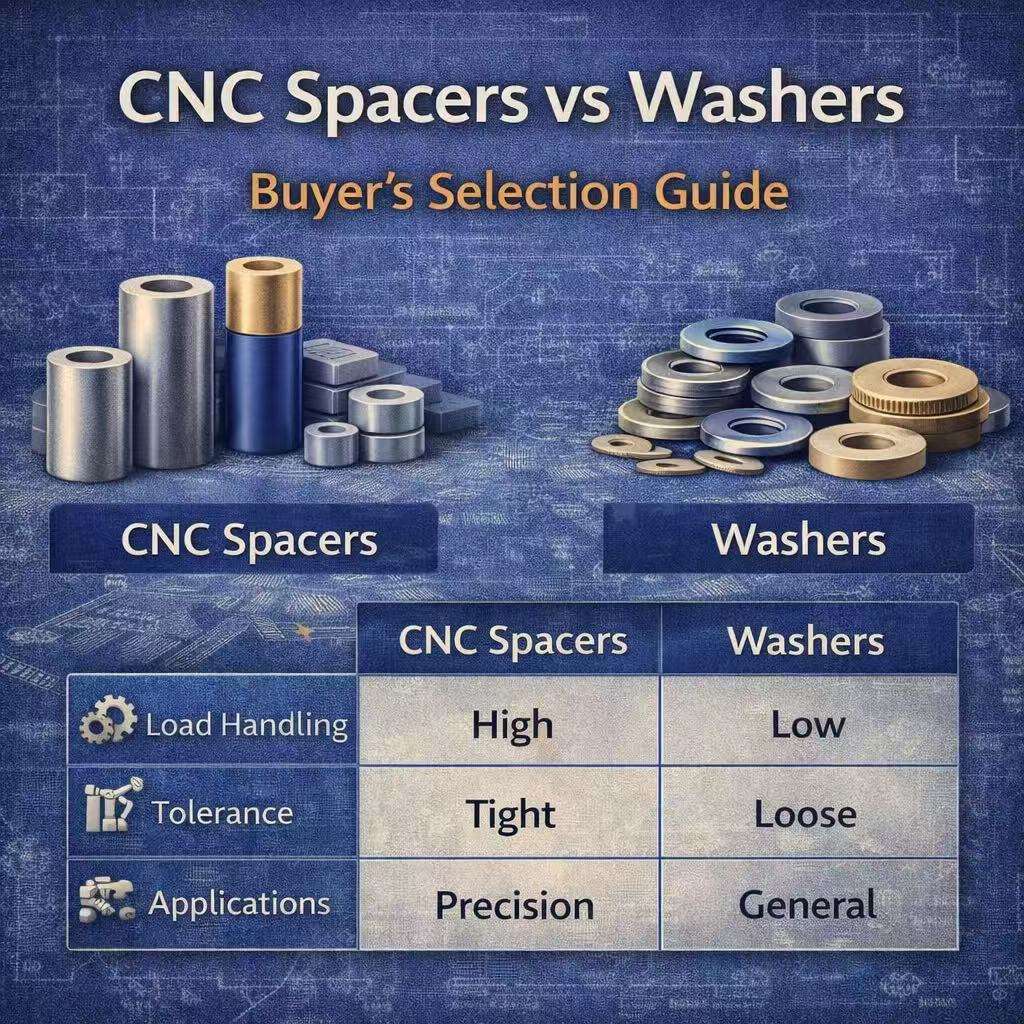
To visualize the functional divergence between CNC spacers and standard washers, the following table outlines key engineering attributes.
| Feature | CNC Spacers | Standard Washers |
| Primary Function | Precise geometric spacing | Load distribution & surface protection |
| Manufacturing Method | CNC Turning (from bar stock) | Stamping / Punching (from sheet) |
| Thickness/Length Tolerance | Tight (±0.01mm – ±0.05mm) | Loose (Standard sheet tolerances) |
| Face Perpendicularity | Strictly Controlled | Uncontrolled |
| Load Bearing Capacity | High (Structural Column) | Limited (Prone to dishing/deformation) |
| Parallelism | High | Low (Variable) |
| Suitability for Automation | High (Consistent geometry) | Low (Prone to jamming feeders) |
5. Load, Alignment & Structural Integrity Comparison
The decision between CNC spacers vs washers often comes down to how the assembly manages load and alignment.
The Structural Column Effect
A CNC spacer acts as a solid structural column. When a bolt is torqued through a spacer, the clamping force compresses the spacer. Because the faces are parallel and perpendicular, the load is transmitted evenly. This stability allows the fastener to maintain its preload over time, preventing loosening due to vibration or thermal cycling. This is the fundamental mechanical difference in the CNC spacers vs washers debate: one defines geometry, the other merely supports a fastener.
The “Washer Stack” Risk
A common makeshift solution in prototyping or low-cost assembly is stacking multiple washers to achieve a specific height. In engineering terms, this is a “tolerance stack-up” nightmare.
Cumulative Error: If one washer has a thickness tolerance of ±0.1mm, a stack of ten creates a potential error of ±1.0mm.
Settling and Preload Loss: A stack of washers acts like a rudimentary spring. Under vibration, the microscopic gaps and surface irregularities between layers settle, causing a loss of bolt tension.
Buckling: Under high shear loads, a stack of washers can shift laterally, leading to mechanical instability.
Mechanical Fasteners require stable clamp loads to function. CNC spacers provide that stability; washer stacks undermine it.
6. Typical Industrial Applications (When to Use Which)
Selecting the right component depends entirely on the application requirements.
CNC Spacers – Used When:
Precise Assembly Heights: In PCB mounting, sensor alignment, or gear spacing where the gap must be controlled within microns.
Robotics and Automation: Creating rigid separation between actuator plates or linkage arms where play cannot be tolerated.
Bearing Preload: Spacing bearings along a shaft where the spacer face must contact the bearing race perfectly flat to prevent binding.
Through-Bolt Support: Inside hollow box sections or plastic housings, a CNC spacer prevents the housing from crushing when the bolt is tightened.
Washers – Used When:
Surface Protection: Under a bolt head to prevent scratching a painted or polished surface.
Soft Mating Materials: When bolting into aluminum or plastic, a washer distributes the force to prevent the bolt head from sinking into the material.
Slot Coverage: Bridging the gap of an oversized or slotted hole.
Locking Mechanisms: Split washers or Belleville washers are used specifically to provide spring tension (a function distinct from spacing).
7. Common Buyer Mistakes
In sourcing industrial spacing components, several recurring errors can lead to product failure or increased assembly costs.
Replacing Spacers with Washer Stacks: As noted, this saves pennies on component costs but costs dollars in rework, quality failures, and manual assembly time.
Ignoring Face Perpendicularity: Buying cut-tube spacers (saw-cut) instead of CNC turned spacers. Saw-cut spacers often have slanted ends, which cause the bolt to bend when tightened, leading to fatigue failure of the fastener.
Material Mismatch: Using aluminum spacers in high-torque steel assemblies. Under extreme load, the aluminum may yield (creep), causing loss of bolt tension.
Overlooking Automation Feeding: In automated assembly lines, stamped washers often stick together (nesting) or have burrs that jam vibratory bowl feeders. CNC spacers have consistent chamfers and geometry, ensuring reliable feeding.
8. Buyer Selection Guide – CNC Spacer or Washer?
When evaluating the Bill of Materials (BOM), engineers and buyers can use this checklist to determine the appropriate component.
Choose a CNC Spacer If:
[ ] The gap dimension is a critical functional requirement (e.g., aligning a sensor).
[ ] The assembly is subjected to high compressive or shear loads.
[ ] Parallelism between the two separated surfaces is essential.
[ ] The component will be installed using automated robotic assembly.
[ ] The assembly involves high-speed rotating parts (e.g., spacing bearings).
Choose a Washer If:
[ ] The primary goal is to protect the surface finish.
[ ] You need to distribute load over a wider area on a soft material.
[ ] The precise height of the fastener assembly is non-critical.
[ ] You are bridging an oversized or slotted hole.
9. Conclusion – Choosing the Right Spacing Component
The comparison of CNC spacers vs washers highlights a fundamental principle in industrial sourcing: geometry dictates function. While washers are essential utility components for surface protection and load distribution, they lack the dimensional fidelity required for precision spacing.
CNC spacers are engineered structural elements. They provide the necessary rigidity, alignment, and tolerance control to ensure that mechanical assemblies perform as designed. For OEM engineers and procurement managers, substituting a precision spacer with a washer is not a cost-saving measure—it is a re-engineering of the joint that introduces unknown risks.
In most industrial failures related to spacing, the issue is not that a washer “broke” — it is that a spacer was never specified in the first place. To ensure long-term system reliability, industrial buyers should treat spacing as a precision requirement, selecting custom CNC spacers whenever alignment, load path integrity, and tolerance control are paramount.