
Buyer’s FAQ: MOQ & Lead Time for CNC Pins
Introduction
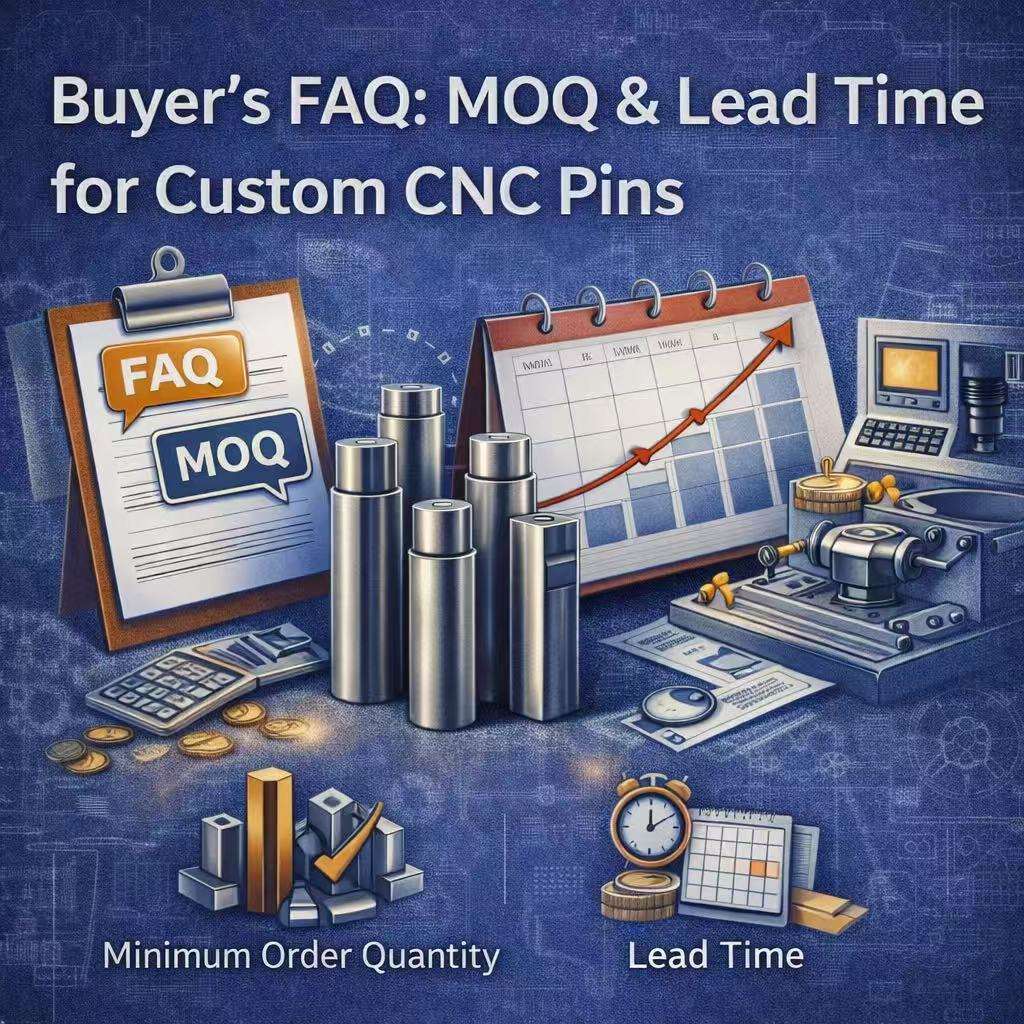
In the world of industrial procurement, two acronyms often dictate the success of a project: MOQ (Minimum Order Quantity) and Lead Time. When sourcing standard off-the-shelf hardware, these factors are rarely an issue—you buy what is in stock, and it ships tomorrow.
However, sourcing custom CNC pins for automotive, hydraulic, or automation applications is a different process. Because these components are engineered to specific drawings and tolerances, they are manufactured on demand. This shift from “stock picking” to “custom manufacturing” introduces necessary logistical constraints.
For industrial buyers and sourcing managers, understanding the engineering and operational reasons behind MOQ and lead time is critical. It moves the conversation from simple price negotiation to strategic supply chain planning. This FAQ guide explains why these constraints exist in industrial pin manufacturing and how buyers can navigate them efficiently.
FAQ 1: What Is MOQ in CNC Pin Manufacturing?
MOQ stands for Minimum Order Quantity. In the context of CNC pins, it represents the smallest number of units a manufacturer is willing to produce in a single production run to ensure the project remains economically viable for both parties.
Unlike a distributor who breaks bulk boxes, a precision pins supplier is a manufacturer. Every order requires setting up machinery, programming code, and allocating raw material. The MOQ is the threshold where these fixed setup activities are justified by the production volume.
FAQ 2: Why Do CNC Pins Have a Minimum Order Quantity?
Buyers often ask, “Why can’t I just order 10 pieces?” The answer lies in the Setup Cost.
Manufacturing a custom CNC pin involves several fixed steps before the first chip is cut:
CAM Programming: Translating the engineering drawing into machine code.
Tooling Setup: Selecting and installing specific cutting tools, drills, and collets.
Machine Warm-up & Calibration: Ensuring the CNC lathe is thermally stable to hold tight tolerances.
First Article Inspection (FAI): Running test parts and verifying dimensions in the metrology lab.
These steps take the same amount of time whether the order is for 10 pins or 10,000 pins. If a buyer orders 10 pins, the high setup cost must be amortized over just 10 units, resulting in an astronomical unit price. A reasonable MOQ ensures that the setup cost is diluted across enough parts to make the unit price competitive.
FAQ 3: Typical MOQ Ranges for CNC Pins
While every industrial pin manufacturing project is unique, MOQs generally fall into three categories:
Prototypes (MOQ 1–50 pcs): Used for testing and validation. These are typically produced in a dedicated prototype cell or tool room. The unit price is high because it is essentially paying for engineering time and setup.
Small Batch (MOQ 100–500 pcs): Common for specialized machinery or low-volume automation builds.
Mass Production (MOQ 1,000–10,000+ pcs): This is where CNC pins become most cost-effective. High volumes allow for the use of Swiss-type CNC lathes, which run automated “lights-out” production, driving unit costs down significantly.
Note: MOQs may be higher for pins requiring specialized raw materials (like specific grades of Titanium or Inconel) that suppliers must purchase in bulk.
FAQ 4: What Factors Influence Lead Time for CNC Pins?
Lead time for CNC pins is not just machining time. It is the cumulative time required for the entire manufacturing lifecycle. Key factors include:
Material Availability: Standard carbon steels (1045) and alloy steels (4140) are usually in stock. Specialized stainless steels or non-ferrous alloys may have their own lead times from the mill.
Machining Complexity: A simple dowel pin machines quickly. A custom pin with cross-holes, internal threads, and grooves requires “live tooling” or secondary operations, increasing cycle time.
Heat Treatment: This is often the biggest bottleneck. Sending parts out for induction hardening or case hardening adds transport and processing time (typically 1–2 weeks).
Grinding & Finishing: Achieving tight ISO tolerances (e.g., h6, m6) requires post-heat-treat grinding. Surface coatings (Zinc, Nickel, DLC) add another processing step.
FAQ 5: Typical Lead Time for Custom CNC Pins
While “standard” lead times vary by market conditions, buyers can generally expect the following ranges for custom CNC pins:
Fast-Turn Prototypes: 1–2 weeks (often without heat treatment or plating).
Standard Production: 3–5 weeks. This allows time for material procurement, machining, and basic inspection.
Complex/Finished Production: 6–8 weeks. This applies to pins requiring heat treatment, centerless grinding, and plating.
Buyer Tip: Lead time typically begins only after the engineering drawing is approved and the raw material is secured, not the moment the PO is sent.
FAQ 6: Can MOQ or Lead Time Be Reduced?
Yes, but usually with trade-offs.
Reducing MOQ:
Trade-off: Higher Unit Price. Suppliers can run smaller batches, but the setup fees will make the per-pin cost significantly higher.
Option: Use standard materials. If you can use a material the supplier already runs frequently (e.g., 303 Stainless), they may lower the MOQ as they don’t need to change machine setups as drastically.
Reducing Lead Time (Expediting):
Trade-off: Expedite Fees. Rushing an order often requires overtime labor or breaking into an existing machine schedule.
Strategy: For urgent needs, ask if the supplier can partial ship (e.g., air freight 100 units ASAP while the remaining 9,000 ship via sea freight later).
FAQ 7: How Buyers Can Plan Orders More Efficiently
To optimize both cost and delivery, buyers should adopt a strategic approach to sourcing precision pins:
Standardize Where Possible: Avoid custom tolerances on non-critical dimensions. Relaxing a tolerance from ±0.005mm to ±0.02mm can sometimes eliminate a grinding operation, shortening lead time.
Blanket Orders (EAU): Instead of placing four separate orders for 2,500 pins, place one blanket order for 10,000 pins with scheduled releases. This allows the manufacturer to produce the full batch at once (optimizing MOQ) while you receive stock throughout the year (managing cash flow).
Clear Documentation: Ambiguous drawings cause delays. Ensure your RFQ includes clear GD&T, material specifications, and heat treat requirements to avoid back-and-forth engineering questions.
Conclusion
For industrial buyers, MOQ and lead time are not arbitrary hurdles; they are reflections of the manufacturing reality behind custom CNC pins. MOQ ensures economic feasibility by covering setup costs, while lead time ensures quality by allowing sufficient time for precision machining, heat treatment, and grinding.
By understanding these factors, sourcing managers can plan projects more effectively. Engaging with a precision pins supplier early in the design phase, utilizing blanket orders, and designing for manufacturability are the best ways to secure high-quality components within budget and on schedule.