
CNC Machining for Industrial Equipment – Full Guide
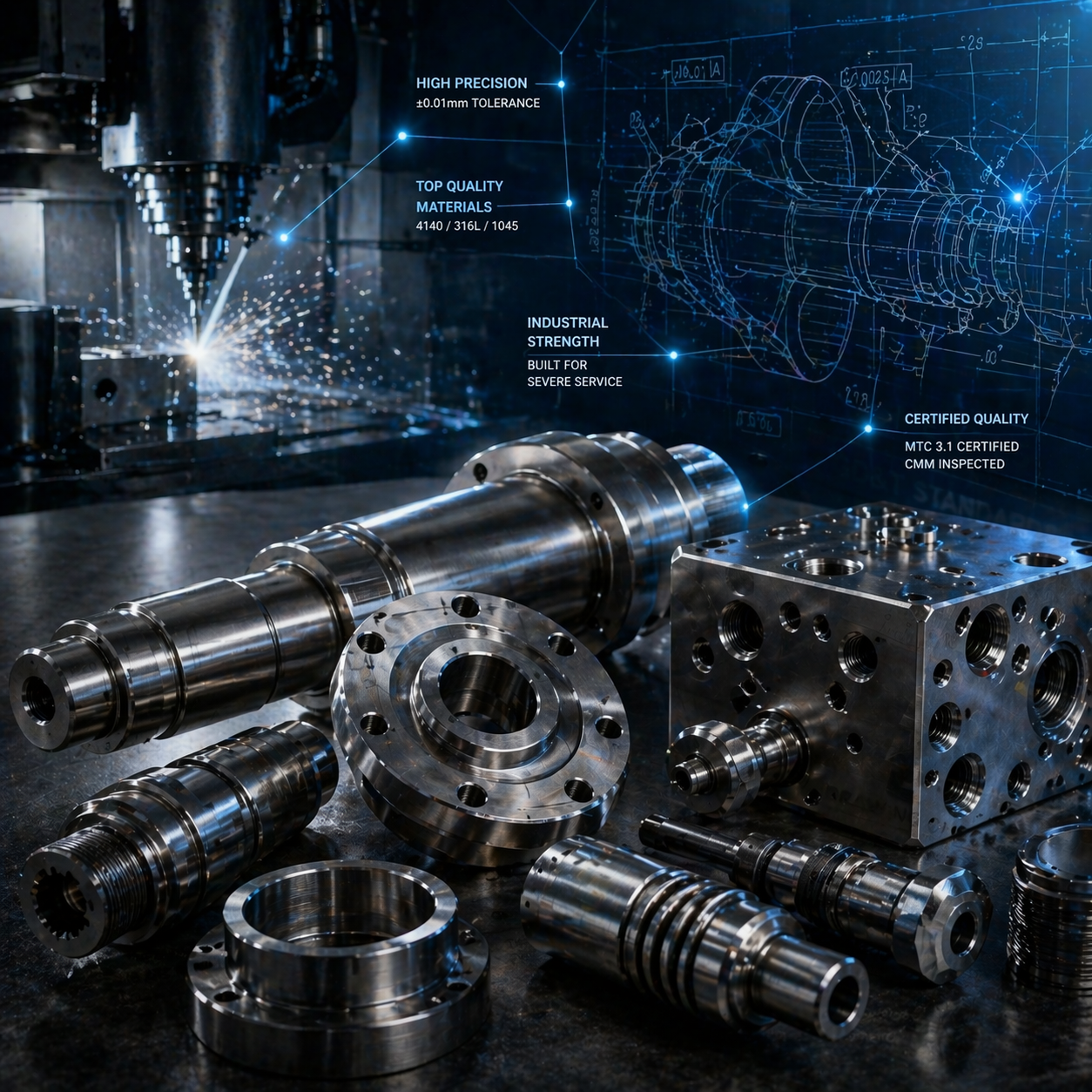
In global industrial procurement, one mistake can cost more than the entire order. For OEM buyers and engineers in oil & gas, mining, and heavy machinery, precision is not a luxury. It is a strategic requirement for survival.
A single misinterpreted drawing, a sub-par material grade, or a minor tolerance failure can shut down an entire production line. This leads to thousands of dollars in downtime per hour. CNC machining for industrial equipment is the foundation of modern mechanical reliability. As equipment operates under higher pressures, extreme temperatures, and heavier loads, the demand for high-performance components is non-negotiable.
2. What is CNC Machining for Industrial Equipment?
Definition
CNC machining for industrial equipment is the specialized application of Computer Numerical Control (CNC) technology to manufacture components designed for “Severe Service” environments. While general CNC machining covers everything from consumer electronics to decorative trim, industrial-grade machining focuses on structural integrity, fatigue resistance, and geometric precision.
The Industrial Difference
Why can’t a standard job shop handle heavy machinery parts? The difference lies in the Physics of Failure.
Stress Cycles: Industrial parts often undergo millions of load cycles. A minor surface defect becomes a “stress riser” that leads to catastrophic fatigue failure.
Material Difficulty: Industrial applications utilize “tough” alloys like 4140 steel or 316L stainless steel. These require high-rigidity 5-axis machines and specialized tooling.
Traceability: In the industrial sector, the paper trail is as important as the metal. Every part requires a Material Test Certificate (MTC 3.1) and a Coordinate Measuring Machine (CMM) report.
3. Key Types of Industrial CNC Components
Understanding the functional role of CNC parts for heavy machinery allows procurement managers to prioritize inspection where it matters most.
Shafts and Drive Components
Shafts are the “muscles” of industrial equipment. Whether it is a transmission axle for a loader or a rotor shaft for an industrial pump, these parts transfer torque.
Critical Requirement: Concentricity. If journals are out of alignment by even 0.05mm, the assembly will vibrate at high RPMs, destroying bearings within weeks.
Flanges and High-Pressure Connectors
In oil & gas and fluid management, flanges must adhere to strict standards like ASME B16.5.
Critical Requirement: Flatness and Surface Finish. The sealing face must be machined to a specific roughness (often Ra 0.8um) to ensure the gasket creates a leak-proof seal.
Housings and Manifolds
These components protect the machine’s “brain” (electronics) or “heart” (hydraulics).
Critical Requirement: Internal geometry and pressure-tight integrity. 5-axis milling is often required to machine complex internal passageways in hydraulic manifolds.
4. Materials Used in Industrial CNC Machining
In CNC manufacturing for industrial applications, the material choice is the first gate of quality. You cannot machine reliability into a poor-quality alloy.
| Material Grade | Type | Key Properties | Typical Application |
| AISI 1045 | Carbon Steel | Medium strength, cost-effective | Structural brackets, simple pins |
| AISI 4140 | Alloy Steel | High fatigue strength, toughness | High-torque shafts, gears |
| AISI 4340 | Alloy Steel | Extreme strength, deep hardenability | Heavy-duty drive axles |
| AISI 316L | Stainless Steel | Superior corrosion resistance | Chemical manifolds, marine pumps |
| 6061-T6 | Aluminum | Strength-to-weight, thermal | Lightweight housings, manifolds |
5. Precision & Tolerance Requirements
In industrial engineering, the “fit” of a part determines its lifespan. We categorize tolerances into three levels based on impact and cost.
Standard Tolerance (180±0.1mm): Suitable for non-moving structural parts, brackets, and covers.
Industrial Tolerance (±0.05mm): The requirement for bolted assemblies and general gear meshing. It ensures interchangeability.
Precision Tolerance (±0.01mm): Reserved for “Functional Interfaces” like bearing seats, shaft journals, and hydraulic bores.
The Cost of a Micron: One of the biggest mistakes in procurement is “over-specifying.” Moving from ±0.1mm to ±0.01mm can increase the part cost by 100% to 300%. Tight tolerances require multiple finish passes, slower feeds, and climate-controlled metrology.
6. Surface Finishing & Durability
Precision machining industrial components is only half the battle. The part must survive the environment.
Heat Treatment: Induction Hardening creates a hard outer case (HRC 50-60) to resist wear while keeping the core ductile.
Protective Coatings: Electroless Nickel Plating (ENP) offers superior uniformity. Unlike electroplating, it coats internal threads and bores with perfect evenness.
Surface Roughness (Ra): For high-pressure seals, an Ra 0.8um finish is the industry standard. Anything rougher will act like a file, shredding polymer seals.
7. Quality Control & Inspection
In the industrial sector, trust is built on data. A professional industrial CNC machining services partner must operate a comprehensive Quality Management System (QMS).
CMM (Coordinate Measuring Machine): Maps the part in 3D space with sub-micron accuracy. This is the only way to verify concentricity over long distances.
MTC 3.1 (Material Test Certificate): The “birth certificate” of the metal. It proves the steel mill’s heat number and chemical integrity.
FAI (First Article Inspection): A 100% dimensional audit of the first part off the machine to green-light the production run.
8. Common Challenges in Industrial CNC Projects
Complex Geometries: Large industrial manifolds often have internal passageways that are difficult to reach.
Exotic Materials: Machining Inconel or Titanium for the oil & gas industry requires specialized “feeds and speeds.”
Thermal Drift: A 5°C change in temperature can cause a 1-meter steel shaft to expand by 0.05mm. Professional shops utilize climate-controlled labs.
9. Case Study: The Shaft Failure Crisis
The Problem: A mining client faced drive assembly failures. Shafts were snapping at the bearing journal every 200 hours.
The Diagnosis: The previous supplier used manual calipers to check size. We performed a CMM inspection and discovered a Runout error of 0.12mm. The size was right, but the journals were not concentric. This caused vibration and fatigue.
The Solution: We moved production to a 5-axis Mill-Turn center, machining both ends in a single setup.
The Result: Lifespan increased to over 3,000 hours. Total Cost of Ownership was reduced by 70%.
10. Buyer Checklist for Industrial CNC Procurement
[ ] Standards: Is ISO 2768-m or ASME Y14.5 clearly defined on the drawing?
[ ] Material: Is the material grade specified by international code (AISI/DIN) and is an MTC 3.1 required?
[ ] Tolerances: Have you relaxed tolerances on non-functional areas to save cost?
[ ] Finishing: Is the Ra 0.8um finish specified for all sealing faces?
[ ] Documentation: Have you requested a CMM report and a Hardness report?
11. Strategic Value in Industrial Sourcing
Whether you are sourcing CNC machining for industrial equipment, evaluating industrial CNC machining services, or looking for a reliable partner for CNC parts for heavy machinery, choosing the right supplier is critical to long-term performance.
Professional CNC manufacturing for industrial applications is not just about machining parts. It is about ensuring reliability, traceability, and zero-failure delivery. With years of experience supporting international OEM projects in mining, oil & gas, and heavy machinery, Lebometal understands the real risks behind industrial CNC sourcing.
12. Conclusion: Secure Your Industrial Future
Ready to reduce failure risk in your CNC components?
At Lebometal, we support OEM buyers and engineers with industrial-grade machining solutions built for severe service environments. Send us your drawings today and you will receive:
A technical feasibility review within 24 hours
DFM suggestions to reduce cost and improve reliability
Full inspection support (CMM reports + MTC 3.1)
Clear feedback on tolerance, material, and production risks
Email your RFQ or drawings now to Lebometal.com to start your project with confidence. Let’s keep your machinery moving with the precision it deserves.