
CNC Machined Parts for Industrial Automation: Complete Guide for OEM Buyers
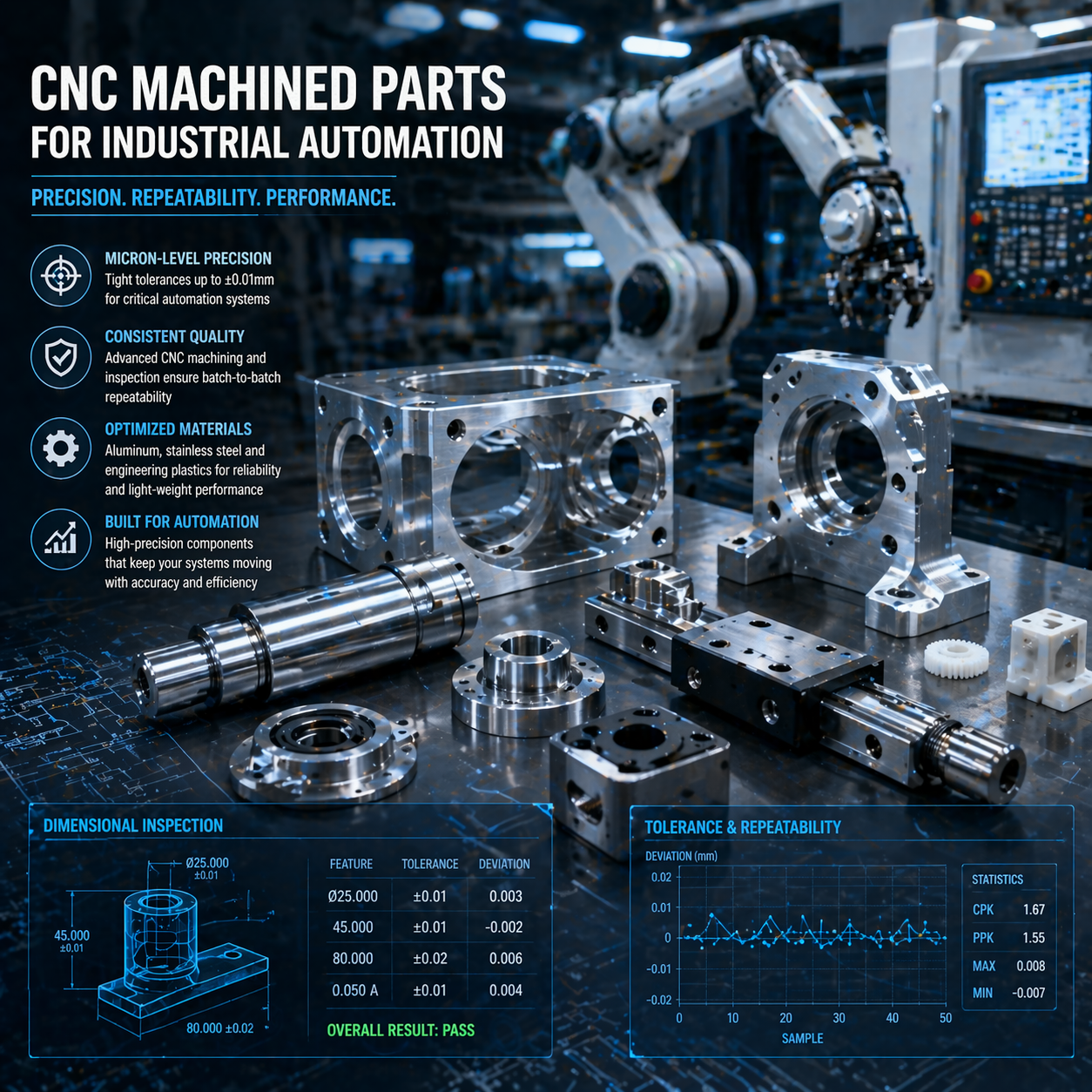
In the era of Industry 4.0, the global manufacturing landscape is undergoing a radical shift toward high-speed, high-precision autonomous systems. In automation systems, even microscopic errors can multiply into major system failures. For an OEM buyer or a procurement manager in the robotics sector, the margin for error is non-existent. A pick-and-place robot operating at 120 cycles per minute does not just require “good” parts; it requires components that achieve micron-level repeatability over millions of cycles.
In industrial automation, a single misaligned mounting plate or a drive shaft with 0.02 mm of runout can trigger a catastrophic failure. This leads to production line stoppages, accuracy loss in sensors, and significant financial damage. High-quality CNC machined parts for industrial automation must ensure consistent precision across every batch.
This guide provides a technical deep dive into the precision requirements, material science, and quality control protocols essential for sourcing high-performance automation components.
2. Why CNC Machining is Critical in Automation Systems
Automation is defined by the elimination of human variability. To achieve this, the hardware must be more consistent than the process it manages. CNC (Computer Numerical Control) machining is the only subtractive manufacturing process capable of delivering the necessary convergence of speed, material integrity, and dimensional precision.
Micron-Level Precision: Automation systems rely on “Stack-up Tolerances.” When multiple components form a robotic joint, tiny errors accumulate. High-precision CNC machining keeps individual errors to a minimum.
Repeatability: In a standard automation project, each robotic arm must perform identically to the software’s kinematic model. CNC machining ensures that the 1,000th part is a perfect twin of the 1st.
Integration: Modern robotics utilize high-resolution encoders that detect movements as small as 1 μm. CNC machining provides the rigid housing that allows these electronics to function at their peak.
Section Summary: In automation projects, CNC machining is the bridge between digital logic and mechanical reality; it ensures the hardware can keep up with the software.
3. Common CNC Machined Parts in Automation Equipment
Industrial automation is a symphony of motion. Each component plays a role in maintaining the accuracy of that movement.
| Category | Typical Components | Functional Priority |
| Motion Control | Precision shafts, lead screw mounts, splines | Concentricity and low friction |
| Structural Frame | Chassis plates, frames, and uprights | Rigidity and flatness |
| Robotics | End-effectors, knuckles, and linkages | Weight-to-strength ratio |
| Positioning | Linear guide rails, sliders, and stops | Surface finish and parallelism |
| Interfacing | Connectors, sensor mounts, and manifolds | Alignment and thread accuracy |
Precision Shafts and Splines
Shafts in automation act as the primary drive interface for servo motors. Any eccentricity leads to vibration, which degrades system accuracy over time.
Robotic End-Effectors (Grippers)
The “hand” of the robot must be lightweight to reduce the robot’s moment of inertia while maintaining strength. These are frequently machined from high-grade aluminum alloys to achieve this balance.
Section Summary: From drive shafts to knuckles, the reliability of a robotic system depends on the micron-level accuracy of these interface points.
4. Materials Used in Automation CNC Parts
Material selection in automation is driven by the need for stability, low mass, and specific friction profiles.
Aluminum Alloys (6061-T6, 7075-T6): The most common material for automation frames. 7075-T6 offers a strength-to-weight ratio comparable to steel, making it ideal for high-stress robotic linkages.
Stainless Steel (303, 304, 316): Used in “Washdown” environments or where high rigidity is required. 303 is preferred for precision shafts due to its superior machinability.
Engineering Plastics (POM/Delrin, PTFE): In parts where metal-on-metal friction must be avoided. POM is valued for its dimensional stability; it does not absorb moisture, ensuring tolerances are maintained.
Section Summary: Material selection in automation is a balance between low inertia for speed and high stability for precision.
5. Precision & Tolerance Requirements
In the automation world, a “standard” tolerance of ±0.1 mm is often considered “rough machining.” Precision components for motion systems typically move into the micron range.
Positional Accuracy: Positioning accuracy in a linear stage is directly dependent on the tolerance of mounting holes and the parallelism of guide surfaces. Buyers typically specify tolerances of ±0.01 mm or even ±0.005 mm.
Thermal Management: In high-speed automation, parts generate heat and expand. A professional CNC supplier accounts for thermal expansion coefficients to ensure the part is “in spec” at its operational temperature.
Section Summary: Precision tolerances are not just about “fit”; they are about preventing the cumulative errors that destroy system accuracy.
6. Surface Finish & Motion Performance
Surface roughness (Ra) is a functional engineering requirement in automation, particularly for parts involved in sliding or rotating contact.
Ra 0.4 μm to Ra 0.8 μm: The standard for linear guides. A rougher finish would lead to “stick-slip” motion, where the robot moves in jerky increments.
Low Friction Requirements: In pneumatic automation, internal bores must be machined to a mirror finish to prevent seal wear and ensure smooth actuation.
Section Summary: In automation systems, surface finish directly impacts motion stability and positioning accuracy.
7. Consistency & Batch Repeatability
For an OEM buyer, the “Consistency” of a supplier is more important than their “Capability.”
Interchangeable Parts
The goal is the ability to pick any part from a box of 100 and have it fit perfectly. This requires the supplier to maintain a “Stable Process.” Professional CNC suppliers use Statistical Quality Control (SQC) to monitor “Process Drift” and replace tools before they move out of the target tolerance zone.
Section Summary: Consistency is the primary metric of a professional automation supplier; it ensures every replacement part is an exact twin of the original.
8. Quality Control & Inspection
A precision CNC component without an inspection report is a liability in an automated line.
CMM Inspection: The Coordinate Measuring Machine is the “ultimate truth.” It is used to verify complex GD&T requirements such as Concentricity, Perpendicularity, and Position.
Repeatability Verification: For robotic linkages, the supplier may be required to perform a “Gauge R&R” study. This proves that their process is stable enough to deliver consistent results across multiple shifts.
Section Summary: Advanced metrology like CMM is the only objective way to prove that a component meets the complex geometric requirements of robotics.
9. Challenges in Machining Automation Parts
Deformation Risks: Thin-walled aluminum housings are prone to “springing” when released from a vise. Skilled machinists use specialized fixturing and “stress-relief” passes to ensure flatness.
Vibration Control: Machining a precision shaft in stainless steel requires high-rigidity machines to prevent “chatter,” which creates microscopic waves on the surface.
Batch Integrity: Maintaining ±0.01 mm accuracy over thousands of parts requires automated tool-wear compensation and constant temperature monitoring.
Section Summary: The technical difficulty of machining automation alloys requires a specialized industrial supplier with high-precision equipment.
10. Supplier Selection for Automation CNC Parts
A shop that makes heavy construction equipment lacks the “Micron-Mindset” required for robotics.
Audit the Environment: Does the supplier have a climate-controlled QC lab? This is vital for parts with ±0.01 mm tolerances.
Technical Support: A Tier-1 supplier will provide Design for Manufacturability (DFM) feedback, suggesting radius changes or material grades that improve positional accuracy.
Section Summary: Choose a manufacturing partner who acts as an extension of your engineering team, prioritizing precision over raw unit price.
11. Common Risks for Buyers
Tolerance Drift: Parts within “max/min” limits but consistently near the edge of the range, causing assembly interference.
Inconsistent Batches: Batch A fits, but Batch B is tight, leading to increased labor costs in the assembly plant.
Subsurface Damage: Aggressive machining that leaves a “shiny” part but creates internal stresses that cause the part to warp months later.
Section Summary: Most industrial automation risks are “hidden” within the metal; rigorous documentation and audit are your only defenses.
12. Case Scenario: The Cost of a 0.03 mm Misalignment
The Problem: A manufacturer of high-speed robots noticed their systems were losing 0.5 mm of accuracy at the end-effector after 100 hours of operation.
The Diagnosis: A CMM audit revealed that the parallelism between the motor mount and the primary linkage was off by 0.03 mm. This was caused by the supplier’s machine table not being properly leveled.
The Impact: The 0.03 mm error at the base was magnified over the 1.5-meter length of the arm. The OEM had to recall 40 robots and replace the mounting plates on-site, costing over $200,000.
13. Buyer Checklist: De-Risk Your Next Project
[ ] Tolerances: Are micron-level requirements (±0.01 mm) clearly highlighted?
[ ] GD&T: Are concentricity and parallelism specified for all motion interfaces?
[ ] Surface Finish: Is the Ra value (e.g., 0.8 μm) specified for all sliding surfaces?
[ ] Material: Has POM or a lightweight aluminum grade been considered for moving parts?
[ ] QC: Has a CMM inspection report been requested for all critical dimensions?
14. Conclusion
In the industrial automation sector, CNC machining is the bridge between software intelligence and mechanical action. The reliability of a robotic system is not found in the code, but in the micron-level accuracy of its joints, shafts, and frames.
Success lies in choosing a partner who understands that precision and repeatability are not just goals—they are the functional requirements of the modern world. When your hardware is as accurate as your software, you achieve the ultimate goal of automation: zero-failure performance.
15. Eliminate Precision Risks Before Production Begins
Don’t let a “near-miss” tolerance compromise your system’s performance. High-speed robotics demand a level of precision that standard job shops cannot deliver. Ensure every component performs with micron-level accuracy.
Send your drawings to Lebometal today to receive:
Tolerance stack-up analysis for complex assemblies.
Motion performance optimization for sliding and rotating parts.
CNC machining feasibility review (DFM) to reduce production risks.
Master your manufacturing timeline. Contact Lebometal.com today to secure your automation project’s reliability.