
CNC Parts for Steel & Metallurgy Equipment: High-Temperature Strength, Precision, and Heavy-Duty Performance
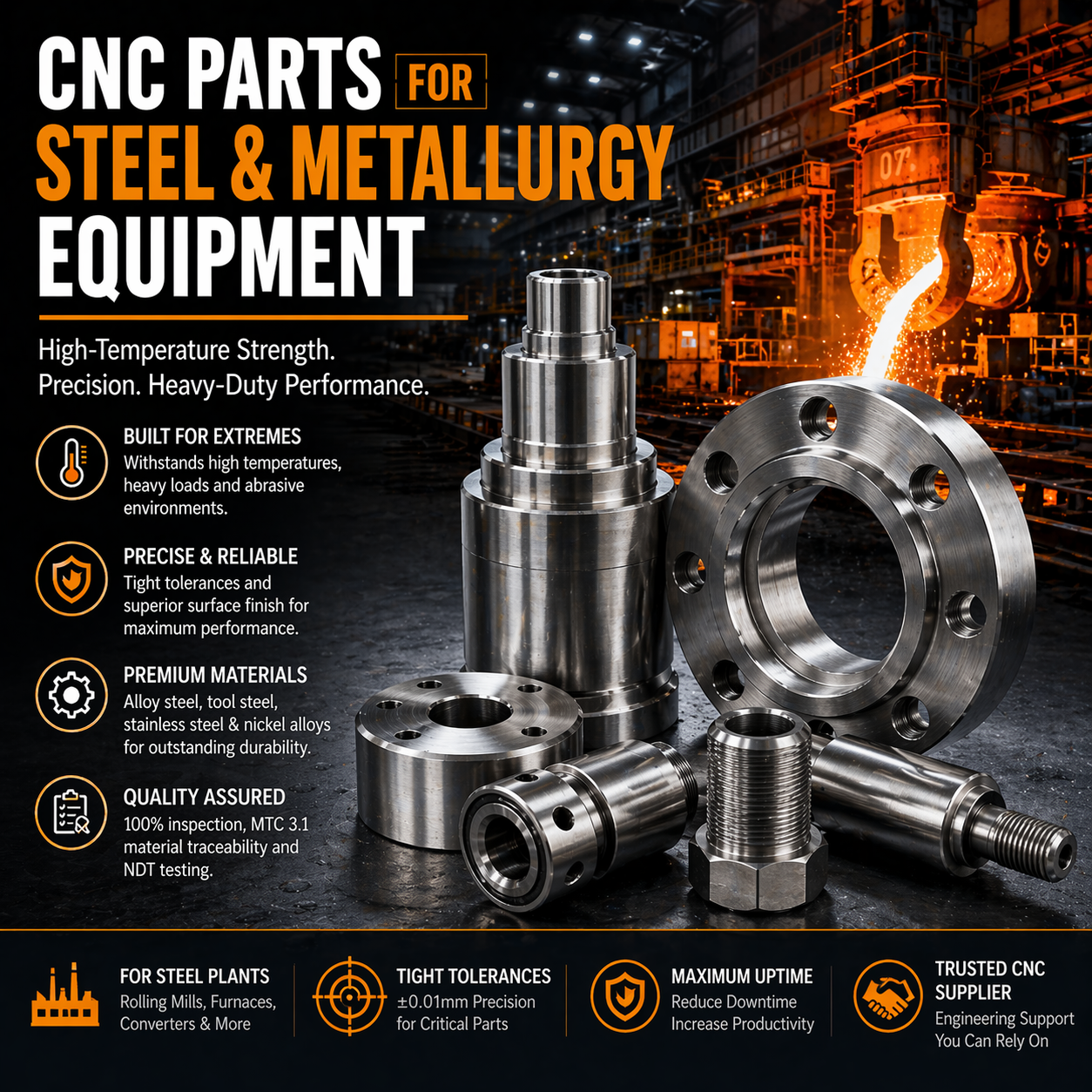
The steel and metallurgy industry is an environment of extremes. It is a world where components survive constant exposure to $1,200^C$ molten metal and multi-ton loads. Unlike water treatment systems that focus on long-term corrosion resistance, metallurgy equipment operates under extreme heat, heavy loads, and abrasive conditions. Material strength and thermal stability are the primary concerns.
For OEM buyers and plant engineers, the procurement of CNC Parts for Steel & Metallurgy Equipment is a critical strategy. Achieving long-term reliability requires a deep understanding of thermal expansion and material fatigue. This guide provides a technical analysis of how high-performance CNC machining supports the metallurgy sector.
2. The Role of CNC Parts in the Metallurgy Industry
In a steel plant, hardware faces a "triple threat": heat, load, and abrasion. Standard manufacturing methods often fall short of the required structural integrity. CNC machining for steel industry applications provides the geometric accuracy needed to endure these variables.
The Challenge of Thermal Expansion
Metals are "living" materials in a furnace environment. A part that fits at room temperature may seize at $800^C$. Precision CNC machining allows engineers to execute "operational clearances" that account for thermal growth. This is why experienced CNC machining suppliers for metallurgy equipment are critical in ensuring long-term operational reliability.
Heavy Loads and Vibration
Metallurgy equipment handles massive kinetic energy. Heavy-duty CNC machined parts must be free of internal stress risers. Subtractive CNC machining from forged billets ensures a consistent grain structure. This allows parts to handle cyclic loads without snapping.
3. Key CNC Parts in Metallurgy Equipment
Every stage of steelmaking relies on specific components. Identifying critical-to-quality (CTQ) features is vital for procurement success.
Rollers and Shafts: These require extreme concentricity. Even a 0.05 mm deviation at high speeds destroys bearings. Specialized CNC machining ensures these shafts maintain balance under intense heat.
Furnace Components: The "hot zone" requires high temperature resistant CNC components. Furnace arms must maintain rigidity to move heavy electrodes.
Valve and Flow Control Parts: Managing gases and cooling water requires high-performance valves. Sealing surfaces must be machined to Ra 0.8 or better for leak-free performance.
Structural Connectors: Connecting massive infrastructure requires heavy-duty CNC machined parts. These flanges must be perfectly flat to prevent hazardous leaks in high-heat zones.
Conversion Hook: Working with a dedicated CNC supplier for metallurgy equipment ensures these critical interfaces survive years of thermal cycling.
4. Material Selection for High-Temperature Environments
In metallurgy, the material is the foundation of the part's lifecycle. A reliable supplier must be an expert in heavy-duty alloys.
| Material Category | Typical Grades | Primary Benefit |
| Alloy Steel | AISI 4140, 4340 | High fatigue strength and excellent hardening. |
| Heat-Resistant SS | 310, 321, Duplex | Resists oxidation at temperatures up to $1,100^C$. |
| Tool Steel | H13, D2 | Retains hardness at elevated temperatures. |
| Nickel Alloys | Inconel 625, 718 | Superior resistance to extreme heat and slag. |
Engineering Insight: For the most critical shafts, 4340 alloy steel is the industry standard. It offers through-hardening capability for large-diameter parts. This ensures the core of the part handles heavy industrial torque.
5. Precision Requirements in Heavy-Duty CNC Parts
Precision in a steel plant is about maintenance reduction and safety. It is not just an aesthetic choice.
Thermal Expansion Tolerances: Interference fits must be functional at operating temperatures. This requires precision in the $\pm 0.01$ mm range.
Surface Finish for Wear Resistance: A rough surface finish ($Ra$) acts like a file in abrasive environments. CNC grinding ensures surfaces resist the "grinding" effect of industrial dust.
Structural Integrity: Precision machining removes the risk of stress concentrations. Replacing sharp angles with smooth, machined radii is essential for heavy-load performance.
Conversion Hook: This is why experienced CNC machining suppliers are critical in ensuring long-term wear resistance for moving mill components.
6. Real-World Scenario: The Business Impact
A major steel plant experienced frequent bearing failures on its primary conveyor rollers. The previous supplier had used manual lathes with high "runout." Under the heat and load of the mill, the vibration destroyed the bearings every 3 weeks.
We provided heavy-duty CNC machined parts using AISI 4140 steel. These were induction hardened and CNC ground to a $\pm 0.01$ mm tolerance.
The ROI Results:
Maintenance Interval: Increased from 3 weeks $\rightarrow$ 14 months.
Bearing Replacement Cost: Reduced by over 70%.
Total Downtime Loss: Reduced by more than $250,000 annually.
For steel plants, machining precision directly translates into operational profit.
7. Challenges in CNC Machining for Metallurgy Equipment
Manufacturing for this sector is harder than general-purpose machining. It requires specialized industrial knowledge.
Machining Hardened Materials
Many metallurgy parts are machined in a "pre-hardened" state ($30$–$45$ HRC). This requires high-rigidity CNC machines and specialized ceramic tooling.
Tool Wear and Heat Generation
Tough alloys like Inconel "eat" standard cutting tools. A professional CNC supplier for metallurgy equipment monitors tool life in real-time. This prevents dimensional drift during long machining cycles.
Maintaining Dimensional Stability
Large-scale parts are prone to "warping" during machining. Advanced shops use stress-relief heat treatments between stages. This ensures the part remains true to the blueprint.
8. Quality Control: The "Passport" of the Part
In heavy industry, you are buying verified performance, not just metal. Documentation is mandatory for safety.
Material Traceability (MTC 3.1): This proves the chemical composition and mechanical properties. At Lebometal, we provide 100% traceability.
Hardness Testing: We verify that induction hardening meets the HRC/HB requirements.
Dimensional Inspection: Using large-scale CMM to verify that multi-meter components meet tolerances.
Non-Destructive Testing (NDT): Ultrasonic inspection checks for internal cracks before the part is shipped.
9. Cost vs. Performance: The TCO Model
Procurement managers often prioritize "unit price." However, in a steel plant, the Total Cost of Ownership (TCO) is the only metric that matters.
| Feature | Low-Quality Part | Professional Component |
| Initial Price | $500$ | $850$ |
| Material Quality | Non-Traceable Carbon Steel | Verified AISI 4140/4340 |
| Surface Finish | Ra $3.2$ (Rough) | Ra $0.4$ (Precision) |
| MTBF (Failure Rate) | Every 6 Months | Every 3 Years |
Conversion Hook: A part that is 40% cheaper but fails 3 times as often actually costs the plant 800% more in maintenance. Choosing the right CNC machining for steel industry partner eliminates these hidden costs.
10. How to Choose a CNC Supplier for Metallurgy Equipment
Selecting the right partner is about risk mitigation. A general machine shop is not equipped for metallurgy demands.
Experience in Heavy Industry: Do they understand the scale? A metallurgy supplier must handle 500 kg+ shafts.
Large-Size Capability: Does the shop have the bed size and crane capacity for heavy components?
Material Expertise: Can they handle AISI 4340 or Inconel? These require specialized "feeds and speeds."
Documentation Rigor: Can they provide full MTC 3.1 and NDT reports?
11. Conclusion: Engineering for the Industrial Core
Steel and metallurgy are the foundation of global construction. The reliability of our industrial core depends on the integrity of the rollers and furnaces that drive them. High-performance CNC machining provides the bridge between extreme demands and operational stability.
By prioritizing high temperature resistant CNC components and verified traceability, OEM buyers ensure maximum uptime. Precision is the foundation of structural safety in the heat.
12. Secure Your Plant Uptime with Lebometal
In metallurgy environments, a single component failure can stop an entire production line. If you are sourcing CNC Parts for Steel & Metallurgy Equipment, long-term durability is your best defense.
At Lebometal, we provide:
Heavy-Duty Authority: Extensive experience with AISI 4340, H13 Tool Steel, and Inconel.
Micron-Level Precision: We maintain tolerances of $\pm 0.01$ mm for high-load mill components.
Verified Quality: 100% material traceability (MTC 3.1) and NDT inspection with every order.
Industrial Capacity: Large-size machining for the metallurgy industry's heaviest demands.
Stop fighting with premature failures and abrasive wear. Partner with a technical team that understands the heat.
📩 Send us your drawings today for a professional machining risk assessment.
→ Receive a comprehensive engineering review and a professional quotation within 24 hours.
Master your manufacturing timeline. Secure your plant's performance with Lebometal.
In metallurgy environments, machining quality directly affects production stability and equipment lifecycle.