
CNC Machined Parts for Renewable Energy Systems: Complete Guide for OEM Buyers
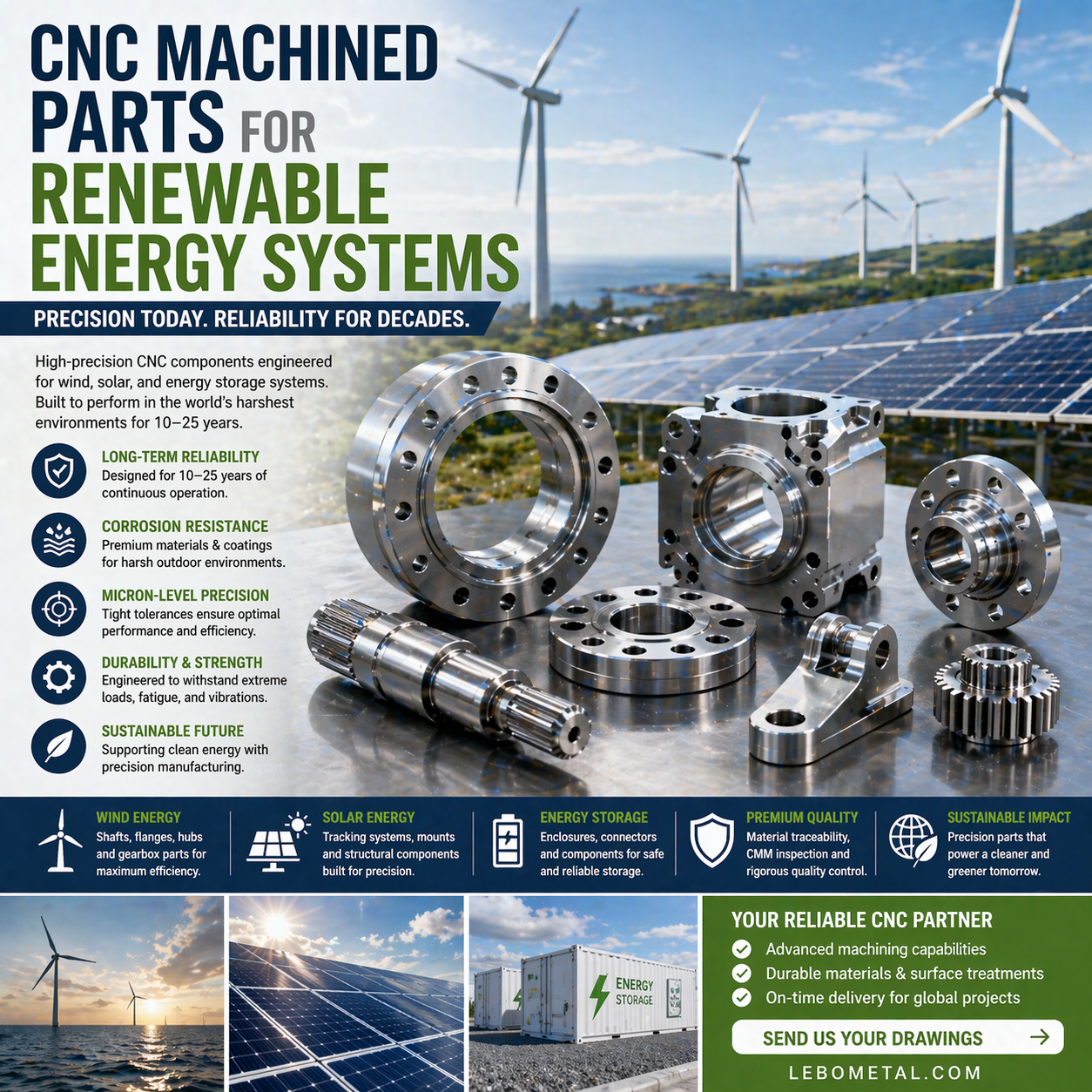
The global transition to sustainable power is more than a shift in energy sources; it is a revolution in industrial engineering. Unlike traditional power plants, which operate in controlled environments, renewable energy assets—wind farms, solar arrays, and hydroelectric stations—are distributed across the planet’s most unforgiving landscapes. Reliable CNC machined parts for renewable energy systems are essential to ensure long-term performance and system stability.
For an OEM (Original Equipment Manufacturer) buyer or an EPC (Engineering, Procurement, Construction) contractor, the primary currency is reliability. In the renewable sector, the “cost of failure” is not just the price of a replacement component; it is the astronomical cost of offshore crane mobilization, lost energy production, and liquidated damages. High-performance CNC machined parts for renewable energy systems are the foundation of this reliability.
2. Why CNC Machining is Critical in Renewable Energy
In the early stages of the renewable boom, many components were sourced from general-purpose casting or fabrication shops. However, as the industry has matured, the demand for precision has moved from “optional” to “essential.”
System Efficiency: In a wind turbine, a $0.05$ mm misalignment in the gearbox can create parasitic drag and harmonic vibrations, reducing electricity output and accelerating wear.
Long Service Life: Renewable assets are fixed-capital investments requiring a lifespan of two decades or more. CNC machining from wrought or forged billets provides superior structural integrity compared to casting.
Stable Output: CNC parts provide the geometric accuracy needed for solar tracking systems to respond perfectly to sensor inputs, maintaining the “sweet spot” of energy generation.
3. Common CNC Parts in Renewable Energy Systems
Wind Energy (Onshore & Offshore)
Main Shafts and Hub Parts: Handle massive torque and require high-precision bearing journals and splines.
Large-Diameter Flanges: Connect tower sections and blade hubs; these must be machined to extreme flatness to ensure a high-strength seal under gust loads.
Gearbox Components: Precision-cut gears that convert low-speed rotation to high-speed generation.
Solar Tracking and Concentrated Solar (CSP)
Actuator Housings: Solar trackers move slowly but with high torque. CNC housings provide the rigid, sealed environment these gears require.
Drive Shafts and Couplings: Connecting motors to panels across hundreds of meters.
Mounting Hubs: Ensuring panels are oriented within a fraction of a degree.
4. Materials Used in Renewable CNC Parts
| Material | Grades | Application | Functional Benefit |
| Stainless Steel | 316L, Duplex | Offshore Wind, Valves | Superior corrosion resistance in saline environments. |
| Aluminum | 6061-T6, 7075 | Solar Tracking, Brackets | High strength-to-weight ratio; reduces load on tracking motors. |
| Alloy Steel | 4140, 4340 | Turbine Shafts, Gears | Exceptional fatigue strength and toughness for high-torque loads. |
| Carbon Steel | A105, 1045 | Flanges, Structural parts | Cost-effective for massive structural parts. |
5. Tolerance & Precision Requirements
In renewables, precision is about alignment. For wind turbines, the concentricity of shafts and perpendicularity of flanges typically require tolerances in the $\pm 0.01$ mm to $\pm 0.05$ mm range. Even a 0.1 mm error on a large turbine shaft can lead to “point loading” on bearings, causing a catastrophic failure within the first year.
6. Surface Treatment & Corrosion Resistance
Renewable energy systems are arguably the most “exposed” machines on the planet. Surface treatment is the first line of defense against wind, rain, and UV.
Anodizing (Aluminum): Provides a protective oxide layer that resists UV degradation and sand abrasion.
Zinc-Nickel Plating: Preferred for precision-machined threads as it provides 1,000+ hours of salt spray resistance without the “bulk” of galvanizing.
C5-M Marine Grade Coatings: Essential for offshore wind components to survive extreme salt exposure.
7. Durability & Long-Term Performance
Renewables are characterized by fatigue. A wind turbine blade flexes and vibrates with every gust, creating “Cyclic Loading.” High-quality CNC machining focuses on controlled surface roughness ($Ra$) and radius management to eliminate “stress risers” where cracks begin. These systems are designed for low maintenance operation over decades.
8. Quality Control & Inspection
In the B2B renewable sector, quality must be built into the process:
CMM Inspection: Essential for verifying geometric tolerances of large-diameter flanges.
Material Traceability (MTC): Every part must be linked back to a Material Test Certificate (MTC 3.1) to prove it is free from internal inclusions or porosity.
ITP (Inspection Test Plan): Ensuring every batch meets CTQ (Critical-to-Quality) dimensions.
9. Challenges & Risks: The Cost of the “Cheap” Part
Corrosion Failure: Using 304 stainless instead of 316L in an offshore environment, leading to rust-seizing within 24 months.
Fatigue Cracking: Poor surface finish on a drive shaft leading to a snap under high-wind conditions.
The $250,000 Lesson: A wind farm developer saved $50,000 on flanges, but a slight flatness error ($0.15$ mm) caused a bearing to seize, resulting in a $250,000 offshore repair bill.
10. Buyer Checklist: De-Risk Your Renewable Project
[ ] Material: Verified alloy/stainless with MTC 3.1 required?
[ ] Coating: Is the coating (Galvanizing/Anodizing) specified for a 20-year outdoor life?
[ ] Tolerance: Are rotating interfaces specified to at least $\pm 0.02$ mm?
[ ] Fatigue: Are all internal sharp corners radiused to prevent stress risers?
[ ] Traceability: Has the supplier confirmed heat-number tracking for the entire batch?
11. Conclusion
In the renewable energy sector, the machine is the investment. A wind turbine or solar tracker is only as successful as its ability to operate without human intervention for decades. CNC machined parts for renewable energy systems provide the structural and geometric certainty required for this long-term performance. Reliable CNC machined parts for renewable energy systems are essential to ensure long-term performance and system stability.
By prioritizing precision, material traceability, and robust surface protection, OEM buyers can ensure that their projects move from “installation” to “operation” with zero surprises.
12. Protect Your Long-Term Energy Investment
Don’t let a sub-par component jeopardize your 20-year energy ROI. Whether you are building the next generation of solar trackers or maintaining a massive wind fleet, reliability starts at the component level. Ensure your renewable systems operate reliably for decades.
Send your drawings to Lebometal today to receive:
High-reliability CNC machining solutions tailored for energy assets.
Material and corrosion resistance recommendations for extreme environments.
Lifecycle-focused engineering support to maximize your project’s uptime.
Master your manufacturing timeline. Contact Lebometal.com today.