
CNC Components for Agricultural Machinery: Engineering for Durability in the Field
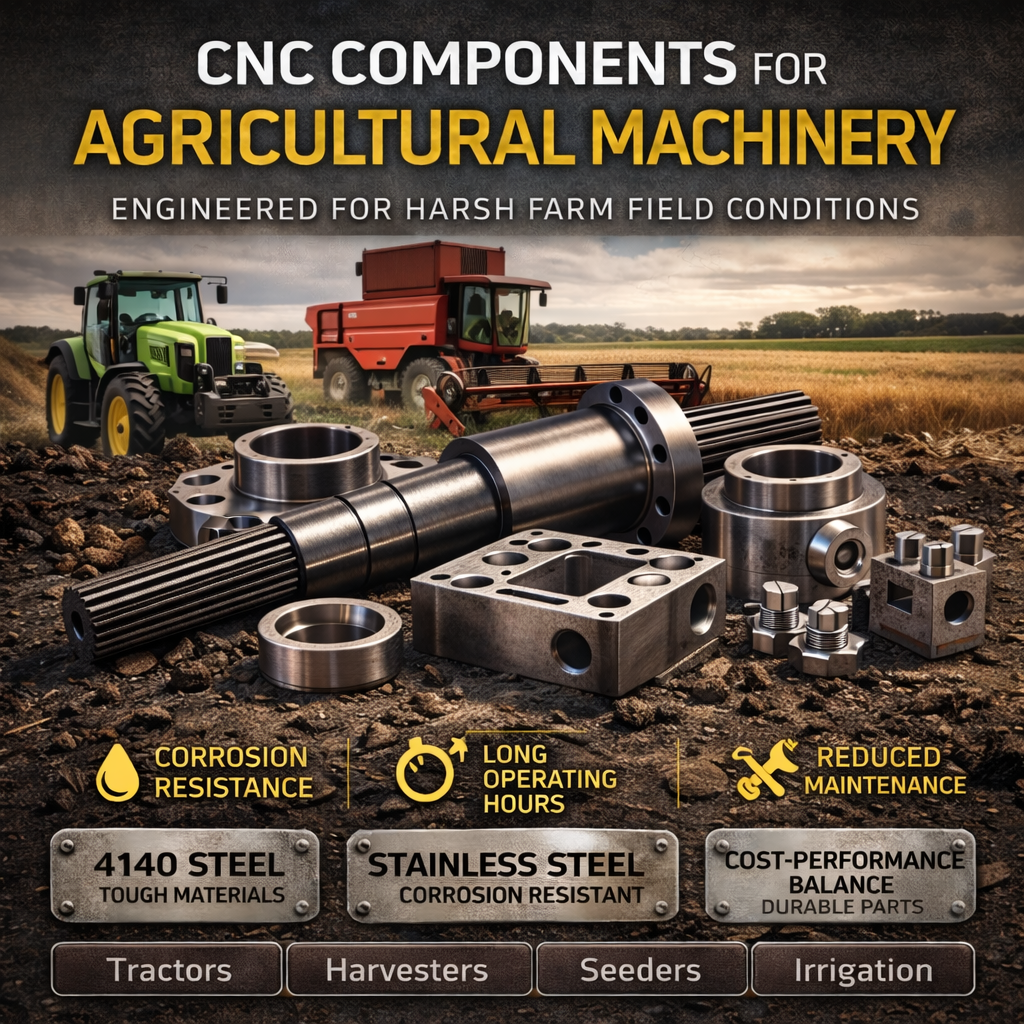
In the modern agricultural sector, the image of the manual plow has been replaced by high-tech, GPS-guided, and highly automated machinery. As farming scales to meet global demand, the reliability of equipment becomes the primary driver of profitability. When a machine fails during the narrow window of harvest or planting, the cost is not just the repair bill—it is the potential loss of an entire season’s yield.
For OEM buyers and procurement managers, CNC components for agricultural machinery represent the critical link between high-tech design and high-durability performance. Unlike the controlled environment of a factory floor, agricultural equipment operates in a brutal ecosystem of abrasive dust, heavy mud, extreme moisture, and chemically aggressive fertilizers. To survive, these components must be engineered for “Severe Service” while maintaining a competitive cost-performance balance.
2. What Makes Agricultural CNC Components Different?
Agricultural environments are unique in their combination of mechanical stress and chemical exposure. CNC machining for farming equipment must address specific challenges that standard industrial parts rarely face:
Long Operating Hours: During peak seasons, machines run nearly 24/7. This puts immense fatigue stress on every rotating shaft, pin, and bushing.
Abrasive Environments: Soil and grain dust act as microscopic sandpaper. Without precision fit and surface hardness, components experience rapid dimensional wear.
Chemical Corrosion: Fertilizers and pesticides are highly corrosive to metal. Corrosion resistant CNC components are essential to prevent structural weakening and seized joints.
In agricultural machinery, precision is not about perfection—it is about ensuring consistent performance, reducing maintenance, and protecting crop yield under harsh field conditions.
3. Targeted Applications in Agricultural Equipment
Precision machining is the foundation of modern “Ag-Tech.” Here is how agricultural machinery CNC parts are utilized across the fleet:
Tractors
The tractor is the central power unit of the farm.
Critical Components: PTO (Power Take-Off) shafts, transmission housings, engine mounts, and hydraulic connectors.
Technical Focus: These parts handle massive torque. CNC turning ensures that spline shafts are perfectly aligned to prevent vibration and mechanical loss.
Harvesters
Combine harvesters are massive, complex mobile factories.
Critical Components: Rotor shafts, gear housings, cutting system drive components, and auger mounts.
Technical Focus: Harvesters involve high-speed rotation. Precision-machined bearing seats are vital to prevent premature bearing failure in the middle of a field.
Seeders
Modern seeders require high precision to ensure correct seed depth and spacing.
Critical Components: Seed metering plates, depth control pins, and linkage bushings.
Technical Focus: These are durable CNC parts agriculture specialists focus on for accuracy. If a seed plate is off by even 0.1mm, it can cause “skipping,” directly impacting crop yield.
Irrigation Systems
Irrigation relies on the movement of water, often mixed with chemicals.
Critical Components: Pump impellers, valve bodies, high-pressure fittings, and flanges.
Technical Focus: These require corrosion resistant CNC components. Utilizing stainless steel or specialized aluminum alloys ensures these systems can withstand constant water exposure without leaking.
4. Common CNC Components in Agriculture
Modern farming relies on a variety of high-performance machined parts:
Shafts and Pins: The “skeleton” of the machine. These act as pivot points or power transmitters.
Bushings and Sleeves: These provide the low-friction interface that protects expensive structural frames from wear.
Flanges and Connectors: Critical for hydraulic systems that power the lifting and folding functions of large implements.
Structural Components: Heavy-duty brackets and mounts that must clear other moving parts while maintaining rigidity.
5. Materials Used: Balancing Cost and Strength
In agriculture, over-engineering can be as damaging to the bottom line as under-engineering. Material selection is about finding the optimal balance for the specific application.
| Material | Key Properties | Typical Application |
| 1045 Carbon Steel | Cost-effective, good strength | General pins, simple shafts, structural brackets |
| 4140 Alloy Steel | High fatigue strength, toughness | High-torque PTO shafts, transmission gears |
| Stainless Steel (316) | Superior corrosion resistance | Irrigation fittings, chemical spray nozzles |
| Aluminum (6061) | Lightweight, thermal conductivity | Electronic housings, pneumatic manifolds |
6. Precision and Tolerance Requirements
There is a common misconception that farming equipment is “clunky” and doesn’t need precision. In reality, precision is what enables durability.
The Tolerance Balance: While a frame bracket might only need $\pm 0.1$mm, a bearing seat in a harvester rotor needs $\pm 0.01$mm.
Maintenance Impact: A part that fits perfectly vibrates less. Less vibration means fewer loose bolts and a longer life for the hydraulic seals. By investing in CNC components for agricultural machinery with tighter tolerances, you effectively reduce the total maintenance hours required per season.
7. Surface Treatment and Durability
Heat Treatment: Induction hardening is frequently used on 1045 or 4140 shafts to create a hard outer “shell” to resist abrasive dust while keeping the core ductile to absorb impacts.
Anti-Corrosion Coatings: Zinc plating or specialized powder coating protects parts from fertilizers and high-humidity storage.
Surface Finish: For irrigation and hydraulic connectors, a surface finish of Ra 0.8um is standard to ensure that seals remain leak-free over years of service.
8. Quality Control for Agricultural Parts
A failure in the field is too expensive to risk. At Lebometal, our QC process for agricultural parts includes:
Material Traceability: Ensuring the 1045 steel we use is actually 1045, backed by MTC 3.1 certificates.
Hardness Testing: Verifying that the induction hardening has reached the specified depth to handle abrasive mud.
Dimensional Inspection: Utilizing CMM (Coordinate Measuring Machines) to ensure mounting holes align perfectly for fast assembly on the OEM production line.
9. How to Choose a CNC Supplier for Agriculture
For an OEM procurement manager, the ideal supplier is a partner who understands the “Seasonality” of the business. Look for:
Cost-Performance Balance: Can they suggest a material change that saves money without sacrificing part life?
Material Expertise: Do they have experience handling corrosion resistant CNC components?
Delivery Stability: Agriculture waits for no one. Can they guarantee delivery before the harvest window opens?
10. Our Capabilities for Agricultural Machinery Components
As a specialized manufacturer of CNC components for agricultural machinery, Lebometal supports OEM buyers with a technical infrastructure built for the field:
Advanced Machining: 3-axis and 5-axis CNC machining centers for complex manifolds, shafts, and connectors used in Tractors and Harvesters.
High-Durability Focus: Expertise in heat treatment and surface finishing to ensure parts survive abrasive mud and dust.
Optimized Production: Scalable batch production for Seeders and Irrigation systems, ensuring stable delivery and competitive pricing.
Integrated Export Support: Full documentation (CI, PL, MTC 3.1) and specialized anti-corrosion packaging for global shipping.
11. Conclusion: Precision as a Farming Strategy
In the agricultural sector, precision machining is not an added expense—it is a cost-saving strategy. By investing in CNC components for agricultural machinery that meet strict material and durability standards, OEM buyers can protect their brand reputation and ensure their customers’ equipment runs reliably through every season.
Looking for a reliable supplier for CNC components for agricultural machinery?
Send us your drawings today to receive:
Cost-performance optimized material solutions for farming equipment
Corrosion-resistant and wear-resistant component design * Precision machining to improve consistency and reduce maintenance
Full QC documentation including MTC 3.1 and inspection reports
Contact Lebometal now at Lebometal.com to improve equipment reliability and protect your harvest performance.