
Buyer’s Guide to Custom CNC Hydraulic Fittings
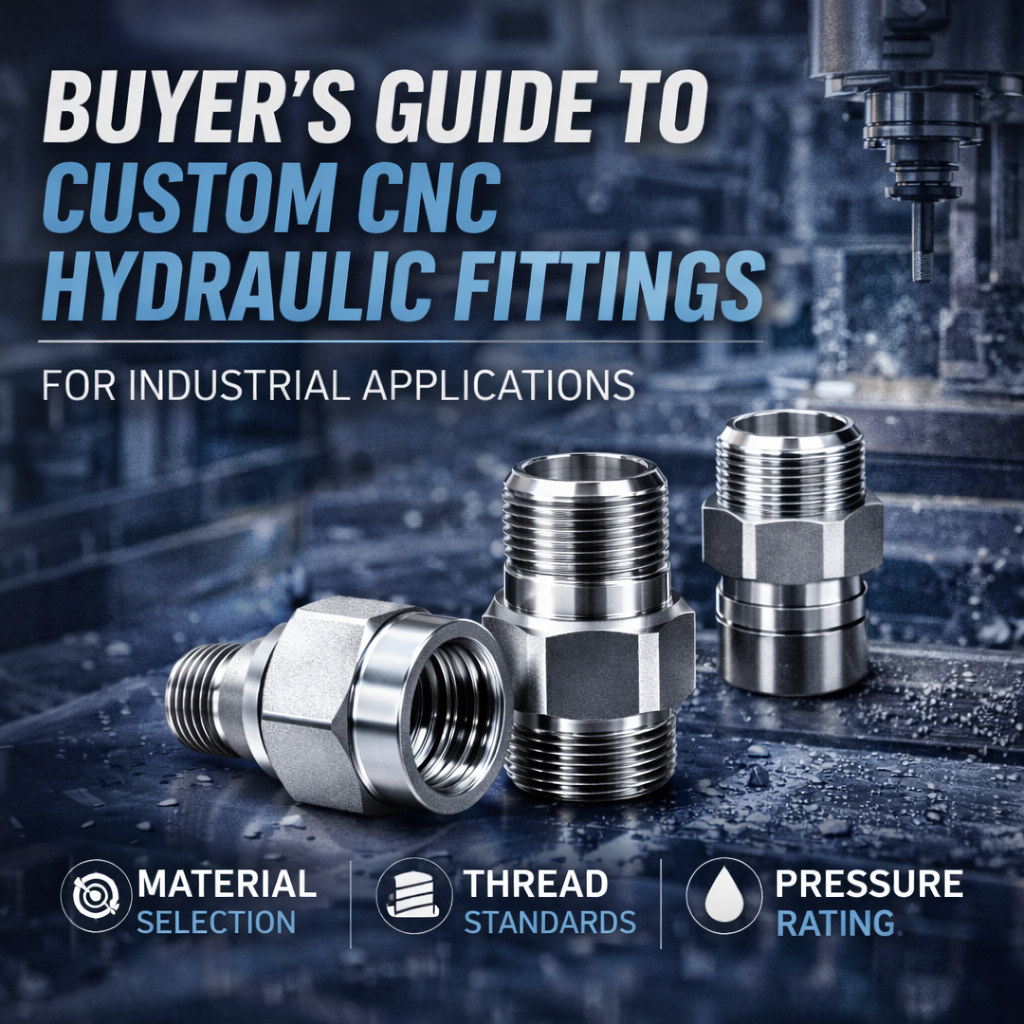
1. Introduction
Procuring components for fluid power systems is an inherently high-risk endeavor. In industrial applications, hydraulic systems generate, transmit, and control immense mechanical power by utilizing fluids under extreme pressure. Within these volatile environments, the connection points—the fittings—are the most critical and vulnerable links. A single compromised connection can result in catastrophic fluid blowouts, severe workplace safety hazards, environmental contamination, and thousands of dollars in unplanned operational downtime.
For procurement teams, the biggest challenge is not just sourcing fittings—but ensuring compatibility, pressure safety, and long-term reliability across different systems and standards.
For industrial buyers, procurement managers, and OEM engineers, relying on standard, mass-produced cast fittings is often insufficient for specialized machinery. To guarantee leak-free performance, precise flow control, and pressure reliability, buyers must turn to custom CNC hydraulic fittings. Advanced computer numerical control (CNC) machining eliminates the microscopic defects found in standard castings, delivering the exact geometries, flawless thread profiles, and robust structural integrity required to keep high-pressure fluid systems running safely.
2. What Are Custom CNC Hydraulic Fittings
Standard hydraulic fittings are mass-produced catalog items designed to connect common hose and tube sizes using standard port thread configurations. While cost-effective, they are limited by generic material grades, standard tolerances, and fixed geometries.
Custom CNC hydraulic fittings, conversely, are bespoke connection components engineered and machined to highly specific blueprints. Rather than being cast in a mold, they are precision-machined from solid blocks or extruded bars of high-grade metal (billet). A reliable hydraulic fittings manufacturer utilizes multi-axis CNC lathes and mills to cut the internal fluid bores, shape the external mating surfaces, and thread the connection points with microscopic accuracy.
OEM and industrial buyers require these custom solutions when designing proprietary machinery, such as heavy-duty excavators, specialized agricultural harvesters, automated injection molding presses, or subsea blowout preventers, where standard catalog parts cannot accommodate the required flow rates, spatial constraints, or extreme operational pressures.
3. When Should You Choose Custom Instead of Standard
While catalog components serve basic needs, several engineering scenarios strictly dictate the procurement of custom hydraulic fittings:
Non-Standard Thread Combinations: Often, an engineer must connect a European metric pump port directly to an American JIC hydraulic hose. If a standard adapter does not exist, or if stacking multiple standard adapters creates unacceptable leak paths, a custom transition fitting is the only viable solution.
Space Constraints: Modern machinery is incredibly compact. When fluid lines must navigate tight engine blocks or complex automated chassis, custom multi-port manifolds or unique angled elbows (e.g., a specific 33-degree bend rather than a standard 45-degree or 90-degree) become necessary to maintain fluid flow without kinking hoses.
High-Pressure Systems: Standard cast fittings contain microscopic voids and porosity that will fracture under extreme loads. Systems operating above 5,000 PSI require high pressure hydraulic fittings machined from solid, high-tensile alloy billets.
Corrosive Environments: Standard fittings are typically made of carbon steel with basic zinc plating. For offshore oil rigs, marine applications, or chemical processing plants, buyers must source custom fittings machined from specialized, highly corrosion-resistant alloys like 316L stainless steel or duplex stainless steel.
4. Key Factors Buyers Must Evaluate
When sourcing components, the technical specifications dictate the ultimate success of the procurement cycle. Buyers must evaluate the following critical factors before finalizing an order with a CNC hydraulic fittings supplier.
Material Selection
The raw material fundamentally determines the component’s burst pressure, corrosion resistance, and overall lifecycle cost. For a comprehensive dive into metallurgy, refer to our detailed guide on Materials for CNC Hydraulic Fittings.
Carbon Steel: The industry workhorse. It offers exceptional tensile strength for high-pressure applications and is highly cost-effective and machinable. Because it is highly susceptible to rust, it strictly requires secondary surface plating (such as zinc or zinc-nickel).
Stainless Steel: Premium grades like 304 and 316L offer outstanding natural corrosion resistance and high strength. Stainless steel is mandatory for marine environments, offshore drilling, and strict hygiene applications (like food processing). It is significantly more expensive and harder to machine than carbon steel.
Brass: Naturally resistant to corrosion and highly machinable, keeping production costs low. However, brass is a soft metal with low tensile strength, making it suitable only for low-pressure fluid lines, pneumatics, and cooling circuits.
Aluminum: Alloys like 6061-T6 provide an excellent strength-to-weight ratio. Aluminum is utilized exclusively in weight-sensitive applications, such as aerospace hydraulics, mobile robotics, and high-performance automotive fluid systems.
Material Comparison Table
| Material | Tensile Strength | Corrosion Resistance | Relative Cost | Primary Application |
| Carbon Steel | High | Low (Requires coating) | Low | Heavy Machinery, General Industry |
| Stainless Steel 316L | High | Excellent | High | Marine, Oil & Gas, Chemical |
| Brass | Low | Good | Medium | Low-Pressure, Pneumatics |
| Aluminum 6061 | Medium | Good (When anodized) | Medium | Aerospace, Robotics, Weight-Sensitive |
Thread Standards
Threads are the mechanical anchor of the fluid seal. A mismatch here guarantees catastrophic failure. To prevent costly compatibility errors, review our breakdown of Thread Standards in Hydraulic Fittings. Buyers must precisely specify the required global thread standard:
NPT (National Pipe Taper): The North American standard. Tapered threads wedge together to form a seal, requiring Teflon tape or liquid sealant. They are generally not recommended for extreme high-pressure due to the wedging force expanding the female port.
BSP (British Standard Pipe): Common in Europe and Asia. BSPP (parallel) relies on a bonded washer or O-ring for sealing, while BSPT (tapered) operates similarly to NPT.
JIC (37-Degree Flare): Utilizes straight threads to pull two 37-degree flared metal surfaces together. The resulting metal-to-metal crush seal is exceptionally reliable in high-vibration environments.
ORB (O-Ring Boss): Uses straight threads to compress an elastomeric O-ring into a machined chamfer. It provides superior, zero-leak performance and withstands intense pressure transients.
Metric Threads: Standardized by ISO, these parallel threads rely on O-rings or cutting rings and are dominant in modern European manufacturing.
Pressure Rating
A fitting’s pressure rating is the maximum fluid pressure it can safely contain. Buyers must understand the system’s Working Pressure (the continuous operational load) and specify an appropriate Safety Factor (often 4:1 for industrial hydraulics). This means a fitting designed for a 5,000 PSI working pressure must have an engineered burst pressure of at least 20,000 PSI. Failure to communicate PSI requirements to the manufacturer will result in under-engineered, dangerous components.
Surface Treatment
If carbon steel is selected, buyers must specify the exact post-machining surface treatment to prevent environmental degradation.
Zinc Plating: Standard economical protection against basic oxidation.
Zinc-Nickel Plating: An advanced coating offering up to ten times the corrosion resistance of standard zinc; ideal for agricultural and mobile equipment exposed to harsh weather and road salts.
Passivation: A chemical treatment for stainless steel that removes free iron from the surface, accelerating the formation of a protective chromium-oxide layer.
Anodizing: An electrochemical process for aluminum that thickens the natural oxide layer, drastically improving surface hardness and wear resistance against thread galling.
Tolerance & Sealing Surfaces
In high-pressure systems, leak-free performance is entirely dependent on the precision of the sealing surfaces. For JIC flares or O-ring grooves, the surface roughness (Ra) must be exceptionally smooth—often Ra 1.6 µm or better. If the CNC tooling leaves chatter marks or burrs, pressurized fluid will bypass the seal. Precision hydraulic fittings require a manufacturer capable of holding tight dimensional tolerances (often ±0.01mm) to ensure perfect concentricity and mating alignment.
5. CNC Manufacturing Capabilities to Look For
Not all machine shops are equipped to handle the rigorous demands of fluid power components. When evaluating a potential manufacturing partner, industrial buyers should verify the facility possesses specific CNC capabilities:
CNC Turning: The foundation of fitting manufacturing. Rigid, high-speed turning centers are required to spin raw bar stock and precisely profile the cylindrical inner and outer diameters.
Mill-Turn Machining: Advanced multi-axis machines feature live tooling, allowing the machine to stop spinning the part and use milling cutters to cut external hex flats or cross-drill intersecting fluid ports without unclamping the part. This guarantees perfect concentricity between the threads and the wrenching flats.
Thread Cutting Accuracy: The shop must utilize rigid tapping and high-quality carbide single-point threading inserts to cut flawless thread pitches that do not gall or bind during assembly.
Deep Hole Drilling: For custom manifold blocks, the supplier must have high-pressure through-spindle coolant systems to efficiently evacuate metal chips while drilling deep internal fluid channels, preventing internal scoring that causes fluid turbulence.
6. Quality Control Checklist
The true value of a custom fitting is proven through metrology and testing. To learn exactly how premium suppliers verify their parts, read our comprehensive overview on Quality Inspection for Hydraulic Fittings. Buyers must ensure the supplier utilizes a robust quality control protocol:
Thread Gauges: Operators must use calibrated Go/No-Go thread pitch gauges directly on the shop floor for 100% thread verification during production.
CMM Inspection: A Coordinate Measuring Machine (CMM) must be utilized in a climate-controlled lab to verify complex Geometric Dimensioning and Tolerancing (GD&T) callouts, such as angularity of flared seats and concentricity.
Pressure Testing: Premium suppliers should offer hydrostatic pressure testing capabilities, allowing them to pressurize sample batches to their maximum burst ratings to physically prove the engineering design.
Material Certification (MTC): The supplier must provide EN 10204 3.1 Material Test Certificates, proving the chemical composition and mechanical properties of the raw billet steel are fully traceable back to the mill.
7. Supplier Evaluation Checklist
Selecting a reliable CNC hydraulic fittings supplier is a strategic procurement decision. Use the following checklist to vet potential manufacturing partners during the Request for Information (RFI) phase.
Supplier Vetting Matrix
| Evaluation Category | What to Verify | Why It Matters |
| Machining Capability | Multi-axis CNC mill-turn centers | Ensures complex geometries and hex flats are cut concentrically in one setup. |
| Material Handling | Ability to machine 316L and Alloy steels | Proves competence in high-strength, difficult-to-machine metals. |
| Thread Standards | Experience with NPT, BSP, JIC, Metric | Guarantees perfect pitch and angle execution for leak-free mating. |
| Quality Control | CMM, Go/No-Go gauges, Profilometers | Verifies dimensions, thread accuracy, and sealing face surface roughness (Ra). |
| Testing | In-house hydrostatic pressure testing | Physically proves the burst rating and safety factor of the batch. |
| Documentation | ISO 9001, Material Test Certificates (MTC) | Ensures full supply chain traceability and standardized management. |
| Lead Time & MOQ | Flexible scaling from prototype to batch | Ensures the supplier can support both pilot runs and mass OEM production. |
| Engineering Support | Design for Manufacturability (DFM) review | Prevents costly design flaws and optimizes the part for faster, cheaper machining. |
8. Common Mistakes Buyers Make
Procurement errors in the fluid power sector often lead to severe mechanical failures. Avoid these common pitfalls:
Choosing the Lowest Price: Selecting a supplier solely on piece-price often results in poor surface finishes, lack of material traceability, and microscopic thread defects that lead to massive downtime costs later.
Ignoring Thread Compatibility: Assuming a generic “1/4-inch” specification is sufficient. A 1/4-inch NPT will violently blow out of a 1/4-inch BSPP port under pressure.
Over-Specifying Tolerances: Demanding aerospace-level tolerances (e.g., ±0.001mm) on non-critical external surfaces drastically inflates machining time and cost without improving sealing performance. Focus tight tolerances only on sealing faces and threads.
Not Asking for Testing: Assuming the part will hold pressure just because the dimensions match the drawing. Always demand material traceability and inquire about hydrostatic testing.
9. Cost Factors
Understanding how manufacturers price custom hydraulic fittings allows procurement managers to negotiate effectively and optimize designs. The final unit price is dictated by:
Material Costs: Heavy reliance on market fluctuations. Premium alloys like 316L are significantly more expensive per pound than standard 1045 carbon steel.
Machining Time: The harder the material and the tighter the tolerance, the slower the CNC machine must run. Slow cycle times and excessive cutting tool wear directly increase the price.
Part Complexity: Features requiring secondary setups (like off-axis drilling) or specialized custom threading tools increase the Non-Recurring Engineering (NRE) setup costs.
Production Volume (MOQ): CNC machining features high initial setup costs. Ordering a prototype batch of 10 pieces will result in a very high per-unit cost, whereas ordering 5,000 pieces allows the setup cost to be amortized, drastically lowering the individual unit price.
10. How to Send an RFQ
A precise Request for Quote (RFQ) eliminates guesswork and results in faster, more accurate pricing. When contacting a hydraulic fittings manufacturer, always include the following:
Engineering Files: Provide both 3D CAD models (STEP files) for the machinist to program the toolpaths, and 2D technical drawings (PDF format) highlighting critical tolerances and thread callouts.
Key Specifications: Explicitly state the thread standard (e.g., 3/4″-16 UNF JIC), the target working pressure (e.g., 5,000 PSI), and the specific material grade (e.g., AISI 316L).
Quantities: Request tiered pricing to understand the economies of scale (e.g., quote for 100 pcs, 500 pcs, and 2,000 pcs).
Surface Finish Requirements: Detail any required plating (e.g., Zinc-Nickel to ASTM B841) and the maximum allowable surface roughness (Ra) on the sealing faces.
11. Need Custom CNC Hydraulic Fittings for Your Project?
If you are sourcing high-pressure or non-standard hydraulic fittings, working with an experienced CNC manufacturer is critical.
At Lebo Metal, we support OEM clients with:
Custom thread standards (NPT, BSP, JIC, Metric)
High-pressure applications up to 10,000+ PSI
Precision CNC machining with tight tolerance control
Full inspection reports (MTC, CMM, pressure testing)
Send us your drawing (STEP/PDF), and our engineering team will provide DFM feedback and a quotation within 24–48 hours.
12. Conclusion
In the demanding landscape of industrial fluid power, connection components are not a commodity where corners can be cut. Sourcing reliable custom CNC hydraulic fittings requires a thorough understanding of material metallurgy, international thread standards, and strict quality control protocols.
For OEM engineers and industrial buyers, the ultimate goal is risk mitigation. Selecting the right CNC hydraulic fittings supplier is vastly more important than securing the lowest upfront piece-price. A capable manufacturing partner will provide proactive engineering support, verified material traceability, and flawless CNC execution, ensuring your heavy machinery operates safely and efficiently for years to come. By applying the checklists and technical criteria outlined in this guide, procurement teams can confidently navigate the supply chain and secure the precision components their high-pressure systems demand.