
Hydraulic Fitting Thread Standards Explained: NPT vs BSP vs Metric
1. Introduction: Why Thread Standards Matter
For industrial buyers and engineers, selecting the correct hydraulic fitting thread standards is critical to ensuring system compatibility, preventing leaks, and avoiding costly equipment failures. A hydraulic system can have the most robust pumps and reinforced hoses on the market, but if the connections do not perfectly mate, the system will fail. Connection failures lead to severe consequences: hazardous fluid leaks, catastrophic blowouts, costly unplanned downtime, and significant safety risks to personnel.
Navigating these standards is a critical requirement. The global market is saturated with different equipment origins, meaning buyers will inevitably encounter American, British, and European specifications. Understanding these standards ensures system compatibility, eliminates the risk of mismatched components, and streamlines the procurement process for replacement parts and new assemblies.
2. Overview of Hydraulic Thread Types
Before diving into specifics, having hydraulic thread types explained provides a baseline for procurement decisions. The industry relies on several primary standards to secure high-pressure fluid lines.
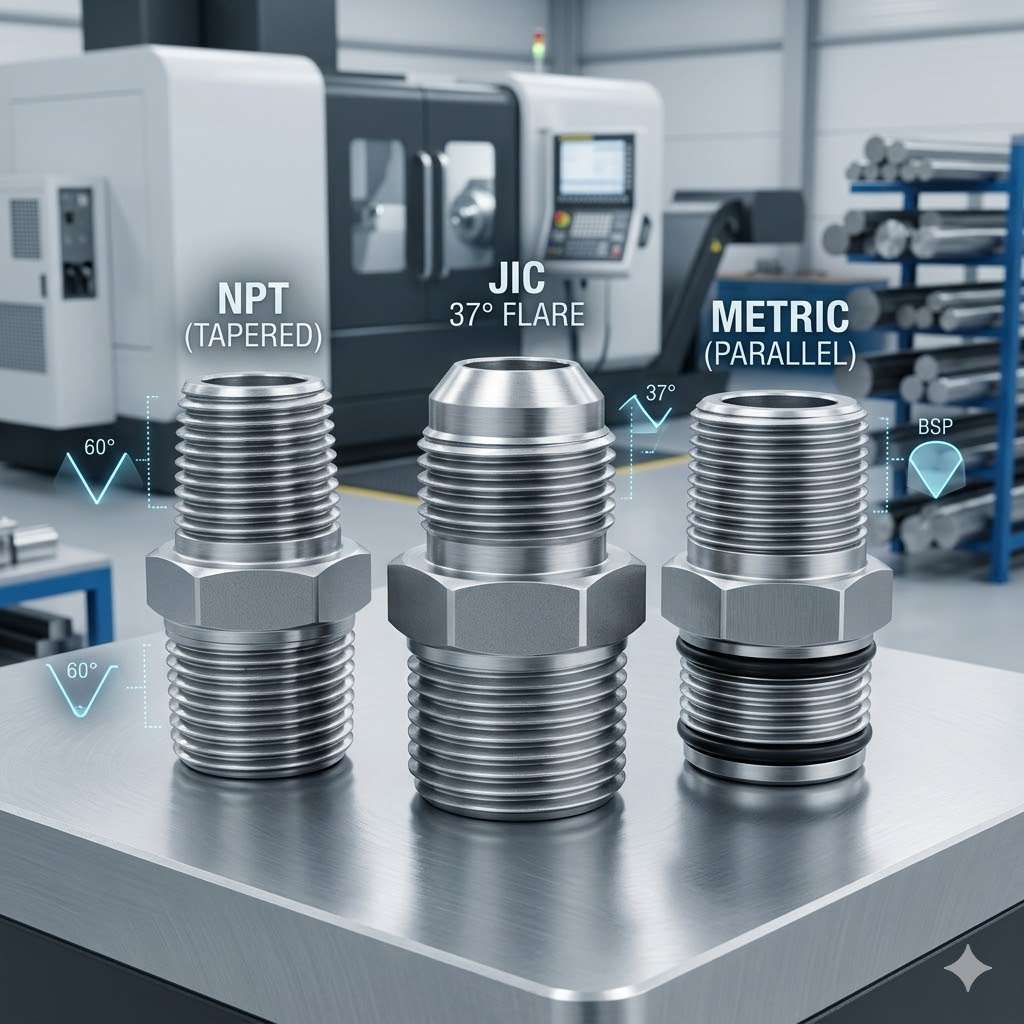
The most globally recognized standards are NPT, BSP, and Metric. However, buyers will also frequently encounter JIC (Joint Industry Council, featuring a 37° flare) and ORB (O-Ring Boss, using straight threads and an O-ring seal). While JIC and ORB are excellent for high-pressure and high-vibration environments, the foundational pipe thread standards—NPT, BSP, and Metric—often cause the most confusion and compatibility issues on the shop floor.
3. NPT Thread Standard (National Pipe Taper)
The National Pipe Taper (NPT) standard is the traditional and most widely used thread type in the United States and Canada. NPT threads are tapered, meaning the diameter of the thread decreases slightly toward the tip of the fitting.
As a male NPT fitting is threaded into a female NPT port, the tapered flanks wedge tightly together. To achieve a leak-free seal, NPT relies on this thread deformation combined with a thread sealant (like Teflon tape or pipe dope) to fill the microscopic gaps between the metal surfaces.
While cost-effective and universally available in North America, NPT has limitations. The wedging action places immense outward radial stress on the female port. In extreme high-pressure applications, over-tightening an NPT fitting can actually crack the surrounding metal port. Because of this, reviewing Materials for CNC Hydraulic Fittings is vital to ensure the port can withstand this expansion stress.
4. BSP Thread Standard (BSPP vs BSPT)
The British Standard Pipe (BSP) is the standard of choice across the UK, Europe, Asia, and Australia. It utilizes the Whitworth thread form, which features rounded peaks and valleys. When dealing with BSP, buyers must understand the critical difference between its two variations: BSPP and BSPT.
BSPP (British Standard Pipe Parallel): These threads are straight. Because they do not wedge together, they cannot seal on their own. BSPP relies entirely on a mechanical seal, such as an embedded O-ring or a bonded washer, which compresses between the fitting shoulder and the port face.
BSPT (British Standard Pipe Tapered): Similar to NPT, these are tapered threads that wedge together to form a seal, typically requiring a sealant.
The fundamental BSP vs NPT difference lies in the thread angle and the shape of the thread crests, meaning they are completely incompatible despite looking visually similar to the untrained eye.
5. Metric Thread Standards
Standardized by the International Organization for Standardization (ISO), metric hydraulic fittings are the default choice for modern European and Asian machinery. Metric threads are easily identified by their precise millimeter-based sizing and parallel (straight) thread design.
Because the threads are straight, metric fittings do not seal via thread deformation. Instead, they rely on highly reliable mechanical sealing methods. This usually involves an O-ring seated in a machined chamfer or a specialized bite/cutting ring that grips the hydraulic tube as a nut is tightened. Metric systems are highly favored in modern manufacturing because they offer excellent reusability; since the threads do not deform upon installation, they can be disassembled and reassembled multiple times without losing their sealing integrity.
6. NPT vs BSP vs Metric: Key Differences
Understanding the nuances between NPT vs BSP fittings and Metric standards is essential for preventing dangerous mismatches.
The most defining difference is the thread angle. NPT threads are cut at a 60° angle with flattened peaks and valleys. BSP threads are cut at a 55° angle with rounded peaks and valleys. This is the core difference. Furthermore, Metric threads also use a 60° angle but are measured by their outer diameter and pitch in millimeters, whereas NPT and BSP use imperial fractional sizes and Threads Per Inch (TPI).
Hydraulic Thread Standards Comparison Table
| Thread Type | Thread Angle | Taper/Parallel | Sealing Method | Region |
| NPT | 60° | Tapered | Thread deformation + Sealant | North America |
| BSPP | 55° | Parallel | O-ring or Bonded Washer | Europe, Asia, UK, AUS |
| BSPT | 55° | Tapered | Thread deformation + Sealant | Europe, Asia, UK, AUS |
| Metric (ISO) | 60° | Parallel | O-ring or Cutting Ring | Global (Standardized) |
In most industrial applications, metric and BSPP fittings are preferred for their reliable sealing performance, while NPT is mainly used for legacy systems in North America.
7. Compatibility and Interchangeability Risks
A golden rule in fluid power is that you must never mix different hydraulic fitting thread standards. They are absolutely not interchangeable.
Because NPT and BSP threads share similar diameters and TPI counts in certain sizes (such as the 1/2″ and 3/4″ sizes where both use 14 TPI), a mechanic might successfully thread a male NPT fitting into a female BSP port for a few turns. It may even feel tight. However, because the 60° and 55° angles clash, the threads will cross-thread and strip the metal. As detailed in our guide on High-Pressure Hydraulic Fittings Explained, applying 5,000 PSI to a mismatched, stripped thread will inevitably result in a violent and dangerous blowout. Even a minor mismatch between thread standards can result in sudden high-pressure failure, posing serious safety risks in industrial environments.
8. How to Identify Thread Types
To avoid these catastrophic failures, procurement and maintenance teams must know how to accurately identify threads in the field. This requires three simple tools: calipers, a thread pitch gauge, and a visual inspection.
Visual Differences: Look at the fitting profile. Does the diameter visibly narrow toward the tip? It is tapered (NPT or BSPT). Is it perfectly straight? It is parallel (BSPP or Metric).
Thread Pitch Gauge: Press a thread gauge against the threads. Find the blade that perfectly drops into the grooves. This will tell you the exact TPI for imperial fittings or the distance between threads in millimeters for metric fittings.
Measuring Diameter: Use digital calipers to measure the outer diameter of a male thread or the inner diameter of a female thread, then cross-reference this measurement with a standard thread chart.
9. Choosing the Right Thread Standard
When selecting hydraulic fitting thread standards for new equipment designs, engineers must factor in the target market, operating pressures, and maintenance reliability.
Based on Region: If you are an OEM building machinery strictly for the US market, NPT and JIC are practical defaults. If you are exporting globally, transitioning to Metric or BSPP ensures end-users can source replacement parts locally.
Based on Pressure: Avoid tapered threads (NPT/BSPT) for ultra-high-pressure applications. The wedging force can damage manifolds.
Based on Sealing Reliability: For high-vibration systems or connections that require frequent maintenance, parallel threads with elastomeric seals (BSPP, Metric, ORB) are vastly superior. They provide a reliable seal without wearing out the port threads.
10. Common Mistakes in Thread Selection
Procurement errors regarding thread standards usually stem from assumptions. The most common mistakes include:
Mixing BSP and NPT: Assuming that a “1/4-inch” fitting is universal. A 1/4″ NPT fitting will not safely seal in a 1/4″ BSP port.
Wrong Sealing Method: Failing to supply the required bonded washer for a BSPP fitting, leading to immediate fluid leaks.
Ignoring Pressure Ratings: Choosing a standard NPT brass fitting for a heavy-duty hydraulic circuit just because the threads match, ignoring the fact that the material cannot handle the burst pressure.
11. Applications by Industry
Different industries adopt different hydraulic fitting thread standards based on regional and operational requirements:
Construction Machinery: Excavators and wheel loaders manufactured by Asian and European brands heavily utilize metric hydraulic fittings and BSP. American legacy brands historically relied on NPT and JIC.
Oil & Gas: The harsh offshore environment requires extremely robust connections. You will frequently find NPT in heavy piping, alongside specialized high-pressure alloy standards.
Industrial Automation: Modern factory robotics and injection molding machines heavily favor Metric and BSPP standards due to their compact size, zero-leak O-ring seals, and ease of automated assembly.
12. Conclusion
The long-term reliability of any heavy machinery is fundamentally tied to the integrity of its hydraulic connections. Selecting the correct hydraulic fitting thread standards is not merely a matter of mechanical preference; it is a critical safety and procurement requirement. By understanding the distinct differences between NPT, BSP, and Metric systems, industrial buyers can eliminate cross-threading risks, reduce leak points, and ensure their equipment performs safely under maximum pressure.
To ensure your components are machined to exact specifications and thread tolerances, refer to our Custom Hydraulic Fittings Supplier Guide to learn how to vet and partner with a reliable manufacturing expert.