
Custom CNC Pins Manufacturer Guide
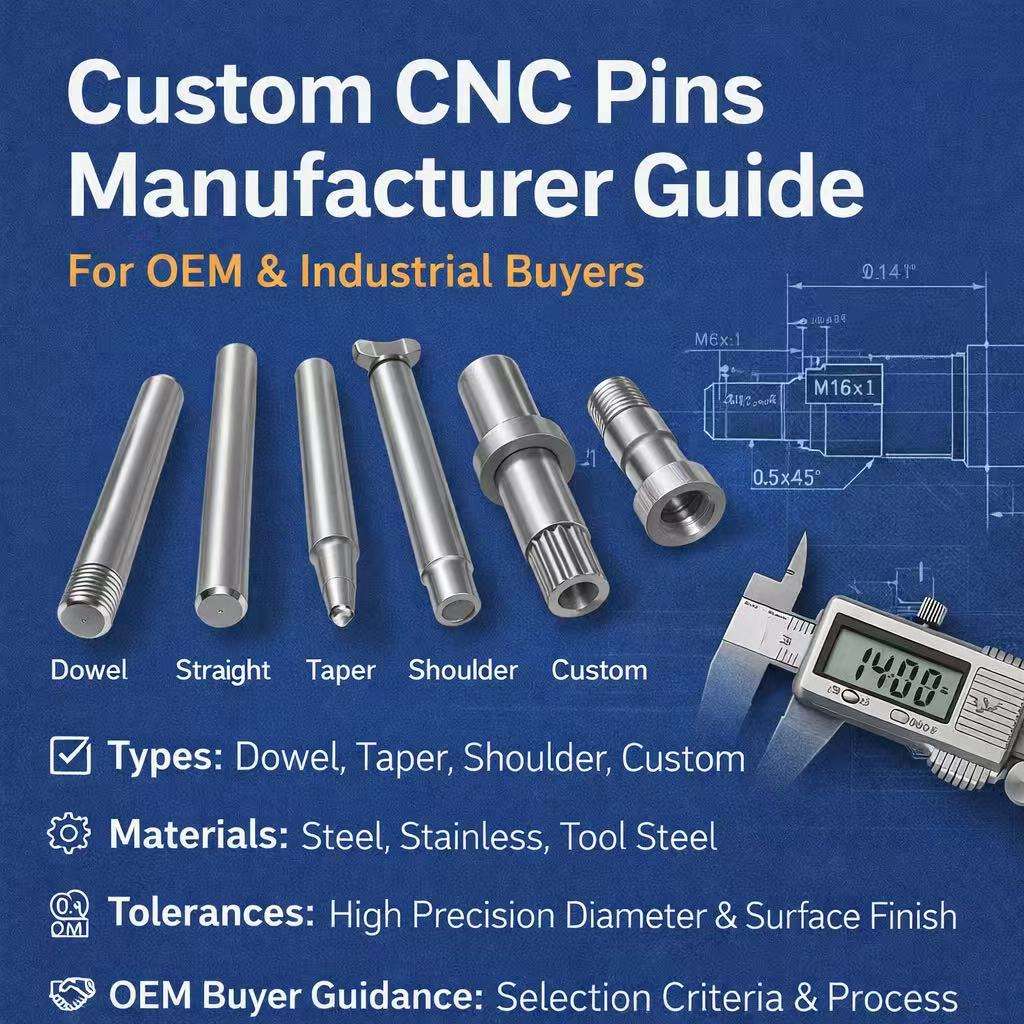
1. Introduction – Why Custom CNC Pins Matter in Precision Assemblies
In the vast ecosystem of industrial machinery, the pin is often the smallest component on the Bill of Materials (BOM), yet it frequently dictates the assembly accuracy and structural integrity of the entire system. While standard catalog pins (DIN/ISO/ANSI standards) serve a purpose for general fastening, high-performance OEM applications often reach the limits of what off-the-shelf components can offer.
For mechanical engineers and procurement managers, the shift from standard hardware to CNC machined pins is usually driven by specific engineering constraints. A standard dowel pin might offer a generic tolerance of m6, but a high-speed robotic joint may require a specific interference fit that falls between standard classes. Or, a medical device may require a pin made from a specific bio-compatible alloy not found in fastener catalogs.
As a custom CNC pins manufacturer, we understand that a pin is not merely a commodity; it is a precision interface. This guide explores the engineering logic behind sourcing custom pins, detailing materials, manufacturing processes, and the critical quality standards required for industrial applications.
2. What Defines a “Custom CNC Pin” (From a Manufacturer’s Perspective)
To a distributor, a pin is defined by a part number. To a manufacturer, a non-standard CNC pin is defined by its deviation from the norm and its specific functional requirements. It represents a component where the “standard” solution compromises performance. From a production standpoint, most “custom” pins are driven by assembly constraints rather than cost considerations.
From our manufacturing perspective, customization typically falls into four categories:
Non-Standard Dimensions: Custom pins are machined to exact requirements (e.g., 11.45mm length) to sit flush with unique housing geometries, unlike incremental standard lengths.
Material Specificity: Moving beyond basic steel to heat-treated alloys, precipitation-hardening stainless steels, or non-ferrous metals tailored for conductivity or weight.
Tailored Tolerances: Specifying GD&T controls, such as concentricity between a head and a shaft, or a surface finish smoother than the standard Ra 0.8µm.
Feature Integration: Combining multiple functions, such as internal extraction threads, milled flats for air release, or lubrication grooves—features impossible to find in a catalog.
3. Common Applications of Custom CNC Pins
The demand for custom CNC pins spans across industries where precision and reliability are non-negotiable.
Automation & Robotics
In robotic arms and end-effectors, pins act as high-precision pivot points and alignment aids. They must withstand high shear loads and cyclic motion without developing play (backlash), which would degrade the robot’s positional accuracy.
Injection Molding Tooling
Core pins and ejector pins in mold bases operate in harsh environments involving high temperatures and abrasive glass-filled plastics. Custom pins here are often made from hardened tool steels to resist wear and maintain flash-free molding lines.
Heavy Machinery & Mining
In hydraulic cylinders and articulating joints of excavators, large-diameter pivot pins are subjected to massive shear forces. Custom manufacturing allows for deep case hardening and specific oil-groove patterns to ensure longevity under load.
Automotive & EV
Transmission alignment pins and battery module assembly pins require strict cleanliness and specific conductive or insulating properties, often driving the need for custom materials.
Jigs & Fixtures
Manufacturing fixtures rely on locating pins to hold workpieces in the exact same position for machining. These pins often require unique diamond or relieved shapes to facilitate easy loading and unloading of parts.
4. Types of Custom CNC Pins We Manufacture
As a dedicated CNC pins manufacturer, we categorize production based on geometry and function.
Custom Dowel Pins
These are high-precision cylindrical pins used primarily for alignment. Customization typically involves non-standard diameters (e.g., oversized for repair work) or specific chamfer angles to aid automated assembly.
Taper Pins
Used for locking components together, taper pins allow for disassembly and reassembly without losing alignment. We manufacture custom tapers (beyond the standard 1:50) and custom lengths to suit specific hub-and-shaft interfaces.
Shoulder Pins
Featuring two or more diameters, shoulder pins act as spacers or pivots. The manufacturing challenge lies in maintaining concentricity between the varying diameters and ensuring perpendicularity at the shoulder face to prevent binding.
Threaded Pins
These combine the alignment function of a pin with the fastening capability of a screw. Customization includes specific thread pitches, thread lengths, or internal extraction threads for blind-hole applications.
Complex Non-Standard Pins
These are pins that act as multi-functional components. They may feature cross-holes for cotter pins, milled flats for set screws, or knurling for press-fit retention in plastic housings.
5. Materials for Custom CNC Pins (Selection Guide)
Selecting the right material is as critical as the geometry. The choice dictates the strength, wear resistance, and cost of the precision CNC pins.
Carbon Steel (AISI 1045)
Why Choose It: Excellent machinability and low cost.
Trade-offs: Low corrosion resistance (requires plating); moderate strength compared to alloys.
Alloy Steel (4140 / 4340)
Why Choose It: High tensile strength and toughness; responds excellently to heat treatment.
Trade-offs: Harder to machine than carbon steel; requires coating for corrosion protection.
Stainless Steel (303 / 304 / 316 / 17-4PH)
Why Choose It: 303 for machinability; 316 for harsh environments; 17-4PH for high strength.
Trade-offs: Higher material cost; work-hardening can complicate machining (especially 304/316).
Tool Steel (A2 / D2)
Why Choose It: Extreme hardness and wear resistance after heat treatment.
Trade-offs: Difficult to machine; usually requires post-heat-treat grinding to hold tolerances.
6. CNC Manufacturing Process for Precision Pins
Manufacturing CNC machined pins requires a process flow distinct from general machining. It focuses on high length-to-diameter (L/D) ratios and surface integrity.
Swiss-Type Machining
For pins under 32mm in diameter, Swiss machining is the industry standard. A guide bushing supports the material right next to the cutting tool, eliminating deflection. This allows us to turn long, slender pins with extreme precision in a single setup.
Secondary Operations
While turning defines the shape, secondary features like cross-holes, flats, or threads are often machined simultaneously on Swiss lathes using live tooling. This ensures that secondary features are perfectly aligned with the pin axis.
Heat Treatment
For high-strength applications, pins are sent for heat treatment (hardening, case hardening, or nitriding). This creates a durable surface but can cause slight distortion.
Centerless Grinding & Polishing
To achieve tolerances tighter than ±0.01mm or surface finishes better than Ra 0.8µm, pins often undergo centerless grinding. In high-volume programs, tool wear compensation and bar straightness control become more critical than nominal machine accuracy.
7. Tolerances & Surface Finish Requirements
The difference between a functional pin and a scrap part often lies in the tolerance specification.
Diameter Tolerances
Standard turning holds ±0.01mm. For interference fits, tolerances of ±0.005mm or tighter are often required, necessitating grinding.
Press Fit: Pin diameter > Hole diameter.
Slip Fit: Pin diameter < Hole diameter.
Surface Roughness (Ra)
Ra 1.6 – 3.2 µm: Standard turned finish; suitable for static structural pins.
Ra 0.8 µm: Fine turned finish; good for alignment.
Ra 0.2 – 0.4 µm: Ground/Polished finish; required for sliding surfaces to reduce friction.
Chamfer Control
A precisely machined lead-in chamfer is critical for automated assembly. If the chamfer is eccentric or rough, it can cause jamming during robotic insertion.
8. Quality Control & Inspection Standards
Reliability is built on verification. As a precision CNC pins supplier, our quality control is tiered to prevent non-conformances from reaching the assembly line.
Incoming Material Control
We verify raw material accuracy using Mill Test Reports (MTRs) and diameter checks before loading the bar feeder.
In-Process Inspection
During the run, operators use laser micrometers and air gauges to monitor diameter drift caused by tool wear. Statistical Process Control (SPC) is used for large batches to ensure Cpk stability.
Final Inspection
Completed pins undergo a final audit for:
Dimensional Accuracy: Using micrometers and optical comparators.
Geometric Tolerances: Checking roundness and straightness.
Surface Finish: Using profilometers.
Documentation
We provide optional First Article Inspection (FAI) reports and Certificates of Conformance (COC) to validate that the batch meets all engineering specifications.
9. How to Work With a Custom CNC Pins Manufacturer
Sourcing custom components is a partnership. To get the best results and accurate quotes, buyers should provide the following:
Drawing vs. Sample
While we can reverse-engineer from a sample, a technical drawing with defined GD&T (Geometric Dimensioning and Tolerancing) is always preferred. From our experience, unclear fit definitions are the most common reason for delayed approvals during prototype validation.
MOQ & Lead Time Logic
Custom manufacturing involves setup time (CAM programming, tooling setup). Therefore, ordering 10 pins carries a high unit cost compared to ordering 1,000. Understanding Economic Order Quantity (EOQ) helps optimize costs.
Prototyping to Mass Production
We often start with a small prototype batch to validate the fit in the customer’s assembly. Once validated, we lock the process for mass production to ensure the 10,000th pin is identical to the sample.
10. Conclusion – Choosing the Right Custom CNC Pins Partner
While pins are often viewed as simple hardware, custom CNC pins are critical engineering components that enable the performance of sophisticated machinery. The difference between a smooth assembly line and a production stoppage often comes down to the quality of the locating pins used.
Choosing the right partner means looking beyond the lowest piece price. It requires finding a manufacturer who understands materials, controls the grinding process, and delivers consistent tolerances batch after batch.
For OEM buyers, selecting a custom CNC pins manufacturer is less about sourcing hardware and more about securing process stability.
A capable manufacturing partner does not simply machine pins to print, but understands how tolerances, material behavior, and volume scaling affect long-term assembly performance.
When precision, repeatability, and engineering accountability matter, the value of a dedicated CNC pins manufacturer becomes clear.