
What Are CNC Pins? A Buyer FAQ Guide to Types, Materials, and Applications
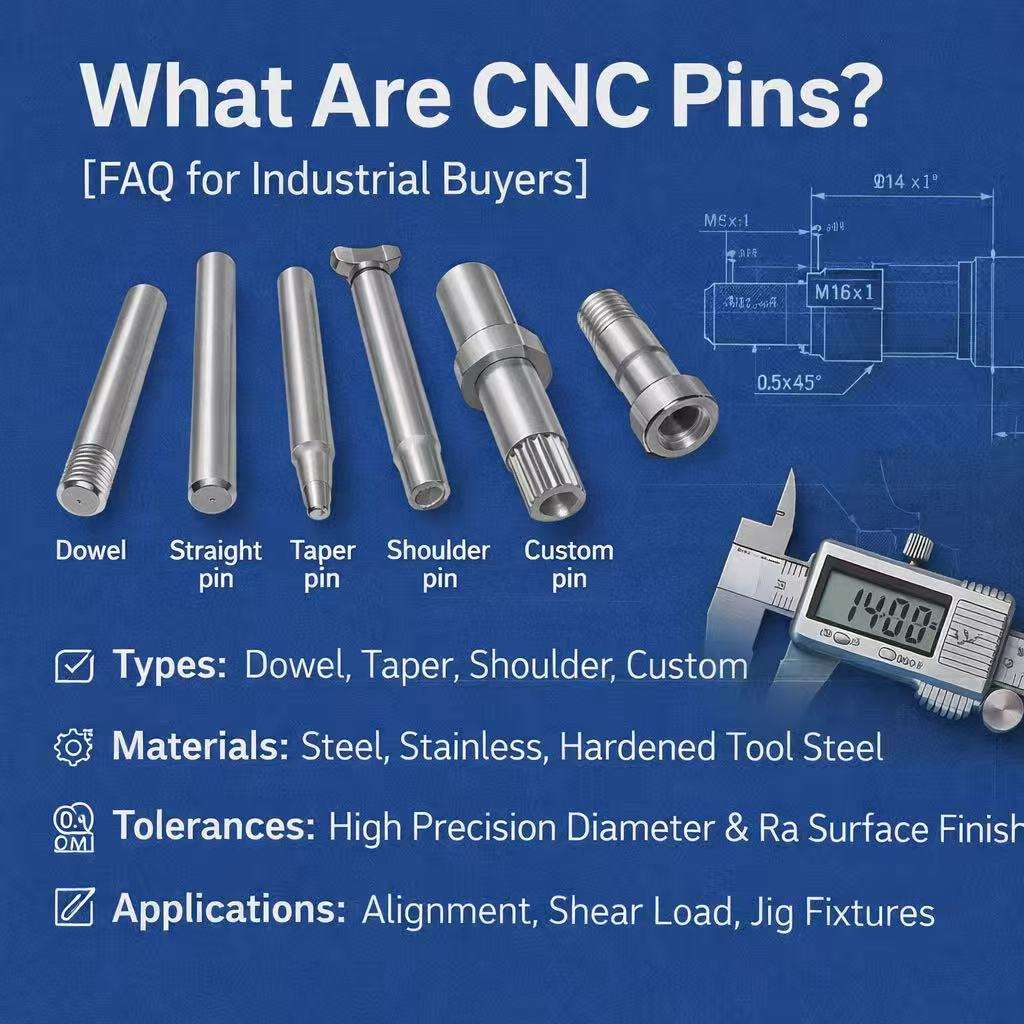
What Are CNC Pins?
CNC pins are precision-machined cylindrical components primarily used to align, position, or join two or more parts within a mechanical assembly. Unlike standard cold-headed or stamped pins produced in mass volume, CNC pins are manufactured using Computer Numerical Control (CNC) turning centers or Swiss-type lathes.
The defining characteristic of a CNC pin is its dimensional accuracy. While a standard hardware store pin might vary in diameter, a CNC pin is machined to strict tolerances (often within microns) to ensure a specific fit—whether that be a press fit, slip fit, or interference fit. They serve as the critical reference points that ensure complex machinery is assembled correctly and maintains its geometry under load.
What Are CNC Pins Used For?
In industrial engineering, a pin is rarely just a fastener; it is a precision interface. CNC pins generally serve three primary functions:
Locating and Alignment: This is the most common application. Pins are used to align two mating components (such as a mold core and cavity, or a motor housing and a cover) before bolts are tightened. The pin takes the alignment load, ensuring the assembly is geometrically perfect.
Shear Load Transmission: In many drive trains or articulated joints, pins act as the load-bearing element, transmitting shear forces between a shaft and a hub or acting as a pivot point.
Jigs and Fixtures: In manufacturing setups, CNC pins act as stops or locators to hold a workpiece in the exact same position for repeatable machining or welding.
Typical Industries:
Automation & Robotics: Joint pivots and actuator alignment.
Injection Molding: Core pins and ejector pins.
Automotive: Transmission alignment and engine assembly.
Precision Machinery: Gearbox and pump assembly alignment.
Common Types of CNC Pins
Industrial buyers encounter various pin geometries depending on the application. The most common types manufactured via CNC include:
Dowel Pins: Simple, straight cylinders with chamfered ends. They are machined to tight diameter tolerances for precise alignment.
Straight Pins: Similar to dowels but often with looser tolerances, used for simple hinging or fastening.
Taper Pins: These have a slight conical taper (typically 1:48 or 1:50). They are self-locking and used where components need to be disassembled and reassembled frequently without losing alignment.
Shoulder Pins: Feature two or more diameters. The larger diameter acts as a stop or pivot surface, while the smaller diameter fastens into a hole.
Custom Non-Standard Pins: Pins with unique features like internal threads, milled flats, cross-holes, or specific head geometries tailored to a unique OEM design.
Materials Used for CNC Pins
Material selection dictates the pin’s strength, wear resistance, and environmental durability.
Carbon Steel (AISI 1045): The baseline material. It offers good strength and machinability at a low cost. Suitable for general-purpose alignment in non-corrosive environments.
Alloy Steel (AISI 4140 / 4340): High tensile strength and toughness. Often heat-treated (Quench and Temper) for high-stress applications like heavy machinery pivots.
Stainless Steel:
303: Excellent machinability, commonly used for high-volume precision pins.
304 / 316: Superior corrosion resistance, mandatory for medical, food processing, or marine applications.
Hardened Tool Steel (A2 / D2): Used for molding and stamping dies. These pins are heat-treated to high hardness (HRC 58-62) to resist extreme abrasion and wear.
Typical Tolerances & Surface Finish
The value of a CNC pin lies in its precision. If a pin is too large, it damages the part; if it is too small, the assembly wobbles.
Diameter Tolerance: Standard CNC pins typically hold tolerances of ±0.01 mm (0.0004″). For critical alignment (interference fits), precision grinding may be used to achieve ±0.002 mm to ±0.005 mm.
Surface Finish: A smooth finish is essential to allow the pin to slide into the hole without seizing (galling). Typical requirements are Ra 0.8 µm (fine turned) or Ra 0.4 µm (ground/polished).
Chamfers: Precise end chamfers are machined to guide the pin into the hole, preventing damage to the mating component during installation.
Because CNC pins are often used as locating elements rather than rotating parts, even small diameter deviations can directly translate into assembly misalignment.
Standard Pins vs CNC Machined Pins
For buyers, the choice between off-the-shelf and custom CNC comes down to application requirements.
| Feature | Standard Pins (Catalog) | CNC Machined Pins (Custom) |
| Availability | In stock, immediate delivery | Lead time required (manufactured to order) |
| Cost | Low (mass produced) | Higher (setup + machining time) |
| Dimensions | Fixed (DIN / ISO / ANSI standards) | Fully flexible (Any diameter/length) |
| Material | Limited to standard grades | Any machinable material |
| Precision | Standard tolerance classes (e.g. h8, h9) | Tailored tolerance classes (e.g. h6, g6, m6) |
When to choose CNC: Select CNC pins when you need non-standard lengths, specific high-performance materials (like 17-4PH or Titanium), or when the pin includes complex features like threads or grooves.
Can CNC Pins Be Customized?
Yes, customization is the primary advantage of CNC manufacturing. Unlike cold-heading, which requires expensive molds, CNC turning allows for rapid modification of pin features.
Common customizations include:
Non-Standard Diameters: e.g., A 6.35mm pin for a specific inch-based assembly.
Special Lengths: To accommodate specific plate thicknesses.
End Geometry: Spherical ends, flat ends, or specific chamfer angles (e.g., 15° vs 45°).
Features: Adding pull-out threads (for removal), air-release flats, or retaining ring grooves.
Surface Treatments: Black oxide for corrosion resistance, passivation for stainless steel, or heat treatment for hardness.
FAQ
Are CNC pins stronger than standard pins?
Not necessarily by geometry, but CNC allows you to select stronger materials (like 4140 or 17-4PH) that may not be available in standard catalog pins, resulting in a stronger final component.
What tolerance should I specify for locating pins?
For a press fit (permanent), a tolerance like m6 (slightly oversized) is common. For a slip fit (removable), h6 or g6 (slightly undersized) is standard. Always consult the ISO Limits and Fits chart.
Can CNC pins be used as load-bearing components?
Yes, they are primarily designed for shear loads (forces cutting across the pin). For tensile or bending loads, pins should only be used when explicitly engineered and validated for structural applications.
What information is needed to quote custom CNC pins?
To get an accurate quote, provide a 2D technical drawing specifying: Material grade, Diameter and Length with tolerances, Surface finish requirements, and Quantity.
Conclusion
While they may appear to be simple components, CNC pins are the silent guardians of assembly precision. They dictate the alignment accuracy of complex machinery and the structural integrity of high-load joints.
For industrial buyers, understanding the difference between a generic pin and a precision CNC pin is critical. Investing in the correct material and tolerance class for your pins reduces assembly time, eliminates rework caused by misalignment, and ensures the long-term reliability of the final product. For buyers, specifying the correct pin material and tolerance at the sourcing stage is far more cost-effective than correcting alignment issues during assembly.