
CNC Drilling and Milling in Flange Production – Buyer’s Guide
1. Introduction
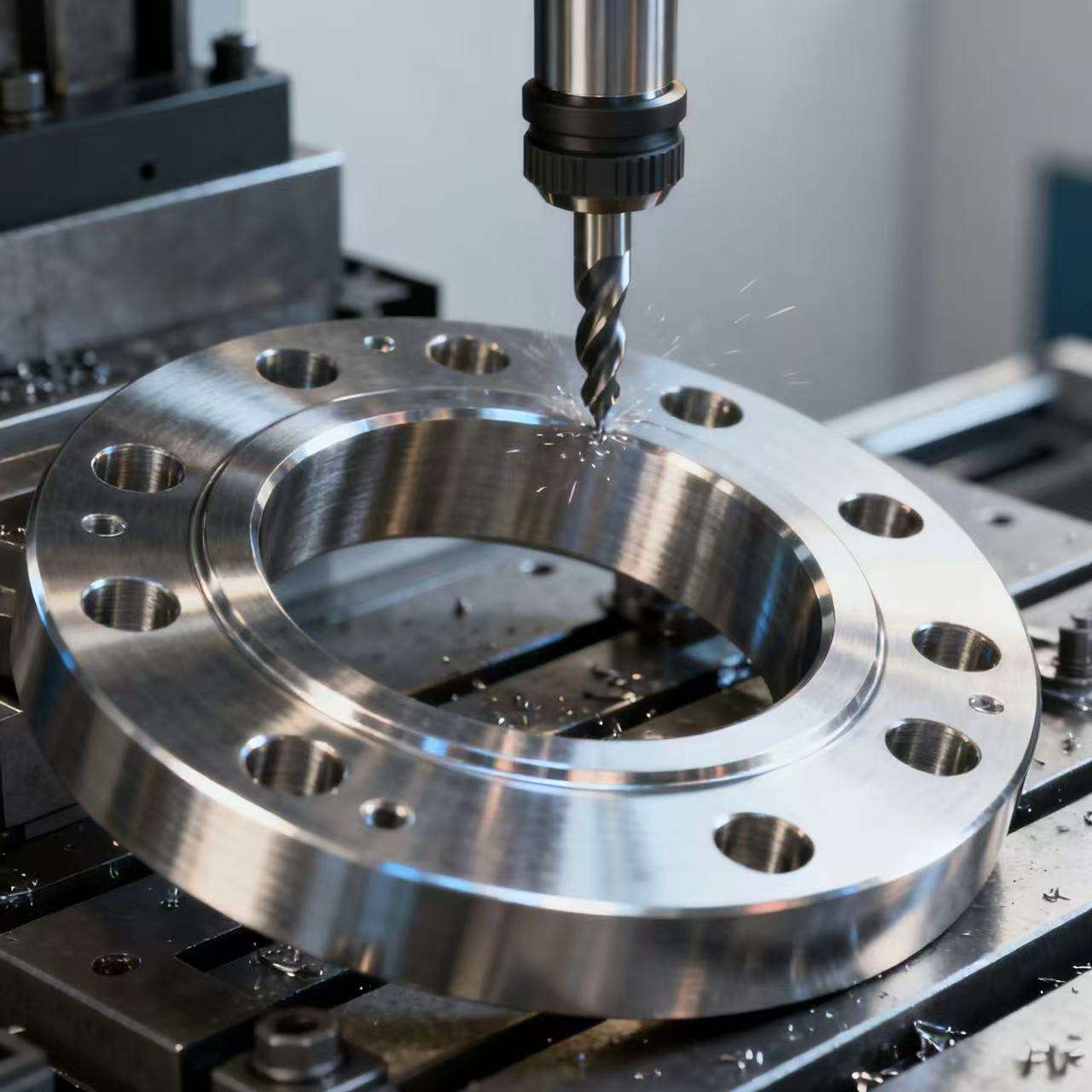
In the world of industrial components, the reliability of a flange is paramount. A secure, leak-proof seal depends on the precision of its machined features. While CNC turning creates the basic form, the subsequent processes of CNC drilling and milling truly define a flange’s performance. For industrial buyers, understanding CNC drilling and milling in flange production is key to sourcing high-quality, reliable components. This guide provides a clear overview of these critical processes. It helps procurement managers and engineers evaluate supplier capabilities and ensure equipment integrity.
2. Why CNC Drilling and Milling Matter in Flange Production
The core function of a flange is to connect and seal. This depends on the accuracy of its bolt holes and sealing face.
- Precision is Non-Negotiable: A small error in a bolt hole’s position can make assembly impossible. It can also cause uneven clamping pressure, leading to seal failure. An imperfect sealing face will inevitably cause leaks.
- Repeatability and Accuracy: CNC processes provide unmatched repeatability. They deliver a level of precision that manual methods cannot achieve. This automated control eliminates human error. It ensures every flange in a large production run is identical and meets specifications. This is critical for OEM assembly lines and aftermarket parts.
3. CNC Drilling in Flange Production
The bolt holes are a critical feature of any flange. Their accuracy is essential for a secure connection.
- The Importance of Precise Bolt Hole Patterns: The bolt holes must be perfectly positioned on the bolt circle diameter (BCD). This ensures proper alignment with the mating flange or equipment. Any deviation can prevent bolts from being inserted or cause them to be installed at an angle. This leads to uneven stress and a high risk of joint failure.
- Common Tolerance Requirements: The positional tolerance for bolt holes is often very tight. The hole diameter itself must also be controlled to ensure a proper fit with the bolts.
- Advantages of CNC Drilling: Modern multi-axis CNC drilling centers use automated positioning. This allows them to drill the entire bolt pattern in a single setup. It guarantees the hole pattern is perfectly symmetrical and located with extreme accuracy. This level of precision is difficult to achieve with manual drilling methods.
4. CNC Milling in Flange Manufacturing
CNC milling is a versatile process. It is used to create all non-cylindrical features on a flange with high precision.
Machining Sealing Faces
Milling is used to create various types of sealing faces required by industry standards, including:
- Raised Face (RF): The most common type of flange face.
- Ring-Type Joint (RTJ) Grooves: A high-integrity seal for high-pressure applications.
- Smooth Finish: A perfectly flat surface for specific gasket types.
Creating Special Features
CNC milling is also used to machine non-symmetrical or special features. Examples include wrench flats, mounting slots, or custom pocket designs.
Controlling Flatness and Roughness
The precision of the CNC milling process allows a manufacturer to control the critical flatness of the sealing face. It also helps achieve the specified surface roughness (Ra). Both are essential for a leak-proof seal.
5. Tolerances and Standards for CNC Drilling and Milling
The precision of these features is governed by internationally recognized standards.
- Common Standards: Flange dimensions and tolerances are typically defined by ASME B16.5 / B16.47, ISO, or DIN standards. These standards specify the required tolerances for features like bolt hole position, flatness of the sealing face, and concentricity of the bore.
- Key Tolerances: Buyers should ensure their supplier can meet the required tolerances for flatness, concentricity, and hole position deviation. These are the key metrics that define a high-quality flange.
6. Quality Assurance in Drilling and Milling
Verifying the accuracy of these machined features requires advanced inspection equipment.
Inspection Methods
- CMM (Coordinate Measuring Machine): This is the ultimate tool for quality assurance. A CMM can accurately measure the position of each bolt hole relative to each other and to the flange’s center. It can also verify the concentricity of the bore.
- Surface Roughness Testing: A profilometer is used to measure the Ra value of the sealing face. This ensures it is within the specified range for proper gasket performance.
Quality Documents
- For industrial buyers, the MTC (Material Test Certificate) and the CMM report are essential proofs of quality. They provide objective, traceable data that confirms the part meets all specifications.
7. Buyer’s Checklist
When evaluating a supplier’s drilling and milling capabilities, use this checklist:
- ✅ Confirm CNC Equipment: Does the supplier have modern, multi-axis CNC drilling and milling centers capable of handling your flange size and complexity?
- ✅ Verify Inspection Capabilities: Are they equipped with a CMM and a surface roughness tester? Can they provide full inspection reports?
- ✅ Check for Experience: Does the supplier have proven experience in manufacturing large-diameter or high-pressure flanges for your industry?
8. Conclusion
CNC drilling and milling are the core processes that guarantee the performance, reliability, and safety of a custom flange. They are what transform a simple piece of metal into a high-precision engineering component. For industrial buyers, selecting a supplier with high-precision equipment and a rigorous quality control system is the most effective way to mitigate risks and ensure the long-term integrity of your critical systems.
Contact our engineering team today for technical consultation and a customized quotation for your custom flange solutions.