
Case Study: CNC Bushings in Hydraulic Systems
1. Introduction
Hydraulic systems are the power core of modern industry, widely used in construction machinery, agricultural equipment, injection molding machines, and heavy manufacturing. From the immense power of an excavator to the stable control of a precision machine tool, hydraulic systems transmit energy through fluid pressure to achieve precise and powerful mechanical motion. However, in such high-pressure, high-load environments, the reliability of every single component is paramount.
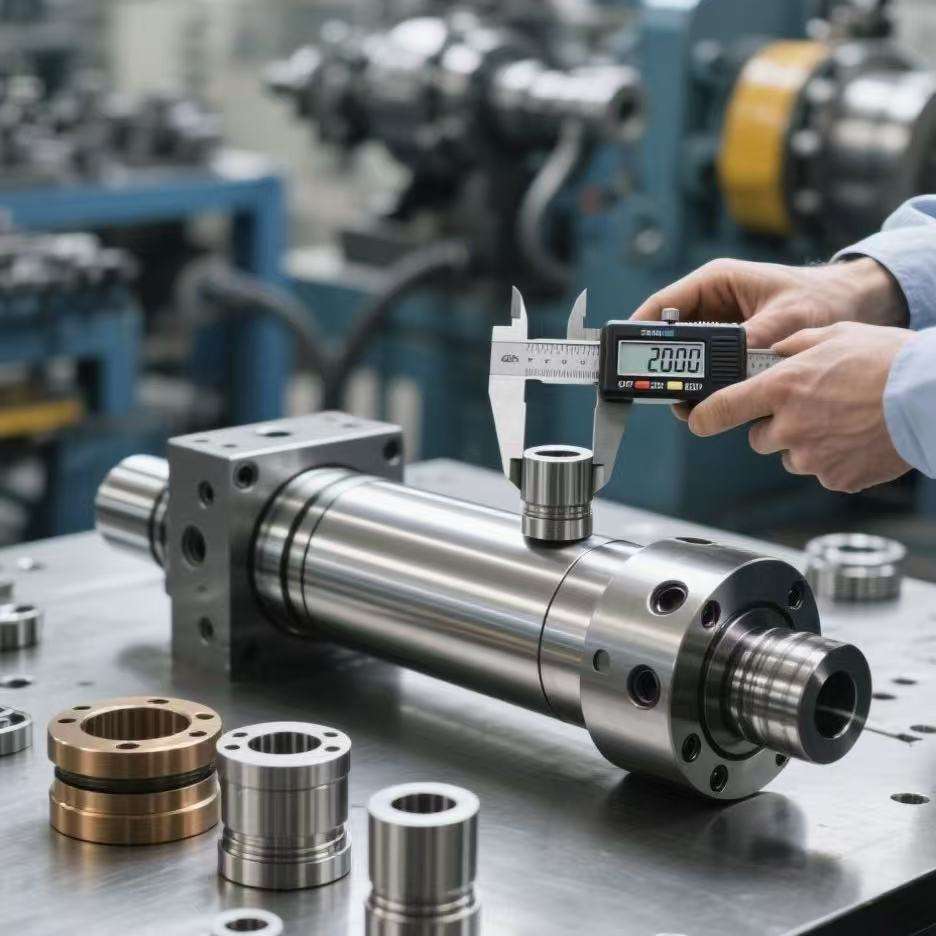
Within the core components of hydraulic systems—such as hydraulic cylinders, pumps, and valves—bushings play a seemingly small yet critically important role. Their primary task is to withstand immense pressure between reciprocating or rotating parts, reduce friction, and act as a protective barrier to extend the life of expensive components like piston rods and pins.
This article will present a detailed case study, combining a real-world application context to fully demonstrate the value of CNC bushings in hydraulic systems—from design and material selection to manufacturing and performance validation. It aims to provide a powerful technical reference for industrial procurement decision-makers.
2. System Requirements for Hydraulic Bushings
The operating environment of a hydraulic system places extremely demanding requirements on bushings, far exceeding those of general industrial applications.
- High-Pressure Environment: Operating pressures in hydraulic systems typically range from tens to hundreds of bar, with peak pressures being even higher. Bushings must be able to withstand this immense radial load without deforming.
- High Loads and Reciprocating Motion: For example, in hydraulic cylinder bushings, the reciprocating motion of the piston rod creates continuous high loads and friction. The bushings must have extremely high wear resistance to handle these conditions.
- Lubrication Requirements: Although hydraulic fluid itself provides lubrication, the design of the bushing (e.g., oil grooves) must be able to effectively establish and maintain an oil film to minimize direct metal-to-metal contact.
- Dimensional Stability: Under varying pressure and temperature, the dimensions of the bushing must remain stable to ensure that the operating clearance stays within the design range, preventing seizure or leakage.
- Corrosion Resistance: Hydraulic fluid may contain additives or become acidic with age, requiring the bushing material to have a certain level of corrosion resistance.
For procurement professionals, these technical requirements ultimately translate into the performance indicators they care about most: equipment service life, operational reliability, and long-term maintenance costs.
3. Material Selection & Justification
Choosing the right material is the first step in successfully designing a hydraulic bushing. Different application locations require different material properties.
3.1 Copper Alloys (Bronze/Brass)
Copper alloys, especially bronze, are the classic bushing material for hydraulic systems.
- Advantages: Excellent wear resistance, good self-lubricating properties (especially under boundary lubrication conditions), superior thermal conductivity, and good corrosion resistance.
- Applications: Commonly used as piston rod guide bushings in hydraulic cylinders, connecting rod bushings, and side plates in gear pumps. They effectively prevent “galling” between steel piston rods and the cylinder body.
3.2 Alloy Steel
For parts that need to withstand extreme impact loads, alloy steel is the top choice.
- Advantages: Extremely high strength, hardness, and toughness. Its surface hardness can be significantly increased through heat treatment (e.g., quenching, carburizing).
- Applications: Often used in excavator arm connection points and pivot bushings on heavy equipment, which must endure significant impact forces.
3.3 Stainless Steel
In damp, saline, or chemically corrosive environments, the importance of stainless steel becomes evident.
- Advantages: Excellent corrosion resistance, able to resist rust without additional surface treatment.
- Applications: Used in hydraulic equipment for marine engineering, food processing, or the chemical industry to prevent system contamination or failure due to rust.
3.4 High-Performance Polymers
Modern engineering plastics (like PEEK and reinforced nylon) also show advantages in specific applications.
- Advantages: Extremely low coefficient of friction, completely self-lubricating, chemical resistance, and lightweight.
- Applications: Suitable for relatively low-load applications where cleanliness is critical or external lubrication is not permitted, such as in the spool guides of some hydraulic valves.
Material Performance Comparison Table
| Material Type | Load Capacity | Wear Resistance | Self-Lubrication | Corrosion Resistance | Cost | Typical Hydraulic Application |
|---|---|---|---|---|---|---|
| Bronze | Excellent | Superior | Good | Good | Medium-High | Piston rod guide bushings, connecting rod bushings |
| Alloy Steel | Superior | Good (w/ Heat Treat) | Poor | Poor (Needs Treat) | Medium | Pivot points, high-impact locations |
| Stainless Steel | Good | Good | Poor | Superior | High | Marine/chemical equipment, food-grade hydraulics |
| PEEK | Moderate | Excellent | Superior | Superior | Very High | Special valves, low-load high-cleanliness areas |
4. CNC Precision Machining Process
A professional custom bushing manufacturer will use a series of precision CNC processes to ensure the final quality of hydraulic bushings.
- CNC Turning: This is the core process for machining the inner and outer diameters of the bushing, ensuring its concentricity and length. Precise turning is fundamental to achieving tight fit tolerances.
- CNC Milling: Used to machine non-revolving features, such as oil grooves for storing and distributing lubricant, or keyways and flats for positioning.
- Drilling/Tapping: Used to create lubrication holes, mounting screw threads, etc.
- Tolerance Control: The fit tolerance of a hydraulic bushing is crucial. It typically follows ISO 286 standards, such as H7/h6 (clearance fit for high-precision rotation) or H8/f7 (clearance fit for general sliding), to ensure appropriate operating clearance under all conditions.
- Surface Finish: The working surface of the bushing usually requires a low surface roughness (Ra 0.4 – 1.6 µm). A surface that is too smooth is not conducive to maintaining an oil film, while one that is too rough will accelerate wear. The right roughness ensures a stable lubricating film on the part’s surface.
5. Heat Treatment & Surface Treatment
For alloy steel bushings, heat treatment and surface treatment are value-adding steps that are key to enhancing their performance and extending their lifespan.
- Heat Treatment:
- Quenching & Tempering: This gives the entire part a good balance of overall mechanical properties (strength and toughness).
- Case Hardening (Carburizing/Nitriding): This creates an extremely hard, wear-resistant layer on the surface while the core remains tough. This “hard on the outside, tough on the inside” property is ideal for withstanding impact and high contact stress.
- Surface Treatment:
- Hard Chrome Plating: Provides a very hard (typically >60 HRC), smooth, and corrosion-resistant surface. It is a common method for extending the life of hydraulic cylinder bushings and piston rods.
- Phosphating: Offers basic corrosion protection and can absorb lubricating oil, improving initial run-in performance.
Case Study Comparison: In a typical heavy-duty hydraulic cylinder application, a standard 45# steel bushing without any treatment might only last a few hundred hours. In contrast, an alloy steel bushing that has undergone precision CNC machining, case hardening, and hard chrome plating can easily have its service life extended by 3 to 5 times, or even more.
6. Performance Testing & Case Results
To quantitatively demonstrate the value of precision CNC bushings, we conducted a simulated performance comparison test.
Test Subjects:
- Group A (Standard Bushing): Made from plain carbon steel, machined on a conventional lathe, with no heat or surface treatment.
- Group B (High-Performance CNC Bushing): Made from alloy steel, precision CNC machined (H7/h6 tolerance, Ra 0.8), case hardened, and hard chrome plated.
Test Methods:
- Wear Test: Operated on a test rig simulating high-load reciprocating motion, with wear measured over time.
- Pressure Cycle Test: Subjected to cyclic pressure impacts in a hydraulic test bench to record the number of cycles before failure.
- Salt Spray Test: Tested according to ASTM B117 to evaluate corrosion resistance.
Test Results:
| Test Item | Group A (Standard Bushing) | Group B (High-Perf. CNC Bushing) | Performance Improvement |
|---|---|---|---|
| Pressure Cycle Life | Significant wear after ~500 hours | > 2500 hours with good condition | > 500% |
| Average Wear Rate | 0.05 mm / 100 hours | < 0.01 mm / 100 hours | Significantly Lower |
| Salt Spray Test | Severe red rust after 96 hours | No significant rust after 480 hours | > 400% |
Conclusion: The test data clearly shows that through material upgrades, precision CNC machining, and professional post-processing, the overall lifespan and reliability of high-performance bushings far exceed those of standard products.
7. Procurement & Supply Chain Insights
For procurement managers, the case study above reveals a core principle: focus on Total Cost of Ownership (TCO), not just unit price.
- TCO vs. Unit Price: The unit price of a Group B bushing may be several times that of Group A, but its TCO is far lower due to reduced equipment downtime, lower labor costs for repairs, and less frequent replacements.
- Sample Development & Communication: Thorough communication with the supplier during the sample stage regarding technical requirements (drawings, tolerances, materials, treatments) is key to ensuring the final product meets expectations.
- Supplier Evaluation Checklist:
- Machining Capability: Do they have high-precision CNC lathes, mills, and multi-axis machining centers?
- Inspection Capability: Are they equipped with CMMs, profilometers, and surface roughness testers?
- Post-Processing Capability: Do they have stable partners or in-house capabilities for heat treatment and surface treatment?
- Quality System Certification: Are they certified with a quality management system like ISO 9001?
8. Case Study Conclusion
This case study clearly demonstrates that the application of CNC bushings in hydraulic systems is a systematic engineering effort. Its ultimate success depends not on a single step, but on the integrated result of quality materials, precision machining, professional post-processing, and strict quality control.
For industrial equipment, high-performance CNC bushings deliver tangible value:
- Significantly extended service life, reducing the frequency of spare part procurement.
- Drastically lower maintenance costs, saving on labor and repair expenses.
- Improved overall equipment reliability, ensuring production continuity.
Ultimately, partnering with a professional supplier who understands the demands of hydraulic systems and possesses comprehensive manufacturing capabilities is the most effective way to guarantee equipment performance and control long-term costs from the source.
If you are looking for customized bushing solutions that can withstand the toughest tests for your hydraulic system, contact our engineering team today. We are happy to provide expert technical support and a quotation.